Deepti · September 17, 2026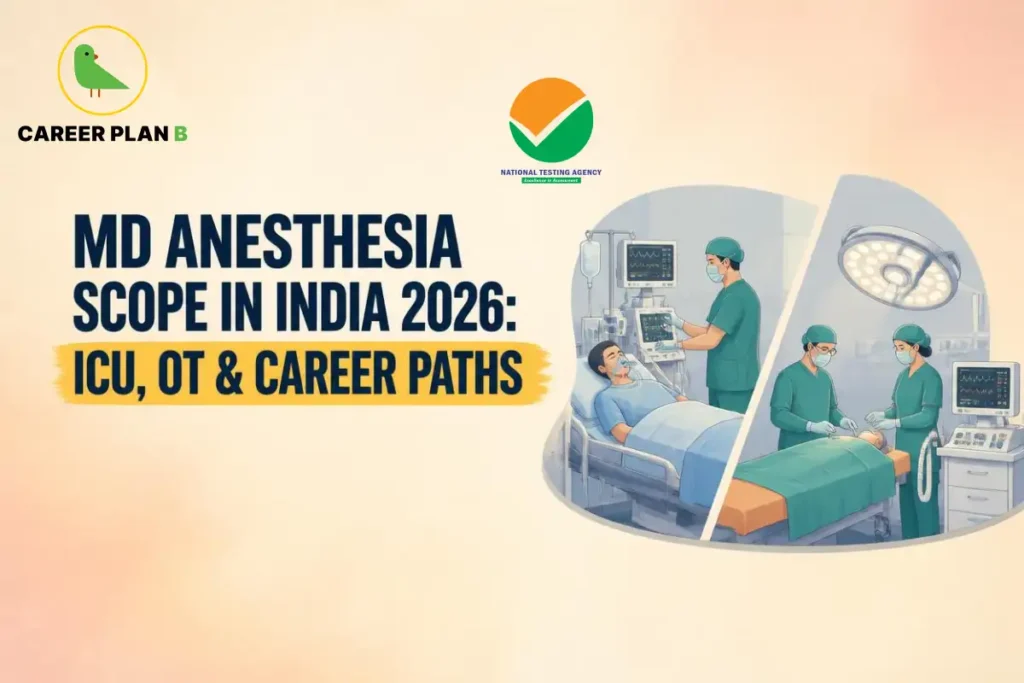
MD Anesthesia scope in India goes far beyond the operating table. An MD Anesthesiologist manages surgical patients, supports intensive care units, treats trauma, and runs chronic pain clinics. India’s anaesthesia workforce remains thin relative to global benchmarks. An earlier ISA/WFSA-linked survey placed India’s physician-anaesthesiologist density at 1.27 per 100,000 population, and current WFSA data lists a higher figure of 4.27 per 100,000 for India. Workforce estimates vary by dataset and year, but the underlying gap against the WFSA’s recommended minimum of 5 per 100,000 keeps demand strong across every practice setting. This guide maps each career path an MD Anesthesia doctor can take in 2026.
What Does MD Anesthesia Actually Cover?
MD Anesthesiology trains a doctor to manage a patient’s entire surgical journey. The role starts before surgery with risk assessment. It continues through the procedure with vital-sign monitoring. It extends into recovery with pain control. NMC’s postgraduate curriculum places anesthesiologists across perioperative care, intensive care, acute and chronic pain management, and resuscitation. This breadth is what makes the degree flexible.
MD Anesthesiology ICU Career: A Major Practice Area Beyond the OT
Anesthesiologists have a major role in intensive and critical care in India. Their training in airway management, ventilation, hemodynamic support, and resuscitation makes them well suited to ICU practice. Many hospitals recruit anesthesiology-trained doctors for ICU and critical-care roles, though exact requirements vary by institution and post. COVID-19 highlighted this overlap sharply — a 2025 peer-reviewed policy analysis notes that the pandemic exposed India’s unmet need for critical care and safe anesthesia, alongside the existing shortage of trained anaesthetists. For graduates drawn to prolonged management of critically ill patients, ICU and critical care offer an established pathway alongside conventional OT-based anesthesiology.
MD Anesthesiology Operation Theatre Career
The OT remains the anesthesiologist’s home base. Doctors administer general, regional, and spinal anesthesia. They manage airways during complex surgeries — cardiac, neuro, pediatric, and transplant cases included. Anesthesiologists also design perioperative protocols and lead OT safety audits as their careers mature, adding an administrative dimension to the clinical role.
MD Anesthesia Critical Care Career
Critical care builds directly on MD Anesthesia training. Current NBEMS NEET-SS feeder documents list MD/DNB Anaesthesiology as an eligible feeder qualification for DM/DrNB Critical Care Medicine, alongside other feeder specialties such as Emergency Medicine, General Medicine, Pediatrics, and Respiratory Medicine depending on the exact route (Source: NBEMS NEET-SS Information Bulletin). Graduates who complete this super-specialty run multi-disciplinary ICUs and manage trauma and post-surgical complications independently. Tele-ICU is also emerging in India as a model for extending critical-care expertise to hospitals with limited access to intensivists, including smaller and underserved centres.
For Personalized Guidance
MD Anesthesia Emergency Care
MD Anesthesiology provides strong transferable skills for emergency and trauma care — particularly airway management, procedural sedation, resuscitation, and perioperative stabilization. NMC’s anesthesiology curriculum explicitly includes emergency anesthesia and trauma competencies. Emergency Medicine remains a separate postgraduate specialty, but many anesthesiologists rotate through trauma centers and pre-hospital transport teams where these skills apply directly. Readers comparing the two branches can check our MD Emergency Medicine guide for a side-by-side view of scope and training.
MD Anesthesiology Career Opportunities in Pain Management
Pain medicine gives MD Anesthesia graduates a more clinic- and procedure-oriented practice option. NBEMS currently recognizes FNB Pain Medicine as a two-year fellowship open to MD/DNB Anaesthesia graduates, run through an entrance test (FET) and centralized counselling. Doctors treat chronic back pain, cancer pain, and post-surgical pain through injections, nerve blocks, and medication plans. Working hours and on-call responsibilities in pain medicine vary by practice setting — interventional pain work can still involve procedures and hospital consultations, so it isn’t uniformly lighter than OT or ICU work.
MD Anesthesiology Subspecialties After MD
| Subspecialty | Focus Area | Training Route |
|---|---|---|
| Cardiac Anaesthesia | Heart surgery, echocardiography | DM/DrNB (NEET-SS) |
| Neuroanaesthesia | Brain and spine surgery | DM/DrNB (NEET-SS) |
| Critical Care Medicine | ICU super-specialization | DM/DrNB (NEET-SS) |
| Organ Transplant Anaesthesia & Critical Care | Perioperative transplant care | DM (NEET-SS) |
| Paediatric & Neonatal Anaesthesia | Children’s surgical care | DM (NEET-SS) |
| Pain Medicine | Chronic and cancer pain | FNB Fellowship (NBEMS) |
MD Anesthesia Jobs After MD: Work Profile
Government-sector opportunities include medical colleges, teaching hospitals, and state health services, with recruitment happening through state PSCs, institutional hiring, central government bodies, or other notified processes depending on the post.
The Armed Forces Medical Services also recruit anesthesiologists as commissioned medical officers through their own selection process. Private and corporate hospitals offer a wide compensation range, with pay varying by experience, location, hospital type, workload, and subspecialty.
average anesthesiologist pay in India around ₹12.18 LPA but treat this as an indicative estimate rather than a fixed national average, since it isn’t independently verifiable against Payscale’s own current listings.
MD Anesthesia Career Pathways in Academics & Research
Teaching offers a stable, structured MD Anesthesia career pathway. Assistant professors progress to associate professor and professor ranks in government and private medical colleges, and many also train DNB and MD residents. Research opportunities include clinical studies of anesthetic techniques, pain interventions, critical-care protocols, patient safety, and monitoring technologies. For NEET PG rank-based branch selection or subspecialty seat competition specific to anesthesia, our NEET PG toughest specialties cut-off guide covers the admission side in detail.
How Career Plan B Helps
Choosing between ICU, OT, or pain medicine after MD Anesthesia feels overwhelming without guidance.
- Career Plan B offers Personalized Career Counselling to match your interests with the right subspecialty.
- Our PsycheIntel and Career Assessment Tests reveal whether you’re suited for high-intensity OT/ICU work or steadier clinic-based roles.
- We also provide Admission and Academic Profile Guidance plus Career Roadmapping for fellowship and DM planning.
Get In Touch With Us
FAQs
Q1. Is MD Anesthesiology scope in India good for the future?
Yes, A 2025 peer-reviewed analysis estimated India needs at least 60,000 additional physician-anesthesiologists over the following decade to meet WFSA workforce benchmarks — a research estimate, not an official government forecast (Source: Public Health Challenges, 2025, PMC).
Q2. What is the MD Anesthesia critical care career path?
Graduates pursue DM/DrNB Critical Care Medicine after MD, using Anaesthesiology as one of several eligible feeder qualifications. They then manage ICUs independently in government and private hospitals.
Q3. Can MD Anesthesiology lead to an ICU career without a DM?
Yes, many hospitals hire MD Anesthesiologists directly for ICU and critical-care roles without requiring a DM, though requirements vary by institution.
Q4. What is the MD Anesthesiology operation theatre role compared to ICU work?
OT work focuses on surgical anesthesia during procedures. ICU work involves ongoing management of critically ill patients over days or weeks.
Q5. Does MD Anesthesia offer research opportunities?
Yes, Academic anesthesiologists publish on drug safety, ICU protocols, and pain management, and many contribute to clinical studies on anesthetic techniques and monitoring technologies.
Conclusion
MD Anesthesia scope in India stretches across ICU, OT, critical care, emergency-linked practice, pain clinics, and research. Few branches offer this much career flexibility after a single postgraduate degree. Talk to Career Plan B today to map your MD Anesthesia career path with confidence.