Deepti · September 17, 2026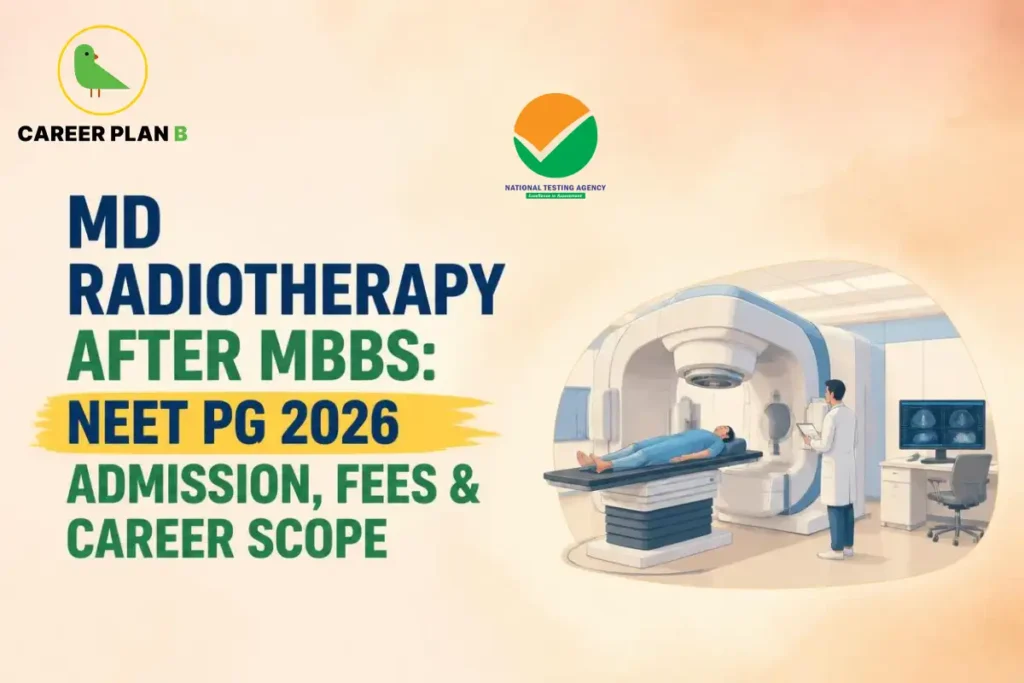
MD Radiotherapy after MBBS trains you to treat cancer with radiation instead of a scalpel. India now records over 14 lakh new cancer cases every year, and radiation oncologists stay in short supply across most states (Source: ICMR-National Cancer Registry Programme). This guide covers eligibility, NEET PG 2026 admission, fees, cutoff and colleges, syllabus, clinical training and salary for MD Radiotherapy.
What Is MD Radiotherapy?
MD Radiotherapy is a three-year postgraduate medical degree approved by the National Medical Commission (NMC). Many institutions, including AIIMS New Delhi, now issue the same degree as MD Radiation Oncology, since the department renamed itself to reflect current practice. The course trains you to plan and deliver radiation treatment for cancer and to manage patients alongside surgeons and medical oncologists.
MD Radiotherapy Eligibility
You need an MBBS degree from an NMC-recognised college with at least 50% aggregate marks in the final exam. You must complete a one-year compulsory rotating internship and hold provisional or permanent registration with a State Medical Council or the NMC. A qualifying NEET PG score completes your eligibility for counselling. The qualifying percentile stands at 50 for General/EWS candidates and 40 for SC/ST/OBC candidates, though NBE can lower this threshold in a given cycle (Source: National Board of Examinations, NEET PG information bulletin).
MD Radiotherapy Admission Through NEET PG
NEET PG, conducted by the National Board of Examinations, remains the primary entrance for MD Radiotherapy. Follow these steps:
- Register for NEET PG and clear the qualifying percentile for your category.
- Register for MCC counselling for All India Quota seats, or your state counselling body for state quota seats.
- Select MD Radiotherapy or MD Radiation Oncology during choice-filling.
- Accept your seat allotment and report to the college with your documents.
AIIMS, PGIMER and JIPMER admit candidates through INI-CET, a separate combined entrance exam that runs outside the regular NEET PG counselling cycle. Check their individual notifications if you’re targeting these institutes.
MD Radiotherapy Cutoff and Colleges
Seats stay limited nationwide, so MD Radiotherapy cutoffs at top institutes sit well above the qualifying percentile. Closing ranks shift every year based on the seat matrix and applicant pool, so check current MCC and state counselling data before you finalise your choices. These institutions offer strong radiotherapy training:
- AIIMS Delhi
- Tata Memorial Centre, Mumbai
- CMC Vellore
- PGIMER Chandigarh
- Kidwai Memorial Institute of Oncology, Bangalore
- Osmania Medical College, Hyderabad
- Madras Medical College, Chennai
- Armed Forces Medical College, Pune
Government cancer institutes like Tata Memorial and Kidwai carry a heavier patient load than many general medical colleges, and that case volume matters more than college ranking for a radiation oncology resident.
For Personalized Guidance
MD Radiotherapy Duration and Fees
The course runs three years full-time at NMC-recognised medical colleges. Government and central institutions charge far less than private colleges:
| College Type | Fee Range (Full Course) |
|---|---|
| Central government institutes (AIIMS Delhi, AIIMS Rishikesh) | ₹1,200 – ₹2 lakh |
| State government medical colleges | ₹85,000 – ₹6 lakh |
| Private medical colleges | ₹15 lakh – ₹58 lakh |
A strong NEET PG rank that secures a government seat saves you lakhs of rupees over three years, so rank matters as much as branch preference during counselling.
MD Radiotherapy Syllabus
The NMC curriculum blends physics, biology and clinical oncology. Core areas include:
- Radiation physics, atomic structure and radioactive decay
- Radiobiology and the biological effects of ionising radiation
- Applied anatomy, pathology and staging of malignant diseases
- External beam therapy and computerised treatment planning
- Brachytherapy, including sealed-source dose distribution
- Palliative care and symptom management in advanced cancer
You sit theory papers, practical exams and a thesis defence at the end of three years.
Clinical Training and the Radiotherapy Workflow
Competitor guides stop at the syllabus list. Real residency life shapes your career far more than exam papers do.
A typical week mixes four activities. During OPD sessions, you assess new referrals and review patients for treatment side effects. CT-simulation sessions involve mapping the tumour and marking the treatment field on the patient’s body. Much of the residency also involves contouring and dose-planning software, where you draw tumour volumes and organs at risk for the physics team to calculate doses against. Weekly tumour board meetings bring you together with surgeons, medical oncologists, radiologists and pathologists to build joint treatment plans for complex cases.
Modern departments train residents on advanced delivery techniques, not just conventional radiation:
- IMRT and IGRT for image-guided dose delivery that spares healthy tissue
- SBRT/SRS for high-precision treatment of small tumours in fewer sessions
- Brachytherapy units for cervical, breast and head-and-neck cancers
- Palliative radiotherapy protocols for pain and symptom control in advanced-stage patients
Larger centres run proton therapy or CyberKnife facilities, and residents who rotate through these gain a real edge in the job market. Palliative care also forms a core rotation, not an afterthought — you learn to manage pain, bleeding and breathlessness, and to counsel families through hard conversations.
MD Radiotherapy Scope and Career Options in India
Cancer incidence keeps rising in India, and radiation infrastructure keeps expanding to meet it. That combination drives steady long-term demand for trained radiation oncologists.
| Career Path | Typical Setting | Growth Route |
|---|---|---|
| Radiation Oncologist | Government cancer centres, corporate hospital chains | Senior consultant, department head |
| Academician | Medical colleges, research institutes | Professor, funded research, PhD |
| Radiation Safety Officer | Hospitals, regulatory bodies | Compliance and policy roles (requires separate AERB certification) |
| Private Practice | Standalone cancer clinics | Partner or clinic owner |
After MD, many doctors pursue a DM in Medical or Surgical Oncology, a fellowship in advanced techniques such as SBRT or brachytherapy, or a research doctorate. Corporate hospital chains, government cancer institutes and academic medical colleges all actively hire radiation oncologists, and the specialist shortage keeps openings steady across tier-1 and tier-2 cities.
If you’re weighing MD Radiotherapy against other postgraduate branches, our PG courses after MBBS guide compares every major specialisation side by side, and our NEET PG pattern change 2026 guide walks you through this year’s exam format before you plan your counselling strategy.
MD Radiotherapy Salary in India
Starting salaries for radiation oncologists in India range between ₹3.5 lakh and ₹7.2 lakh per year for freshers, and climb past ₹10-20 lakh per year with a few years of experience or private practice (Source: AmbitionBox, radiation oncologist salary data). Government cancer institute posts and corporate hospital consultant roles typically pay at the higher end of this range.
How Career Plan B Helps
Choosing MD Radiotherapy after MBBS means weighing rank, institution type and long-term fit together.
Career Plan B’s Personalised Career Counselling and PsycheIntel Career Assessment Tests check whether radiation oncology genuinely suits your working style.
Our Admission and Academic Profile Guidance and Career Roadmapping turn your NEET PG rank into a realistic, verified college shortlist.
Get In Touch With Us
FAQs
Q1. Is MD Radiotherapy admission through NEET PG compulsory?
Yes, NEET PG stays compulsory for every MD Radiotherapy seat in India, except institutional exams run separately by AIIMS, PGIMER and JIPMER.
Q2. What is the MD Radiotherapy eligibility and fees range?
You need an MBBS degree with 50% marks, a completed internship and a valid NEET PG score. Fees range from around ₹1,200 at some AIIMS campuses to ₹58 lakh at top private colleges.
Q3. How competitive is the MD Radiotherapy cutoff and colleges list?
Seats stay limited nationwide, so cutoffs at AIIMS, Tata Memorial and CMC Vellore sit well above the general qualifying percentile. State quota cutoffs run lower than All India Quota cutoffs at most colleges.
Q4. What is the MD Radiotherapy career scope in India?
Graduates work as radiation oncologists in government cancer centres, corporate hospitals and private clinics. Many also move into academia, research or radiation safety roles.
Q5. What is the MD Radiotherapy salary in India for freshers?
Freshers typically earn ₹3.5-7.2 lakh per year. Salaries grow past ₹10-20 lakh per year with experience, sub-specialisation or private practice.
Q6. Is MD Radiotherapy the same as MD Radiation Oncology?
Yes, different universities use different names for the same NMC-approved three-year postgraduate degree.
Conclusion
MD Radiotherapy after MBBS opens a career that treats one of India’s biggest health challenges directly. Eligibility, admission, fees and scope all read clearly on paper — the real question is whether this specialty fits your interests and NEET PG rank. Curious where you stand? Talk to a Career Plan B counsellor and map out your NEET PG 2026 strategy today.