Team6 · November 2, 2026
Introduction
Imagine working at a scale so small that matter behaves in ways completely different from what we observe in everyday life, where a tiny change in surface structure can alter strength, conductivity, reactivity, or even biological response. This is the world of nanotechnology, where materials are engineered at the scale of billionths of a meter, and the impact spans across medicine, electronics, energy storage, coatings, and environmental solutions.
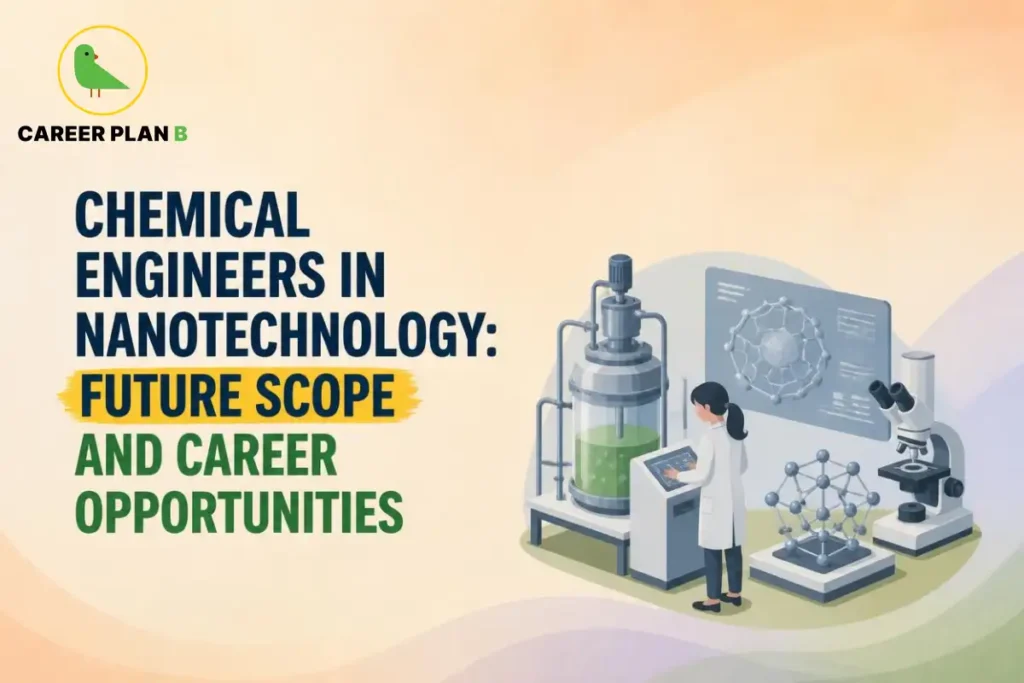
In this field, chemical engineers in nanotechnology play a foundational role. Their understanding of chemical engineering principles such as reaction kinetics, surface chemistry, thermodynamics, and transport phenomena becomes essential when designing and controlling processes at the nanoscale. Whether it is synthesizing nanoparticles with precise properties, developing nano-coatings for corrosion resistance, or engineering drug delivery systems, chemical engineers help bridge the gap between laboratory-scale discoveries and industrial-scale production.
At the core of this transition lies nanotechnology, a field that is rapidly expanding due to advancements in computing, materials science, and biotechnology. For chemical engineering students, this domain opens up opportunities far beyond traditional industries, positioning them in areas where innovation, research, and commercialization intersect to shape the next generation of technologies.
Why Nanotechnology Is a Natural Fit for Chemical Engineers
Nanotechnology is not a separate science; it is an extension of chemistry and engineering applied at the molecular and atomic scale. Chemical engineers already study reaction kinetics, mass transfer, fluid dynamics, and surface phenomena. At the nanoscale, these same principles govern how nanoparticles behave, how they interact with their environment, and how they can be synthesised reliably and safely. Chemical engineering and nanomaterials share a deep scientific overlap, making chemical engineers uniquely qualified to bridge the gap between laboratory nanotech research and scalable industrial production. Where a chemist discovers a nanomaterial, a chemical engineer figures out how to make it consistently, safely, and at a scale that actually matters.
Key Roles of Chemical Engineers in Nanotechnology
Nanomaterial Synthesis and Characterisation
One of the most fundamental roles of chemical engineers in nanotechnology is designing and optimising the synthesis of nanomaterials. This includes metal nanoparticles, carbon nanotubes, graphene, quantum dots, and nanocomposites. Chemical engineers develop synthesis routes such as sol-gel processes, chemical vapour deposition, and hydrothermal methods that produce nanomaterials with consistent size, shape, and surface properties. They also work on characterisation techniques to understand material behaviour at the nanoscale, using tools like electron microscopy, X-ray diffraction, and spectroscopy. The ability to control synthesis conditions with precision is a core chemical engineering strength that is directly applicable here.
Drug Delivery and Biomedical Applications
One of the most exciting nanotechnology careers for chemical engineers is in biomedical applications, especially targeted drug delivery. Nanoparticles can be engineered to deliver drug molecules directly to cancer cells or infected tissues. This targeted approach helps reduce side effects and improves treatment outcomes.
The chemical engineer role in drug delivery and nanotech involves designing nanocarriers such as liposomes, polymeric nanoparticles, and dendrimers. These carriers must be stable, biocompatible, and capable of releasing drugs at the right time and location.This field combines chemical engineering, biology, and medicine. It is also one of the fastest-growing research areas in India’s pharmaceutical and biotechnology sectors.
Energy Storage and Nano-enabled Batteries
Nanotechnology is playing an increasingly important role in next-generation energy storage. Nano-structured electrode materials improve the performance of lithium-ion batteries, supercapacitors, and fuel cells. They increase surface area and enhance ion transport, resulting in better efficiency and performance.
Chemical engineers design and test these advanced electrode materials. They also optimise electrolyte formulations and develop scalable manufacturing processes for energy storage devices.
This work supports India’s goal of expanding domestic battery production under the PLI Scheme for Advanced Chemistry Cell (ACC) Battery Storage. As battery manufacturing grows, the demand for chemical engineers with expertise in nanotechnology and energy storage is expected to increase.
Water Treatment and Environmental Nanotechnology
Access to clean water remains a critical challenge in India. Nanotechnology offers innovative solutions for water purification. These include nano-membranes, photocatalytic nanoparticles, and nano-adsorbents that remove heavy metals, pathogens, and organic pollutants more efficiently than conventional methods.
Chemical engineers design these nano-enabled water treatment systems and help scale them for municipal and industrial use. Their expertise ensures that these technologies are efficient, reliable, and suitable for large-scale deployment.
This is one of the most promising areas where the future of nanotechnology and chemical engineering aligns with national priorities such as water security and environmental sustainability.
India’s Push Towards Nanotechnology Policy and Funding
The scope of nanotechnology in India has received strong government backing over the past decade, making it a viable and well-supported career path for chemical engineers.
Nano Mission by DST (Department of Science and Technology): The DST Nanotechnology Mission India, formally known as the Nano Science and Technology Mission (NSTM), was launched to promote basic research, infrastructure development, and human resource development in nanotechnology across India. It funds universities, national labs, and research institutions to build India’s nanotechnology capability.
CSIR (Council of Scientific and Industrial Research): CSIR operates several laboratories actively engaged in nanotechnology research, including CSIR-NCL (National Chemical Laboratory) in Pune and CSIR-CECRI (Central Electrochemical Research Institute) in Karaikudi. These institutions offer research positions and collaborative projects for chemical engineers.
Ministry of Electronics and Information Technology (MeitY): MeitY funds research in nano-electronics and advanced materials, which creates opportunities for chemical engineers working on semiconductor and electronics-related nanotech applications.
These policy initiatives ensure that nanotech jobs for engineers in India will continue to grow in both government research institutions and private industry over the next decade.
Have Any Doubts?
Top Organisations and Companies Hiring in Nanotechnology
Chemical engineers interested in nanotechnology careers have a wide range of employers to consider across research, defence, energy, and industry:
- DRDO (Defence Research and Development Organisation): Several DRDO laboratories work on nano-enabled materials for defence applications, including armour, sensors, and coatings. Chemical engineers contribute to material synthesis and process development.
- ISRO (Indian Space Research Organisation): ISRO uses advanced nanomaterials in spacecraft components, thermal protection systems, and lightweight structural materials.
- CSIR-NCL (National Chemical Laboratory): A premier research institution working on polymer nanocomposites, catalysis, and nano-enabled materials with direct industry partnerships.
- CSIR-CECRI (Central Electrochemical Research Institute): Focuses on electrochemical nanotechnology, including nano-enabled energy storage and corrosion protection.
- BARC (Bhabha Atomic Research Centre): Conducts research on nanomaterials for nuclear applications, water purification, and radiation shielding.
- Private Pharma and Biotech Companies: Companies in India’s pharmaceutical sector are increasingly investing in nanoparticle-based drug delivery research, creating industry roles for chemical engineers with a nanotechnology specialisation.
Skills Chemical Engineers Need to Enter Nanotechnology
To build a strong foundation in chemical engineering and nanomaterials, students and early-career professionals should focus on the following:
- Surface and Colloid Chemistry: Understanding how nanoparticles behave at interfaces and in suspension is fundamental to almost every nanotech application
- Nanomaterial Synthesis Techniques: Familiarity with sol-gel, hydrothermal, chemical vapour deposition, and green synthesis methods
- Characterisation Tools: Practical knowledge of SEM, TEM, XRD, FTIR, and dynamic light scattering instruments
- Transport Phenomena at Nanoscale: Understanding how heat, mass, and momentum transfer change at very small scales
- Simulation and Modelling: Tools like COMSOL Multiphysics and molecular dynamics simulation software are increasingly used in nanotechnology research
- Regulatory and Safety Awareness: Understanding the environmental and health implications of engineered nanomaterials, guided by frameworks from bodies like BIS and DST
Developing these skills alongside a strong foundation in core chemical engineering subjects will significantly improve a student’s readiness for nanotechnology careers for chemical engineers in both research and industry roles.
How Career Plan B Helps
Entering the field of nanotechnology requires more than academic knowledge; it requires a clear understanding of your strengths, the right specialisation choices, and a roadmap for skill development. Career Plan B offers personalised career counselling, psychometric and career assessment tests, and structured career roadmapping for engineering students. Whether you are a chemical engineering student exploring nanotech research or looking to enter the biomedical or energy storage sector, Career Plan B helps you build a focused and informed plan for your future.
For Latest Information
Frequently Asked Questions (FAQs)
Q1. Can chemical engineers build a career in nanotechnology in India?
Yes, absolutely. Chemical engineers are among the most well-suited professionals for nanotechnology careers due to their training in reaction engineering, surface chemistry, and process scale-up. Government institutions like DRDO, ISRO, CSIR labs, and BARC actively hire chemical engineers for nanotechnology research and development roles.
Q2. What is the scope of nanotechnology in India for engineers?
The scope of nanotechnology in India is growing steadily. The DST Nano Mission supports research across universities and national laboratories. At the same time, private companies in the pharmaceutical, electronics, and energy sectors are expanding their nanotechnology capabilities.
Q3. Which CSIR laboratories are best for nanotechnology research in chemical engineering?
CSIR-NCL in Pune and CSIR-CECRI in Karaikudi are among the leading national laboratories for chemical engineering-related nanotechnology research, covering areas like polymer nanocomposites, electrochemical energy storage, and catalysis.
Q4. What additional qualifications help chemical engineers enter nanotechnology?
A postgraduate degree such as an M.Tech in Nanotechnology, Materials Science, or Chemical Engineering with a nanotechnology specialisation can significantly improve your career prospects.
Research internships at organisations like CSIR, DRDO, and IIT nanotechnology centres provide valuable hands-on experience. Qualifying GATE also strengthens your profile and opens opportunities for higher studies and research. Together, these experiences can serve as strong stepping stones to a successful career in nanotechnology
Conclusion
Nanotechnology is no longer a futuristic concept. It is a well-funded and rapidly growing field that is transforming industries such as medicine, energy, electronics, and defence.
Chemical engineers in nanotechnology play a key role in this transformation. They apply their expertise in process design and chemical engineering to convert laboratory discoveries into scalable, real-world solutions.
India’s DST Nano Mission, CSIR research institutions, and increasing private sector investment are creating exciting opportunities in this field. As a result, now is an excellent time for chemical engineering students to explore nanotechnology as a career.
The nanoscale may be small, but the career opportunities it offers are enormous.