Team5 · July 31, 2026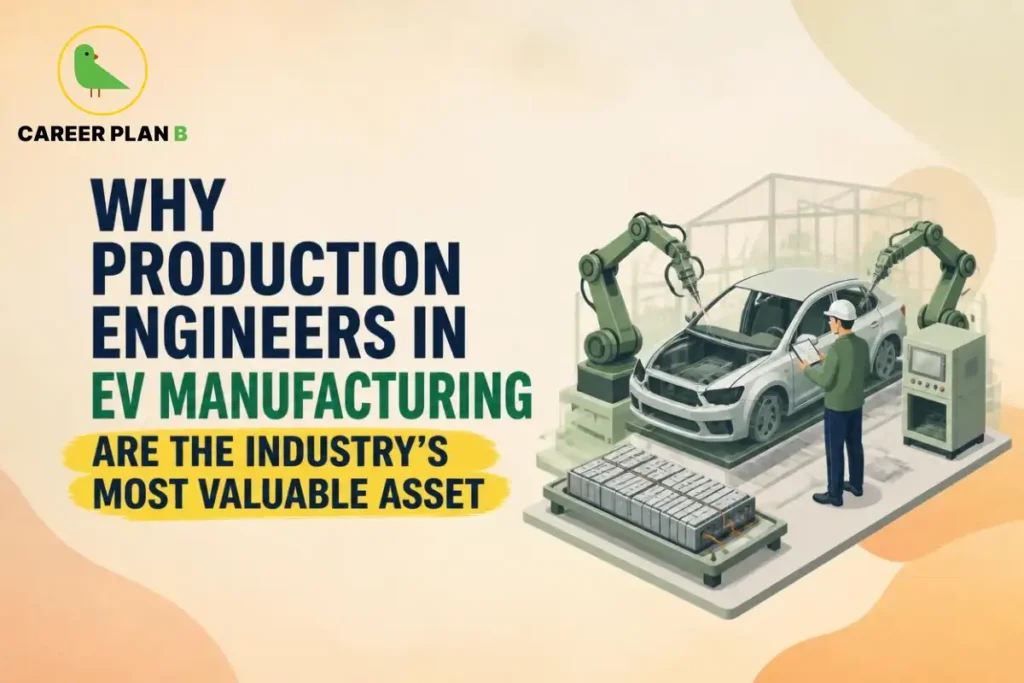
Introduction
The electric vehicle revolution is no longer a distant dream it is happening right now, on factory floors across India and around the world. Every Tesla rolling off a Gigafactory line, every Tata Nexon EV assembled in Pune, and every Ola electric scooter built in Tamil Nadu exists because of one crucial group of professionals: production engineers in EV manufacturing.
But here is the question most engineering students and young professionals are not asking yet what makes this role so uniquely important in the EV world, and is it the right career path for you?
According to the International Energy Agency (IEA), global electric vehicle sales crossed 14 million units in 2023, and the number is climbing steeply every year. That kind of growth does not just need more cars it needs more skilled engineers to build them right.
This blog breaks down exactly why production engineers are the backbone of the EV industry, what they do day to day, and how you can position yourself for one of the most in-demand automotive engineering careers of this decade.
What Does a Production Engineer Actually Do?
Before diving into the EV-specific angle, it helps to understand the core of the role.
A production engineer is responsible for designing, implementing, and improving manufacturing processes. They sit at the intersection of engineering design and real-world factory operations. Their job is to make sure products are built efficiently, safely, consistently, and at scale.
In a traditional automotive plant, that might mean managing an engine assembly line or overseeing stamping processes for metal body parts. In an EV plant, the scope is significantly broader and more complex.
Key Responsibilities on the EV Assembly Line
- Designing and optimising workflows for battery pack assembly
- Overseeing quality control in motor and drivetrain production
- Implementing lean manufacturing techniques to reduce waste and cost
- Coordinating with design and R&D teams to resolve production-level issues
- Ensuring compliance with safety standards, especially around high-voltage systems
- Monitoring EV assembly line optimisation using data and automation tools
In short, if the design team imagines the car, the production engineer figures out how to actually build it thousands of times, without error.
Why EVs Demand a New Kind of Production Engineer
Here is where things get interesting. The EV production process is fundamentally different from building a petrol or diesel vehicle. A conventional internal combustion engine car has roughly 2,000 moving parts. An electric vehicle has fewer than 200. That sounds simpler, but it is not.
EVs introduce entirely new manufacturing challenges:
Battery Pack Complexity: The lithium-ion battery pack is the most expensive and sensitive component of any EV. Assembling it requires precision at a microscopic level cell alignment, thermal management, electrical connections, and structural integrity all have to be perfect. A single defect can lead to catastrophic failure.
High-Voltage Safety: EV systems operate at voltages between 400V and 800V. Production engineers must design processes and train teams to handle these systems safely, following strict protocols. In India, this is guided by standards from the Bureau of Indian Standards (BIS) under the Ministry of Consumer Affairs.
Software-Hardware Integration: Modern EVs are as much software products as mechanical ones. Production engineers now work closely with software teams to ensure that firmware updates, battery management systems (BMS), and onboard diagnostics are tested and validated as part of the manufacturing process itself.
The Skills Gap the EV Industry Cannot Ignore
India’s EV sector is growing fast, but the talent supply has not caught up. The Ministry of Skill Development and Entrepreneurship (MSDE) has acknowledged this gap and launched targeted skilling programmes under the FAME India Scheme Phase II and National Electric Mobility Mission Plan (NEMMP).
This skills shortage means companies are actively competing for qualified production engineers and paying well for them.
Where Are Production Engineers Making the Most Impact in EV Plants?
The electric vehicle manufacturing jobs available today span several specialised areas within the plant. Here is where production engineers are most critically needed:
- Battery Module and Pack Assembly Lines This is the heart of EV manufacturing. Engineers here manage cell-to-module and module-to-pack assembly, including welding, bonding, and sealing processes.
- Electric Motor and Drivetrain Production Permanent magnet motors used in EVs require precise winding, magnetisation, and balancing. Production engineers ensure these processes meet tight tolerances.
- Quality Control and Testing Every EV undergoes rigorous end-of-line testing. Engineers design these test rigs, define pass/fail criteria, and analyse failure data to feed back into process improvement.
- Process Optimisation and Automation EV assembly line optimisation is a growing priority. Production engineers use tools like Six Sigma, Kaizen, and Industry 4.0 technologies sensors, robotics, AI-driven analytics to reduce cycle time and defect rates.
- Supplier Quality Management Since EV components like cells, inverters, and power electronics often come from global suppliers, production engineers also manage incoming quality inspections and supplier audits.
Have Any Doubts?
Career Outlook Is This the Right Path for You?
If you are exploring automotive engineering careers, the numbers make a compelling case for specialising in EV manufacturing.
- The U.S. Bureau of Labor Statistics projects a steady growth in industrial and manufacturing engineering roles, with median salaries above $95,000/year. BLS – Industrial Engineers
- In India, EV-focused production engineers at companies like Tata Motors, Ola Electric, Ather Energy, and Mahindra Electric are commanding salaries 20–35% higher than their ICE counterparts, according to industry reports.
- The electric vehicle industry growth in India is backed by government policy the FAME II scheme has disbursed over ₹10,000 crore in incentives, creating thousands of new manufacturing roles. Ministry of Heavy Industries
Relevant qualifications for this career in EV sector include:
- B.E. / B.Tech in Mechanical, Electrical, Electronics, or Production Engineering
- Postgraduate diplomas in EV Technology (offered by AICTE-approved institutions)
- Certifications in Lean Manufacturing, Six Sigma, or Battery Technology
- Hands-on training through internships in EV plants or Tier-1 automotive suppliers
How Career Plan B Helps
Navigating a career in EV manufacturing can feel overwhelming without the right guidance. Career Plan B helps you cut through the confusion with personalised career counselling, Psycheintel-based career assessment tests to identify if manufacturing engineering roles suit your strengths, and expert academic profile guidance for admissions to top engineering programmes. Whether you are a student choosing a specialisation or a working engineer looking to pivot into the EV sector, Career Plan B’s career roadmapping services help you take the right next step with confidence.
For Latest Information
Frequently Asked Questions (FAQs)
- What qualifications do I need to become a production engineer in EV manufacturing?
A B.Tech in Mechanical, Electrical, or Production Engineering is the standard entry point. Additional certifications in EV technology, battery systems, or lean manufacturing can significantly boost your employability in this field.
- Is there a demand for production engineers in India’s EV sector specifically?
Yes, strongly so. With companies like Ola Electric, Tata Motors EV, Ather Energy, and new entrants investing in Gigafactories across India, the demand for skilled manufacturing engineer roles in the EV space is growing rapidly and outpacing supply.
- How is working in EV manufacturing different from traditional automotive manufacturing?
The core engineering principles are similar, but EV manufacturing introduces unique challenges around battery assembly, high-voltage safety, software integration, and new materials. The learning curve is steeper, but so is the career ceiling.
- Are there government-backed programmes to skill up for EV manufacturing careers?
Yes. The Ministry of Skill Development and Entrepreneurship, along with the FAME India initiative under the Ministry of Heavy Industries, supports EV-specific skilling programmes. You can explore opportunities at msde.gov.in and heavyindustries.gov.in.
- What is the salary range for production engineers in EV companies in India?
Entry-level roles typically start at ₹4–7 LPA, while mid-level engineers with 3–5 years of EV-specific experience can earn ₹10–18 LPA. Senior and specialist roles at leading EV firms can go significantly higher.
Conclusion
The shift to electric mobility is not just a trend it is a structural transformation of one of the world’s largest industries. And at the centre of that transformation, making sure every battery cell is placed correctly, every motor runs true, and every vehicle leaves the line without a defect, are production engineers in EV manufacturing.
This is a career that combines hands-on technical work with strategic problem-solving, and it sits right at the intersection of sustainability and engineering excellence. The electric vehicle industry growth is creating an extraordinary window of opportunity and it is wide open right now.
If you are serious about building a future in the EV sector, start by understanding your strengths, mapping the right academic path, and getting expert guidance. Visit Career Plan B to take the first step toward a career that matters.