Team5 · July 30, 2026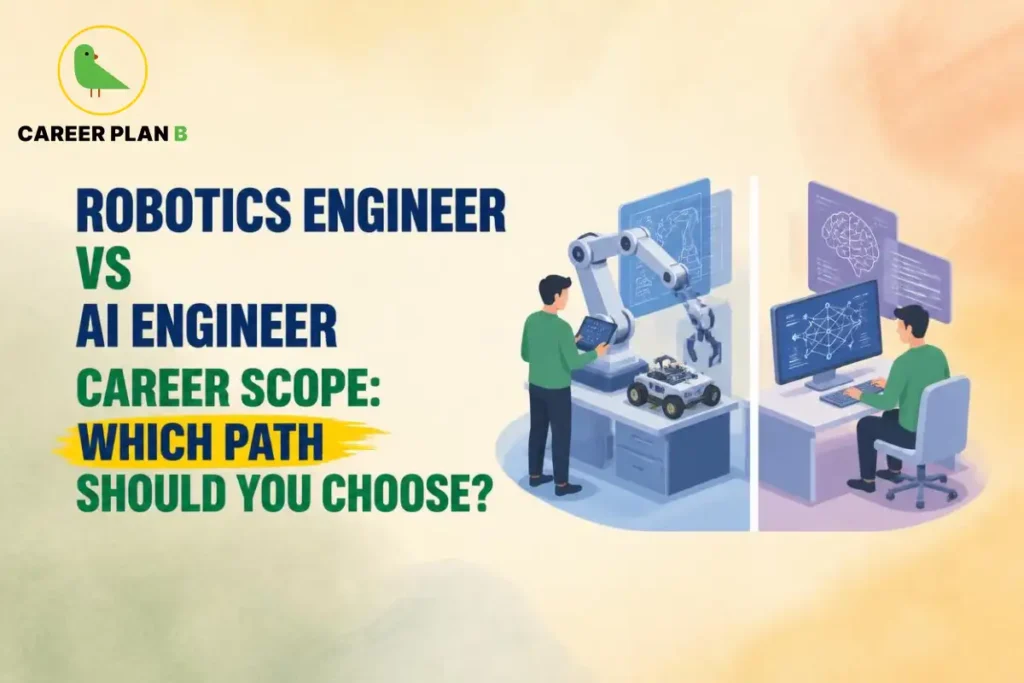
Introduction
Two of the most exciting careers in engineering today share one thing in common everyone is talking about them, but very few people truly understand what sets them apart. Robotics engineering and AI engineering are both shaping the future of industry, healthcare, defence, and everyday life. Yet for students standing at the crossroads, the choice between them feels anything but simple.
If you have been trying to understand the robotics engineer vs AI engineer career scope and figure out which path makes more sense for your skills and ambitions, this blog will give you the clarity you need. These are not just trendy job titles they represent two distinct career philosophies. One is rooted in building intelligent physical machines. The other is focused on teaching systems to think, learn, and decide. Both are growing fast. Both are well-paying. But they demand very different skill sets, mindsets, and preparation paths.
In this blog, we break down both careers side by side covering roles, skills, salaries, top employers, and the future of each field in India so you can make a confident, informed decision.
Who Is a Robotics Engineer?
A robotics engineer designs, builds, and maintains robotic systems machines that can perform tasks autonomously or semi-autonomously in the physical world. The role sits at the intersection of mechanical engineering, electrical engineering, and computer science. Robotics engineers work on everything from industrial robot arms on factory floors to surgical robots in hospitals, unmanned aerial vehicles in defence, and rovers in space exploration.
Key responsibilities in robotics engineering include:
- Designing mechanical structures and actuator systems
- Programming robot motion and control systems
- Integrating sensors, cameras, and feedback mechanisms
- Testing and troubleshooting robotic systems in real environments
- Collaborating with manufacturing, software, and systems teams
Core Skills Required
- Mechanical design and CAD tools
- Embedded systems and microcontroller programming
- ROS (Robot Operating System)
- Control systems and servo programming
- Basic machine learning for perception tasks
- C++, Python, and MATLAB
Who Is an AI Engineer?
An AI engineer builds intelligent software systems that can learn from data, recognise patterns, make predictions, and automate decision-making. Unlike a robotics engineer who works with physical machines, an AI engineer operates primarily in the world of algorithms, data pipelines, and software infrastructure.
AI engineers work across industries including IT services, fintech, healthcare diagnostics, e-commerce recommendation systems, edtech platforms, and autonomous vehicles. The role overlaps significantly with data science and machine learning engineering, but AI engineers tend to focus more on deploying and scaling intelligent systems in production environments.
Key responsibilities in AI engineering include:
- Building and training machine learning and deep learning models
- Developing natural language processing and computer vision systems
- Designing data pipelines and model deployment infrastructure
- Optimising AI models for speed, accuracy, and scalability
- Collaborating with product, data, and software engineering teams
Core Skills Required
- Python, R, and SQL
- Machine learning frameworks: TensorFlow, PyTorch, Scikit-learn
- Data engineering and cloud platforms (AWS, Azure, GCP)
- Statistics, linear algebra, and probability
- MLOps and model deployment tools
- Natural language processing and computer vision
Robotics Engineer vs AI Engineer Head-to-Head Comparison
Here is a clear side-by-side comparison to understand the difference between robotics and artificial intelligence as career paths:
| Parameter | Robotics Engineer | AI Engineer |
|---|---|---|
| Core Focus | Physical machines and automation | Intelligent software and algorithms |
| Primary Skills | Mechanical design, embedded systems, control | Python, ML frameworks, data pipelines |
| Key Tools | ROS, MATLAB, CAD, C++ | TensorFlow, PyTorch, Spark, cloud platforms |
| Industries | Manufacturing, defence, healthcare, space | IT, fintech, healthcare, e-commerce, edtech |
| Work Environment | Labs, factories, R&D centres | Tech offices, remote, cloud-based teams |
| Entry-Level Salary (India) | ₹3 LPA – ₹6 LPA | ₹4 LPA – ₹8 LPA |
| Long-Term Growth | Strong in hardware-heavy sectors | Very high across almost all industries |
| Overlap Area | Autonomous systems, cobots, drone intelligence | AI-powered robotics, perception systems |
The key takeaway from this comparison is that machine learning engineer vs robotics engineer is not an either-or debate for the long term. The two fields are converging but your starting point matters enormously.
Career Scope and Job Roles Robotics Engineering in India
The robotics engineering career in India is closely tied to the country’s ambitions in defence modernisation, space exploration, smart manufacturing, and healthcare technology. While the field is still maturing compared to the US or Japan, it is growing at a rapid pace driven by government investment and private sector adoption.
Top Sectors Hiring Robotics Engineers in India
- Defence and Aerospace: Unmanned systems, bomb disposal robots, surveillance drones
- Space Technology: Rovers, robotic arms, satellite assembly systems
- Healthcare: Surgical robots, rehabilitation devices, lab automation
- Automotive and Manufacturing: Industrial robot arms, automated assembly lines
- Agriculture: Precision farming robots, automated harvesting systems
Top Employers
- DRDO Defence Research and Development Organisation
- ISRO Indian Space Research Organisation
- HAL Hindustan Aeronautics Limited
- Tata Advanced Systems
- ABB India
- Fanuc India
- Wipro Infrastructure Engineering
Salary Range for Robotics Engineers in India
- Fresher (0–2 years): ₹3 LPA – ₹6 LPA
- Mid-Level (3–6 years): ₹7 LPA – ₹14 LPA
- Senior / Specialist (7+ years): ₹15 LPA – ₹28 LPA
Engineers working with DRDO or ISRO on advanced robotics projects, or those with specialisation in autonomous systems and ROS, tend to command the upper end of these ranges.
Career Scope and Job Roles AI Engineering in India
The AI engineer job roles and salary landscape in India is one of the fastest-growing in the entire technology sector. India is now one of the top three countries globally for AI talent, and the demand is outpacing supply significantly which means salaries are being pushed up consistently year on year.
Top Sectors Hiring AI Engineers in India
- IT and Software Services: Building AI-powered enterprise solutions
- Fintech and Banking: Fraud detection, credit scoring, algorithmic trading
- Healthcare: Diagnostic AI, drug discovery, patient data analysis
- E-commerce and Retail: Recommendation engines, demand forecasting, chatbots
- Edtech: Personalised learning systems, automated assessment tools
- Government and Public Sector: Smart city systems, surveillance analytics
Top Employers
- TCS, Infosys, Wipro, and HCL Technologies
- Google India and Microsoft India
- Amazon and Flipkart
- Startups: Sarvam AI, Krutrim, Mad Street Den, Haptik
- NASSCOM member companies
India’s Ministry of Electronics and Information Technology (MeitY) actively supports AI skilling and deployment through the IndiaAI Mission, which aims to make India a global AI powerhouse. This policy backing is directly contributing to job creation in the AI engineering space.
Salary Range for AI Engineers in India
- Fresher (0–2 years): ₹4 LPA – ₹8 LPA
- Mid-Level (3–6 years): ₹10 LPA – ₹20 LPA
- Senior / Specialist (7+ years): ₹22 LPA – ₹45 LPA+
AI engineers with expertise in large language models, computer vision, or MLOps are currently among the highest-paid technical professionals in the Indian job market.
Have Any Doubts?
Future of Robotics and AI in India Where Is the Industry Headed?
The future of robotics and AI in India is being shaped by three powerful forces government policy, private investment, and global technology demand.
NITI Aayog’s National Strategy for Artificial Intelligence positions India as a leader in AI for social and economic transformation, with focus areas including healthcare, agriculture, education, smart cities, and mobility. This strategy is directly creating career opportunities across both robotics and AI engineering.
India’s Make in India initiative is pushing robotics adoption in manufacturing, with PLI schemes incentivising automation across electronics, automotive, and pharmaceutical sectors.
The most significant development for both career paths is the convergence of robotics and AI into what industry calls autonomous systems and collaborative robots cobots. These are robots that use AI-powered perception, decision-making, and learning to work alongside humans in dynamic environments. Engineers who understand both fields will be in the most powerful career position over the next decade.
Automation and AI career opportunities in India are expected to grow significantly through 2030, with the World Economic Forum estimating that AI and robotics will create more jobs than they displace provided engineers continuously upskill.
Robotics vs AI Which Is Better for Your Career?
The honest answer to robotics vs AI which is better for career depends entirely on who you are and what you enjoy. Here is a simple decision framework:
Choose Robotics Engineering if you:
- Enjoy working with physical systems, hardware, and real-world machines
- Have a background in or passion for mechanical or electrical engineering
- Want to work in defence, space, or advanced manufacturing
- Prefer building things you can see, touch, and test in a physical environment
Choose AI Engineering if you:
- Enjoy working with data, code, and algorithms
- Have a strong foundation in mathematics, statistics, and programming
- Want faster salary growth and broader industry applicability
- Are comfortable with remote work and software-first environments
Consider the Hybrid Path if you:
- Want to work on autonomous systems, drones, self-driving vehicles, or intelligent robotics
- Are willing to build expertise in both mechanical systems and machine learning
- Are targeting cutting-edge R&D roles in defence, aerospace, or deep tech startups
The hybrid path combining robotics and AI knowledge is increasingly the most valuable profile in the job market, particularly as industries move toward fully autonomous systems.
How Career Plan B Helps
Choosing between robotics engineering and AI engineering is one of the most consequential career decisions an engineering student can make and it deserves more than a random choice. Career Plan B offers personalised career counselling, PsycheIntel Career Assessment Tests, and structured Career Roadmapping to help you identify whether your strengths and interests align better with robotics, AI, or the exciting hybrid path where both fields meet. Make the decision with data, not guesswork.
For Latest Information
Frequently Asked Questions
- What is the main difference between a robotics engineer and an AI engineer?
A robotics engineer focuses on designing and building physical machines that can perform tasks autonomously. An AI engineer focuses on creating software systems that can learn, reason, and make decisions from data. The difference between robotics and artificial intelligence as career paths lies in hardware versus software orientation though the two fields are increasingly overlapping in areas like autonomous systems and intelligent robotics.
- Which has better salary prospects robotics or AI engineering in India?
Currently, AI engineer job roles and salary in India tend to be higher on average, especially at the mid and senior levels, due to broader industry demand across IT, fintech, and e-commerce. However, robotics engineering career in India is growing rapidly in defence and manufacturing, and senior specialists in robotics can also command strong packages, particularly in government research organisations like DRDO and ISRO.
- Can I pursue both robotics and AI as a career?
Yes and increasingly, this hybrid profile is among the most in-demand in the industry. Engineers who combine robotics knowledge with machine learning and AI skills are ideal candidates for roles in autonomous vehicles, drone technology, surgical robotics, and intelligent manufacturing systems.
- What government initiatives support robotics and AI careers in India?
NITI Aayog’s National Strategy for Artificial Intelligence and MeitY’s IndiaAI Mission support AI career growth through policy, skilling, and investment. For robotics, DRDO and ISRO drive significant research and hiring. The Make in India initiative also promotes robotics adoption in manufacturing through PLI schemes.
Conclusion
The robotics engineer vs AI engineer career scope debate does not have a single right answer it has a right answer for you specifically. Both fields are growing, both are well-compensated, and both will be central to the future of every major industry in India and globally. The difference lies in what you enjoy building, what problems excite you, and what kind of work environment you thrive in.
If you are still unsure which path fits you best, Career Plan B can help you find out through structured assessments, expert counselling, and a personalised career roadmap that takes your strengths, interests, and goals seriously.
The robots are getting smarter. The AI is getting more powerful. The only question left is which side of the future do you want to build?