Team6 · July 15, 2026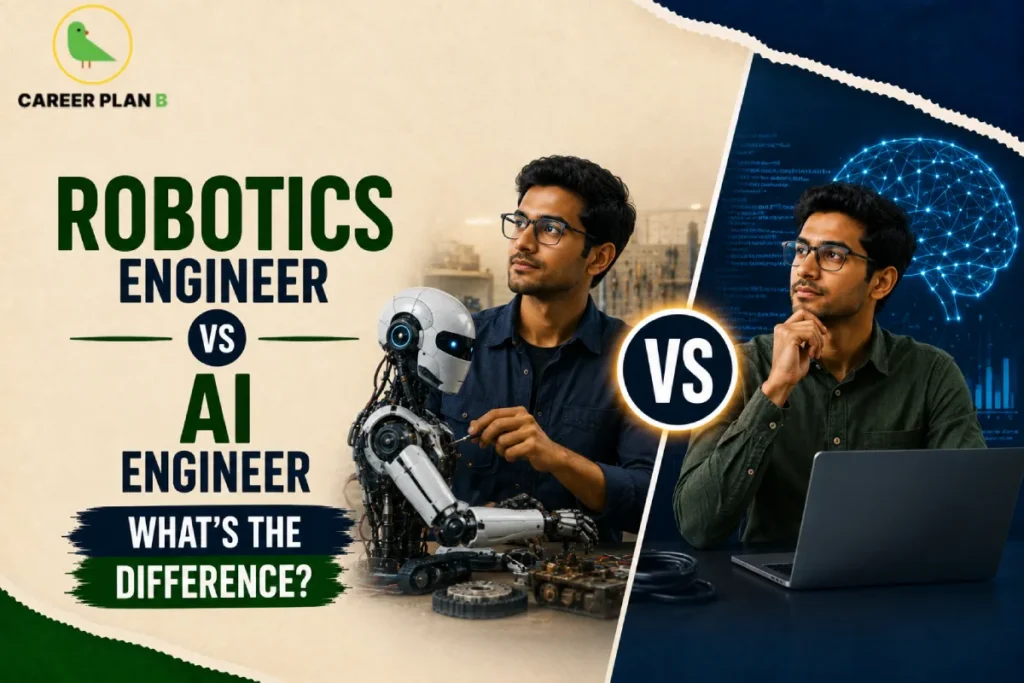
Introduction
Robots that move. Machines that think. But who actually builds them, and are they even the same person?
If you have ever Googled “Robotics Engineer vs AI Engineer” and ended up more confused than when you started, you are not alone. These two fields are closely related, often overlapping, and yet fundamentally different in what they do, what they build, and what skills they demand.
With automation reshaping industries and artificial intelligence powering everything from Netflix recommendations to surgical tools, both careers are booming. But choosing the wrong path, one that does not match your strengths, interests, or goals, can cost you years of misdirected effort.
In this blog, we break down exactly what sets a robotics engineer apart from an AI engineer, what each role pays, and most importantly, how to figure out which career is truly the right fit for you.
Who Is a Robotics Engineer?
A robotics engineer designs, builds, and maintains physical robotic systems. Their work lives at the intersection of mechanical engineering, electronics, and computer science. Simply put, if it moves in the real world, like a factory arm, a surgical robot, or a Mars rover, a robotics engineer probably had a hand in building it.
Their day-to-day work involves working with sensors, motors, actuators, and mechanical structures. They write code to control physical motion and ensure machines interact safely and efficiently with the real world.
Industries that hire robotics engineers: Manufacturing, healthcare, defence, agriculture, space exploration, and logistics.
According to the U.S. Bureau of Labour Statistics, employment in fields closely tied to robotics and mechanical systems is projected to grow steadily through 2032, driven largely by automation and robotics adoption across industries.
Key Skills for a Robotics Engineer
- CAD and mechanical design (SolidWorks, AutoCAD)
- Embedded systems and microcontrollers
- C, C++, and Python programming
- Robot Operating System (ROS)
- Control theory and kinematics
- Sensor integration and signal processing
Who Is an AI Engineer?
An AI engineer works primarily in the software and data space. Their job is to design, develop, and deploy artificial intelligence models and systems that help machines learn, reason, and make decisions without being explicitly programmed for every scenario.
If a robotics engineer builds the body, an AI engineer builds the brain.
A machine learning engineer, a close cousin of the AI engineer, focuses specifically on building and training ML models, often using massive datasets to improve predictions and automate decision-making.
Industries that hire AI engineers: Technology, finance, healthcare, e-commerce, cybersecurity, and media.
The U.S. National Artificial Intelligence Initiative recognises AI as a strategic national priority, with federal investment flowing heavily into AI research, workforce development, and deployment, underscoring just how significant artificial intelligence engineer skills have become globally.
Key Skills for an AI Engineer
- Python, R, and SQL
- Machine learning frameworks (TensorFlow, PyTorch, Scikit-learn)
- Natural Language Processing (NLP)
- Data engineering and data pipelines
- Cloud platforms (AWS, Azure, Google Cloud)
- Model deployment and MLOps
Robotics Engineer vs AI Engineer Key Differences
Here is a side-by-side breakdown to make the comparison clear:
| Feature | Robotics Engineer | AI Engineer |
|---|---|---|
| Primary Focus | Physical systems and hardware | Software, data, and algorithms |
| Core Output | Robots, automated machines | AI models, intelligent software |
| Key Tools | ROS, CAD, C++, embedded systems | Python, TensorFlow, cloud platforms |
| Work Environment | Labs, factories, field sites | Offices, remote, tech companies |
| Education | Mechanical, Electrical, Mechatronics | Computer Science, Data Science, Math |
| Salary (India) | ₹5–18 LPA (experience-based) | ₹6–25 LPA (experience-based) |
| Salary (Global) | $75k–$130k/year | $95k–$160k/year |
It is worth noting that these two fields increasingly overlap. Modern robots use AI for perception, navigation, and decision-making, which means professionals who understand both the future of robotics and AI will be among the most sought-after in the world.
Which One Pays More?
Globally, AI engineers tend to command slightly higher salaries on average, largely due to the explosive demand for machine learning engineer talent in the tech industry. However, robotics engineers with specialised expertise, particularly in defence, space, and medical robotics, can earn equally competitive packages.
In India, the salary gap is narrowing rapidly. As automation and robotics adoption accelerates across manufacturing and logistics (supported by initiatives like Make in India), robotics engineers are seeing strong compensation growth alongside their AI counterparts.
For reference, AICTE (All India Council for Technical Education) continues to expand and accredit programmes in AI, robotics, and mechatronics, reflecting the formal academic demand for both disciplines.
Have Any Doubts?
How to Choose the Right Career Path for You
Here is the most important question to ask yourself: Are you more excited by building something you can physically see and touch or by solving complex problems through data and code?
If you love the idea of a career in robotics engineering, designing machines, working with hardware, and seeing your work move and operate in the real world, robotics is likely your natural fit.
If you are drawn to artificial intelligence engineering skills and enjoy working with data, building predictive models, and creating intelligent software systems, the AI and machine learning path may suit you better.
Your choice should ultimately factor in:
- Your academic strengths (physics and mechanics vs. maths and statistics)
- Your preferred work environment (physical lab vs. data and code)
- The industries you find most exciting
- Long-term goals on your robotics vs AI career path
How Career Plan B Helps
Choosing between a career in robotics engineering and AI can feel overwhelming, especially when both seem equally exciting. Career Plan B helps you cut through the confusion with personalised career counselling, in-depth Psycheintel career assessment tests, and structured career roadmapping. Whether you are a student exploring options or a professional considering a switch, Career Plan B gives you a clear, data-backed direction tailored to your strengths and goals.
For Latest Information
Frequently Asked Questions (FAQs)
1. Can a robotics engineer become an AI engineer?
Yes, absolutely. Many robotics engineers upskill in machine learning and AI to work on intelligent robotic systems. The overlap between the two fields makes this transition quite natural.
2. Which is harder, robotics engineering or AI engineering?
Both are challenging in different ways. Robotics involves physical complexity and hardware constraints. AI requires strong mathematical foundations and data intuition. The “harder” one depends on your strengths.
3. Do robotics engineers need to know AI?
Increasingly, yes. Modern robots rely on AI for vision, navigation, and decision-making. Understanding core AI concepts gives robotics engineers a significant edge.
4. What degree do I need to become an AI engineer?
A bachelor’s degree in computer science, data science, mathematics, or a related field is the typical starting point. Many AI engineers also hold postgraduate qualifications or specialised certifications.
5. Is robotics a good career in India?
Yes. With India’s push toward manufacturing automation and smart infrastructure, the demand for skilled robotics engineers is growing steadily, particularly in sectors like automotive, defence, and healthcare.
Conclusion
The debate of robotics engineer vs AI engineer is not really about which is better; it is about which is better for you. Both careers are high-growth, well-paying, and at the cutting edge of how the world is changing. Robotics engineers shape the physical future; AI engineers shape the intelligent future. And increasingly, the most impactful professionals will be those who can do both.
The first step is understanding where your strengths and passions truly lie, and that is exactly where the right guidance can make all the difference.
Ready to figure out your path? Visit Career Plan B and take the first step toward a career that actually fits you.