Team5 · July 31, 2026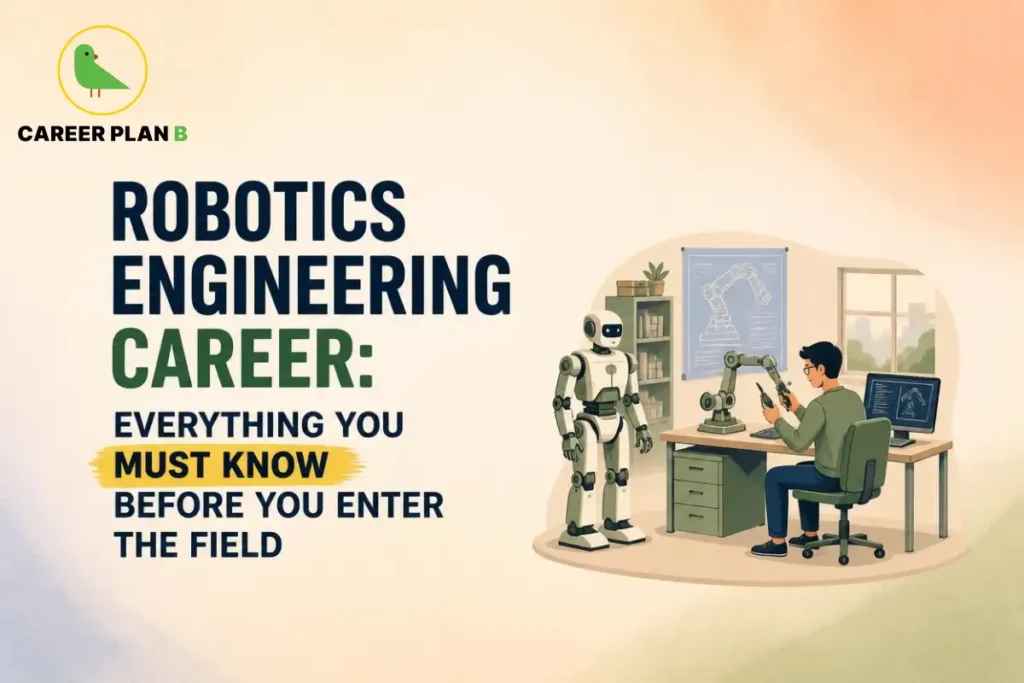
Introduction
Picture a surgical robot performing a procedure with millimetre-level precision, an autonomous drone delivering medicines to a remote village, or an AI-powered arm assembling car parts on a factory floor none of this happens without a robotics engineer behind it.
A robotics engineering career is one of the most exciting, interdisciplinary, and future-proof paths you can choose today. But it is also one of the most misunderstood. Many students jump in expecting to build humanoid robots on Day 1, only to find themselves overwhelmed by the sheer breadth of knowledge the field demands.
According to the International Federation of Robotics (IFR), the global stock of operational industrial robots crossed 3.9 million units in 2023, and that number is accelerating. In India, the push toward Industry 4.0, smart manufacturing, and defence modernisation is creating a strong and growing demand for skilled robotics professionals.
Before you commit to this path, here is everything you genuinely need to know the skills required, the courses available, the job landscape, and the realities no one tells you upfront.
What Is Robotics Engineering, Really?
Let us get one thing straight first. Robotics engineering is not just about building robots. It is about designing, programming, testing, and maintaining systems that can sense, think, and act either autonomously or with human guidance.
A robotics engineer could spend their day writing motion-control algorithms, designing mechanical joints, wiring sensor arrays, simulating robot behaviour in software, or troubleshooting why an automated assembly line keeps mis-aligning components. It is hands-on, intellectually demanding, and constantly evolving.
Where Robotics Meets Other Disciplines
This is what makes a career in robotics both exciting and challenging it sits at the crossroads of multiple engineering fields:
- Mechanical Engineering for structural design, kinematics, and dynamics
- Electrical and Electronics Engineering for circuits, sensors, and actuators
- Computer Science for programming, AI, and machine learning
- Control Systems Engineering for feedback loops and autonomous behaviour
- Artificial Intelligence for perception, decision-making, and learning
If you enjoy working across disciplines rather than within a single silo, robotics is a natural fit.
Essential Robotics Engineering Skills You Need to Build Early
One of the most common questions students ask is: “What skills do I actually need?” The honest answer is more than one domain, and built progressively.
Here are the core robotics engineering skills every aspiring professional should develop:
Programming:
- Python for rapid prototyping, AI integration, and scripting
- C / C++ for embedded systems and real-time robotics applications
- ROS (Robot Operating System) the industry-standard middleware for robotics development
Electronics and Embedded Systems:
- Microcontrollers (Arduino, Raspberry Pi, STM32)
- Sensor integration (LiDAR, ultrasonic, IMU, cameras)
- Circuit design and PCB basics
Mathematics:
- Linear algebra for robot kinematics and transformations
- Calculus and differential equations for dynamics and control
- Probability and statistics for AI and sensor fusion
Mechanical Design:
- CAD tools like SolidWorks or AutoCAD
- Understanding of materials, joints, and load analysis
Tools and Platforms Every Aspiring Robotics Engineer Should Know
- Gazebo / RViz robot simulation environments
- MATLAB / Simulink control system modelling and simulation
- OpenCV computer vision library widely used in robotics
- TensorFlow / PyTorch for integrating machine learning into robotic systems
The good news is that most of these tools are open-source and freely available. You can start building your robotics engineering skills from your own laptop, right now.
Best Robotics Engineering Courses and Pathways in India
Knowing how to become a robotics engineer in India requires understanding the academic pathways available.
Undergraduate Options:
- B.Tech in Robotics and Automation
- B.Tech in Mechatronics Engineering
- B.Tech in Electrical, Mechanical, or Computer Science (with robotics electives)
Several IITs, NITs, and private engineering institutions offer dedicated robotics programmes or specialisations. The All India Council for Technical Education (AICTE) regulates and approves these programmes.
Postgraduate Options:
- M.Tech in Robotics, Automation, or Mechatronics
- M.Tech in AI and Robotics (offered by IIT Hyderabad, IIT Bombay, and others)
Online Certifications Worth Pursuing:
- Robotics Specialisation by University of Pennsylvania on Coursera
- ROS for Beginners and Advanced courses on Udemy
- NPTEL courses on Robotics and Automation free for Indian students
The National Skill Development Corporation (NSDC) under India’s Ministry of Skill Development also supports skilling in emerging tech areas including automation and robotics.
What Does the Robotics and Automation Industry Actually Look Like?
Understanding the robotics and automation industry is essential before you commit to this path. Here is where robotics engineers are actually working:
Manufacturing and Industry 4.0: The largest employer of robotics engineers globally. Automotive, electronics, FMCG, and pharmaceutical plants are rapidly adopting automated systems.
Defence and Space: India’s DRDO actively develops unmanned ground vehicles, aerial drones, and bomb disposal robots. ISRO is investing in robotic systems for future lunar and planetary missions.
Healthcare: Surgical robots, rehabilitation exoskeletons, and hospital logistics robots are growing segments globally.
Agriculture: Agri-robots for sowing, harvesting, and crop monitoring are gaining traction in India under government-backed programmes.
Logistics and Warehousing: Companies like Amazon, Flipkart, and Delhivery are deploying autonomous mobile robots (AMRs) in their fulfilment centres.
Have Any Doubts?
Robotics Job Opportunities and Salary Expectations
The future of robotics engineering from an employment standpoint looks strong. According to the U.S. Bureau of Labor Statistics, mechanical and electronics engineering roles tied to robotics are projected to grow steadily, with median annual wages above $100,000 in the US.
In India, entry-level robotics job opportunities typically start at ₹4–8 LPA, while mid-level professionals with 3–5 years of experience can command ₹12–20 LPA. Specialists in AI-driven robotics or industrial automation often earn significantly more.
Common Misconceptions Before Entering the Field
Before you finalise your decision, here are a few myths worth clearing up:
“You need to be a genius to get into robotics.” Not true. You need curiosity, persistence, and a willingness to work across disciplines. Most robotics engineers will tell you that consistent practice beats raw talent every time.
“Robotics is only for Computer Science students.” Mechanical and electronics engineers are equally in demand. In fact, the best robotics teams are often cross-disciplinary.
“Robotics jobs are only available abroad.” India’s own defence sector, space programme, and manufacturing industry are actively hiring. The domestic market for robotics talent is growing faster than most people realise.
“You need expensive equipment to learn.” A Raspberry Pi, some sensors, open-source software, and a laptop are enough to build your first real robotics project.
How Career Plan B Helps
A robotics engineering career spans multiple disciplines, and figuring out the right entry point on your own can be genuinely confusing. Career Plan B offers personalised career counselling to help you identify whether robotics aligns with your strengths and long-term goals. Through Psycheintel-based career assessment tests, academic profile guidance, and structured career roadmapping, Career Plan B ensures you choose the right specialisation, the right institution, and the right skilling path so you enter the field prepared, not overwhelmed.
For Latest Information
Frequently Asked Questions (FAQs)
- What is the best degree to start a robotics engineering career in India?
A B.Tech in Robotics and Automation or Mechatronics is the most direct path. However, students from Mechanical, Electrical, or Computer Science backgrounds can also transition into robotics through postgraduate programmes or specialised certifications.
- Is coding mandatory for a career in robotics?
Yes, to a significant extent. Python and C++ are the most commonly used languages. ROS (Robot Operating System) is practically an industry standard. The good news is that both are learnable with consistent practice, even without a formal CS background.
- Which government organisations in India hire robotics engineers?
DRDO, ISRO, HAL (Hindustan Aeronautics Limited), BEL (Bharat Electronics Limited), and BARC actively hire robotics and automation engineers. These organisations work on cutting-edge defence, space, and electronics robotics projects.
- How important is mathematics for a robotics engineering career?
Very important. Linear algebra, calculus, and probability form the mathematical backbone of robotics particularly for kinematics, dynamics, control systems, and machine learning integration.
- Can I learn robotics online and still get a job?
Online learning through NPTEL, Coursera, and Udemy can supplement your degree significantly. However, hands-on project work and internship experience are equally critical. Employers look for practical skills, not just certifications.
Conclusion
A robotics engineering career is not just a job it is a front-row seat to the future of technology. From factories and hospitals to space missions and smart cities, robotics is quietly reshaping every major industry. But entering this field unprepared can be just as overwhelming as it is exciting.
The key is to start early, build across disciplines, gain hands-on experience, and get the right career guidance at the right time. If you are serious about breaking into this field and want a clear, personalised roadmap, visit Career Plan B today because the best time to plan your robotics career is before everyone else catches on.