Team Career Plan B · July 20, 2026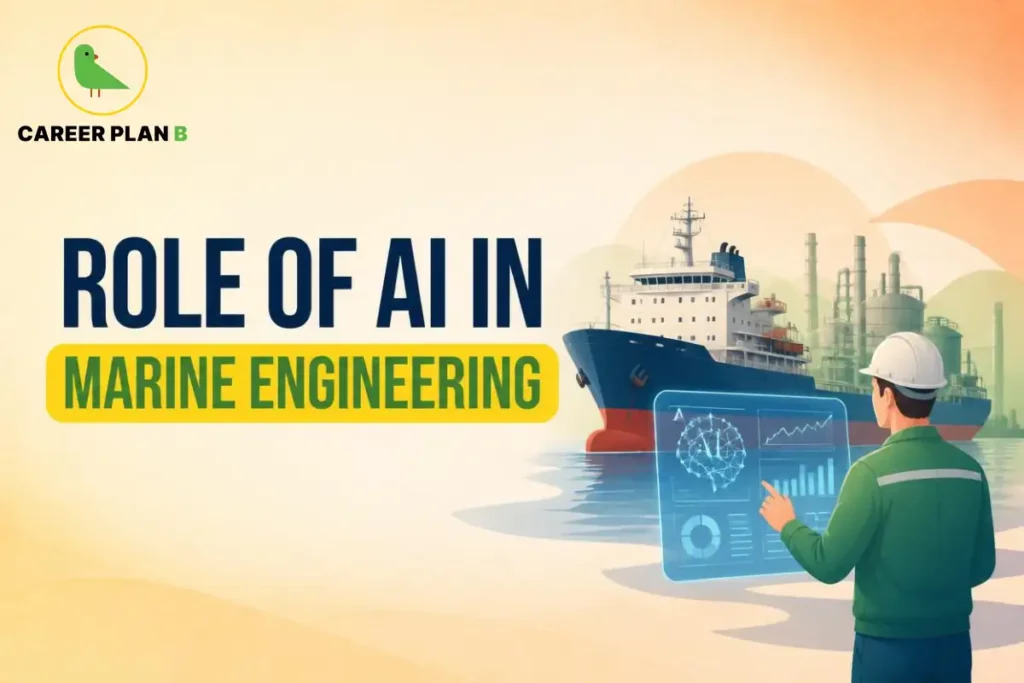
Introduction
Ships are quietly becoming some of the smartest machines on Earth. AI now monitors engine health and predicts mechanical failures before they happen. In some cases, it even assists with navigation. Yet, most people outside the shipping industry haven’t noticed this shift. Naturally, this raises a concern for students considering the field. Does the growing role of AI in marine engineering mean fewer jobs in the future? The honest answer is more nuanced than a simple yes or no. AI is changing how marine engineers work, but it isn’t eliminating the need for them. In this blog, we’ll explore how AI is being used in marine engineering today. We’ll also examine whether it is actually replacing engineers and how the profession is evolving. Finally, we’ll look at the skills that will matter most as AI becomes more widespread.
How Is AI Currently Used in Marine Engineering?
Predictive maintenance is one of the most impactful applications. AI systems analyze engine sensor data continuously, flagging potential failures before they actually happen, which reduces costly breakdowns and unplanned repairs at sea.
Fuel optimization is another major use case. AI systems adjust engine performance in real time to improve fuel efficiency and help vessels meet increasingly strict emissions regulations.
Remote monitoring is also expanding. Shore-based technical teams now use AI-powered dashboards to monitor multiple ships simultaneously, flagging anomalies without requiring engineers to manually check every system constantly.
There’s also growing movement toward autonomous and remotely operated vessels. In fact, the International Maritime Organization recently adopted a major regulatory milestone in this space: in May 2026, the IMO adopted the MASS Code, the first international regulatory framework for autonomous commercial ships, during its 111th Maritime Safety Committee session in London. This Code applies to large internationally trading cargo ships and takes effect from 1 July 2026, starting on a voluntary basis for at least two years before any move toward mandatory adoption.
Is AI Replacing Marine Engineers?
Here’s the direct, honest answer: AI is automating specific tasks rather than entire jobs. These tasks include data monitoring, routine diagnostics, and fuel calculations. Even under the new international framework, the Code keeps humans in the loop. Remote crews or onboard personnel must still interpret system outputs and supervise automated functions. They also retain the ability to override system decisions when necessary. This matters enormously for marine engineers. Safety-critical decisions, physical repairs, and emergency responses at sea still require skilled human judgement. AI systems aren’t equipped to replace that expertise.
Could a Fully Autonomous Cargo Ship Really Work Without Engineers?
Not yet, and not for a long time, based on current regulatory direction. Even the IMO’s own MASS Code timeline anticipates an experience-building phase between 2026 and 2028, with a mandatory version expected to be adopted around 2028 and enforced starting in 2032. This gradual, cautious rollout reflects how much human oversight the industry still considers essential, even for vessels marketed as “autonomous”.
How AI Is Changing the Marine Engineer’s Job (Not Eliminating It)
The nature of the work is shifting from manually monitoring every gauge and system to interpreting AI-generated insights and dashboards, then making informed decisions based on that data. This creates new skill demand: data literacy, familiarity with sensor systems, and comfort working alongside AI diagnostic tools are becoming just as important as traditional mechanical know-how. The marine engineer career scope is expanding into hybrid technical-digital roles that didn’t exist a decade ago.
Marine Engineering Future Scope in an AI-Driven Industry
Marine engineering’s future scope increasingly favours engineers who understand both traditional machinery and AI-based systems. Automation in marine engineering is driving genuine efficiency gains for shipping companies, which indirectly creates demand for tech-savvy engineers capable of managing these newer systems.
Will Automation Reduce the Number of Marine Engineering Jobs Over Time?
Some reduction in routine, manual monitoring roles is likely as automation matures. But given how cautiously international regulators are approaching full autonomy, with mandatory rules for autonomous ships not expected until 2032, this shift is gradual, not sudden, giving engineers time to adapt their skill sets rather than facing abrupt job losses.
Skills Marine Engineers Should Build for an AI-Powered Future
- Basic data analysis and interpretation skills
- Familiarity with smart ships technology and shipboard AI/IoT systems
- Continued mastery of core mechanical and safety skills, since these remain irreplaceable
- Staying updated on evolving international standards, as training curricula through DG Shipping continue adapting to reflect these technological shifts
Have Any Doubts?
What This Means for the Broader Shipping Industry
AI in shipping industry applications is ultimately about efficiency, cost savings, and safety improvements that benefit the industry as a whole. Rather than viewing AI as a threat to the profession, it’s more accurate to see it as a tool that enhances what marine engineers can do by handling routine data analysis so engineers can focus on higher-value technical judgement and safety-critical decisions.
How Career Plan B Helps
Understanding how AI is reshaping marine engineering can help you prepare for where the field is heading, not just where it stands today. Career Plan B offers personalized career counselling, PsycheIntel and career assessment tests, and academic profile guidance to help you build a future-ready career plan, backed by a clear roadmap tailored to this evolving industry.
For Latest Information
Frequently Asked Questions
- What is the role of AI in marine engineering?
AI is used for predictive maintenance, fuel optimization, and remote monitoring, helping marine engineers work more efficiently rather than replacing their core responsibilities.
- Is AI going to replace marine engineers?
No AI automates specific tasks like data monitoring, but safety-critical decisions, physical repairs, and emergency response still require skilled human engineers.
- What is the MASS Code, and how does it affect marine engineers?
It’s the IMO’s new international safety framework for autonomous ships, effective July 2026 on a voluntary basis, and it explicitly requires human oversight even for highly automated vessels.
- Will fully autonomous cargo ships eliminate marine engineering jobs?
Not in the near future; mandatory international rules for autonomous ships aren’t expected until around 2032, and even then, human oversight remains a core requirement.
- What skills should marine engineers build to stay relevant with AI?
Data literacy, familiarity with sensor and AI diagnostic systems, and continued strength in core mechanical and safety skills.
- Is marine engineering still a good career choice given rising automation?
Yes, automation is changing specific tasks gradually, not eliminating the profession, and engineers who adapt their skills will remain in strong demand.
Conclusion
The role of AI in marine engineering is best understood as evolution, not replacement. AI can automate routine monitoring and diagnostics. However, skilled human engineers still handle safety-critical decisions, physical repairs, and emergency responses. The cautious approach of international regulators toward full ship autonomy reinforces this reality. For students considering this field, the takeaway is simple. Build strong core mechanical skills while learning to work confidently with AI tools and data systems. This combination will define the most valuable marine engineers of the next decade.