Careerplanb · June 20, 2026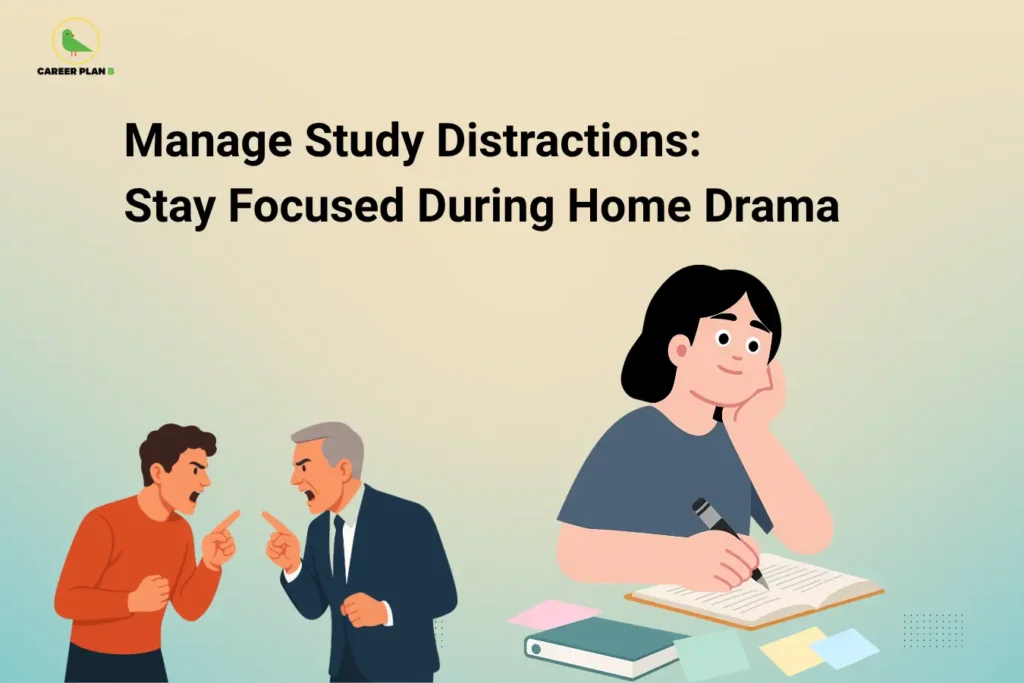
Introduction
There you are, textbooks open, highlighter in hand, finally ready to get some real CUET prep done and then it starts. Someone’s arguing in the next room. The TV is blaring. Your phone won’t stop buzzing. And somehow, the kitchen smells too good to ignore. Sound familiar? If you’re trying to study at home and feel like the whole house is conspiring against you, you’re not alone. Millions of students across India face this exact battle every single day.
Managing study distractions at home is one of the most underrated challenges of CUET preparation. It’s not about being weak or undisciplined, it’s about the fact that home is designed for living, not learning. But here’s the good news: with the right approach, you can train your mind to focus even when your surroundings are anything but quiet. This blog walks you through everything you need to know.
Why Home Is Not Always the Best Place to Study
The Myth of “I’ll Study at Home”
Most students make a plan that sounds great in their head: “I’ll wake up early, make tea, sit at my desk, and study for six hours.” And then life happens. A younger sibling needs help. Parents have a disagreement. The Wi-Fi goes down. The neighbor decides 10 AM is a great time to run a mixer.
The problem isn’t your intention. It’s that home comes with layers of emotional and social responsibilities that a library or classroom simply doesn’t have. You can’t really “switch off” at home the way you can elsewhere. And that invisible emotional weight — the noise, the drama, the tension — quietly eats into your concentration before you even realize it.
What the Research Actually Says About Home Distractions
This isn’t just a feeling — the science backs it up. Research from the American Psychological Association shows that household conflict and background stress are significant contributors to reduced cognitive performance in young people. In simpler words: when there’s drama at home, your brain is literally not working at its full capacity. Part of your mental energy is already being used to process that stress, leaving less room for actual learning.
For CUET aspirants, where every subject and every mark matters, this is a serious concern. The home environment and student performance are deeply connected, and understanding that is the first step to fixing it.
The Real Distractions Students Face at Home (And Don’t Talk About)
Family Conflicts and Emotional Noise
Let’s be honest nobody talks about this in study guides. But a big fight between your parents, a tense atmosphere at home, or constant nagging about your marks can be far more disruptive than any amount of outside noise. Emotional noise is invisible, but it’s deafening inside your head.
If you’re sitting at your desk replaying an argument or worrying about a family situation, you are not studying. Your eyes might be on the page, but your mind is elsewhere. This is what experts call “cognitive load” . Your brain is already carrying something heavy, and it simply can’t carry your chemistry chapter at the same time.
Acknowledging this is important. You are not being distracted because you’re lazy. You’re being distracted because you’re human.
Digital Distractions Disguised as Breaks
“Let me just check Instagram for five minutes.” We’ve all been there. And we all know how that ends — forty-five minutes later, you’ve watched six reels, liked twenty posts, and have no idea what you were studying before. Digital distractions are engineered to be addictive. Apps are designed to keep you scrolling.
The tricky part is that these distractions often come in during the moments when studying gets hard right when a difficult topic shows up. Your brain, looking for relief, reaches for the easiest exit. And your phone is always right there.
A study by Common Sense Media found that teens spend an average of nine hours a day on screens and a huge chunk of that happens during “study time.” That’s not a judgment. That’s just how the system is built.
The Invisible Distraction — Your Own Thoughts
This one is the sneakiest of all. Sometimes there’s no noise, no drama, no phone and you still can’t focus. That’s because the mind loves to wander. Anxiety about exam results, comparisons with classmates, fear of failure all of this creates an internal distraction that’s harder to handle than external ones.
Mental focus during exam season isn’t just about keeping your phone away. It’s about learning to quiet the noise inside your own head.
How to Actually Stay Focused During Home Drama
Build a Study Zone, Not Just a Study Corner
There’s a difference between sitting somewhere with books and actually creating a space that signals to your brain: “This is where we work.” Your study zone should be consistent. Same spot, every day. Clear the clutter. Keep only what you need. If possible, face a wall instead of a window — views are beautiful but distracting.
The National Institutes of Health has published findings showing that environmental cues play a powerful role in attention and memory formation. In short — your brain remembers where it learned things. The more consistent your study environment, the stronger that mental association becomes.
If you genuinely don’t have a quiet corner at home, here are some alternatives to explore:
- Public libraries — free, quiet, and underused by students
- An empty classroom at school during off-hours
- Early mornings before the rest of the house wakes up
- Terrace or balcony with noise-cancelling earphones
Set Boundaries Without Starting Another Argument
This is delicate territory. You can’t exactly tell your family to stop existing. But you can have a calm, respectful conversation about your study schedule. The key is to frame it not as a complaint but as a request.
Instead of: “You guys are so noisy, I can’t study.” Try: “I have my CUET prep from 7 to 10 PM. Can I have some quiet time during those hours?”
Most families, when they understand the stakes, will cooperate. You might be surprised. And if the environment continues to be difficult despite your best efforts, that’s not a reflection of how much your family cares — it’s just the reality of a busy household. In those cases, adjusting your study time to when the house is naturally quieter (early mornings or late nights) can make a huge difference.
The 2-Minute Reset Trick
When a distraction hits whether it’s noise outside or a racing thought inside don’t try to push through it aggressively. That creates more anxiety. Instead, give yourself two minutes to consciously acknowledge it.
Here’s a simple method:
- Stop what you’re doing
- Breathe slowly — five counts in, five counts out
- Write down the distraction (the worry, the thought, the thing you need to do) in a “later list”
- Return to studying with a clear head
This technique comes from mindfulness-based cognitive practices and is widely used for improving concentration tips for students. The idea is simple: your brain is trying to tell you something. Once you write it down, it knows you haven’t forgotten it — and it lets go.
Study Schedules That Actually Work for CUET Aspirants
Structure is your best friend when your environment is unpredictable. Here is a sample study routine for students preparing for CUET:
| Time Slot | Activity |
| 6:00 AM – 6:30 AM | Wake up, freshen up, light breakfast |
| 6:30 AM – 9:00 AM | High-focus study block (tough subjects) |
| 9:00 AM – 9:15 AM | Short break — stretch, don’t scroll |
| 9:15 AM – 11:30 AM | Second study block (practice questions) |
| 11:30 AM – 12:00 PM | Revision of morning material |
| Afternoon | Rest, family time, light reading |
| 7:00 PM – 9:00 PM | Evening study block (lighter topics) |
| 9:00 PM onwards | Wind down — no screens, no heavy studying |
The CUET official website by NTA has detailed information about the exam pattern, subjects, and important dates. Use that as your anchor to build your preparation schedule around what’s actually being tested.
What Toppers Do Differently at Home
Here’s a pattern that shows up again and again when you study high scorers: they don’t have magically quiet homes. They just have a different relationship with their environment.
A few things they consistently do:
They use focus music strategically. Lo-fi music, white noise, or nature sounds can block out unpredictable household noise without adding the distraction of lyrics. Apps like Focus@Will or even simple YouTube playlists can help create an audio “bubble” around your study space.
They don’t study for longer — they study smarter. The Pomodoro Technique — 25 minutes of focused study followed by a 5-minute break — is popular among toppers for a reason. It works because it matches how the human brain processes information: in focused bursts, not endless marathons.
They talk about stress. Managing family stress during exams is not something toppers bottle up. They acknowledge it to a friend, a mentor, or a counselor and they keep moving.
How Career Plan B Helps
Career Plan B helps students navigate exam pressure, distractions, and future decisions with clarity and confidence:
- Personalized Career Counselling: Helps students manage academic pressure, build realistic study plans, and make informed career decisions.
- Psycheintel & Career Assessment Tests: Identifies strengths, aptitude, personality traits, and suitable academic and career pathways.
- Admission & Academic Profile Guidance: Supports students in understanding their options and building a strong academic profile for university admissions.
- Career Roadmapping: Helps students create a structured long-term plan aligned with their goals, interests, and future aspirations.
- End-to-End Guidance: Assists students throughout exam preparation, university selection, admissions, and career planning so they can move forward with clarity instead of confusion.
For Latest Information
Frequently Asked Questions
Q1. How do I study when my house is too noisy?
Start by identifying quieter time slots in your day — early mornings often work well. Use noise-cancelling earphones with white noise or instrumental music to create a sound buffer. If possible, set up your study space in the least-used room in the house. Also, have a gentle conversation with your family about your exam schedule. Most people are more cooperative than we expect.
Q2. Is it okay to study late at night when everyone is asleep?
Occasionally, yes. But making it a habit can seriously disrupt your sleep cycle and actually reduce how much you retain. The Sleep Foundation recommends teenagers get 8 to 10 hours of sleep. Late-night studying works better as a last resort than as a daily plan.
Q3. My parents argue a lot at home. How do I focus on CUET prep in that environment? This is genuinely hard, and it deserves more than just a study tip. First, acknowledge that what you’re dealing with is emotionally difficult — that matters. Beyond that, try noise-cancelling earphones, study in the library when possible, and consider speaking to a counselor who can help you manage the emotional weight alongside your academics. You don’t have to handle this alone.
Q4. How many hours should I study for CUET at home every day?
Quality over quantity, always. Most counselors and toppers recommend 6 to 8 hours of focused study rather than 10 to 12 hours of distracted sitting. Use the NTA’s official CUET syllabus to plan subject-wise, and make sure revision and practice papers are built into your daily routine.
Q5. My phone is my biggest distraction. What can I do?
Put it in another room during study hours — not in silence, not face-down, but physically in another room. Out of sight genuinely means out of mind. You can also use app blockers like Google’s Digital Wellbeing tools (available on Android) or Screen Time on iPhones to set hard limits on apps during your study blocks.
Conclusion
Studying at home during a crucial exam season like CUET is not easy, and nobody should pretend otherwise. Between the noise, the emotional weight of family dynamics, the pull of your phone, and the voice in your own head telling you it’s too much — staying focused feels like a battle on multiple fronts. But every student who has come out the other side will tell you the same thing: it was hard, and they got through it anyway.
The secret isn’t silence. It’s a strategy. Build your routine, protect your space, be kind to yourself on the tough days, and keep showing up. Every hour you reclaim from distraction is an hour invested in the future you’re building. You’ve already shown the commitment by reading this far — now go put one of these strategies into action today.