Team6 · November 2, 2026
Introduction
From the COVID-19 vaccines that protected millions to the biofuels powering India’s clean energy ambitions, biochemical engineers are quietly driving some of the most consequential industries of our time. Yet this career remains one of the most underexplored options among engineering students in India, often overshadowed by computer science, mechanical, and civil engineering.
The reality is clear: why biochemical engineers are in high demand is a question with a compelling answer in 2024. India’s pharmaceutical sector is the third largest in the world by volume; its biotech industry is growing at over 14% annually, and the government is actively investing in biomanufacturing, biofuels, and biologics. If you have an interest in life sciences, chemical processes, and large-scale production systems, this blog will show you exactly why biochemical engineering could be your most strategic career decision. Here is everything you need to know from eligibility and skills to salary and career scope.
What Does a Biochemical Engineer Do?
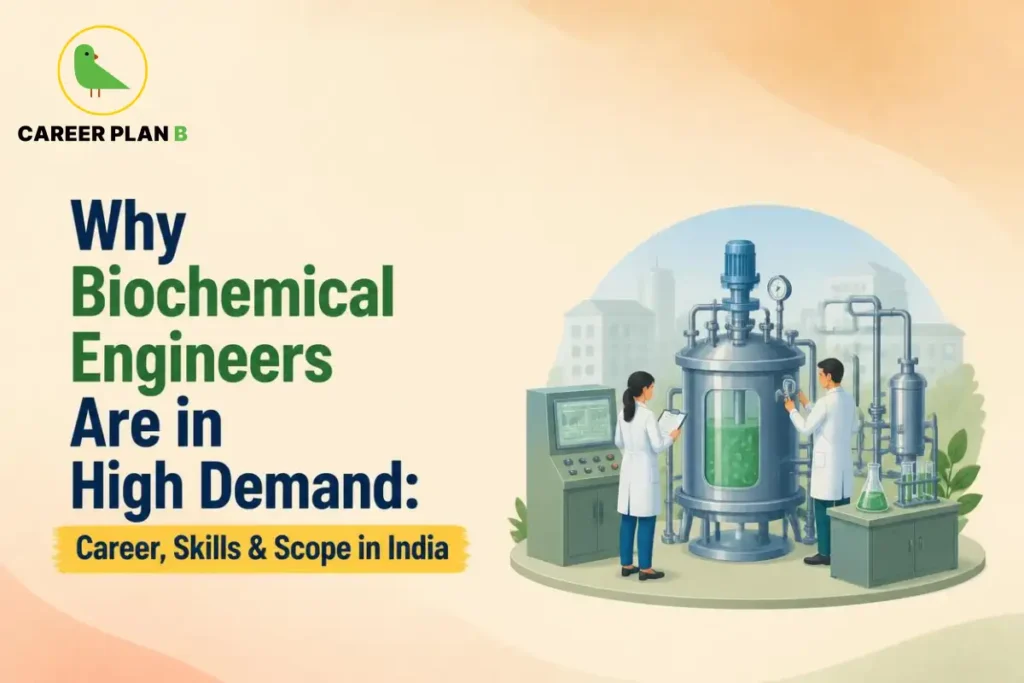
A biochemical engineer sits at the intersection of biology, chemistry, and engineering. Their core function is to design, scale up, and optimise processes that use living organisms, enzymes, or biological systems to produce useful products from medicines and vaccines to biofuels and food ingredients.
Key day-to-day responsibilities include the following:
- Designing and optimising bioprocesses, including fermentation and cell culture systems
- Operating and scaling bioreactors from laboratory to industrial scale
- Managing upstream processing (cell growth, fermentation) and downstream processing (purification, separation)
- Ensuring GMP compliance and regulatory documentation
- Troubleshooting process deviations and improving yield efficiency
- Collaborating with R&D, quality assurance, and regulatory affairs teams
Biochemical engineers work across pharmaceuticals, vaccine manufacturing, biofuels, food and beverage processing, agricultural biotechnology, waste treatment, and environmental engineering, making the biochemical engineer career path one of the most versatile in the engineering space.
Biochemical Engineering vs Biotechnology: What Is the Difference?
Students often confuse these two disciplines. Biotechnology focuses on the science of using biological systems to develop products and processes. Biochemical engineering takes that science and applies engineering principles to make it work at an industrial scale reliably, safely, and cost-effectively. A biotechnologist might develop a new fermentation pathway in a lab; a biochemical engineer designs the plant that produces it at thousands of litres per batch. Both are essential, but biochemical engineering is where science meets production reality.
Why Are Biochemical Engineers in High Demand in India?
Understanding why biochemical engineers are in high demand requires looking at the forces reshaping India’s industrial and scientific landscape.
India’s Pharma and Biotech Boom: India is the largest supplier of generic medicines globally and home to over 3,000 pharmaceutical companies. The biotech sector, supported by the Biotechnology Industry Research Assistance Council (BIRAC) under the Department of Biotechnology is scaling rapidly across therapeutics, diagnostics, and agricultural biotech.
The Department of Biotechnology’s National Biotechnology Development Strategy 2021–2025 targets making India a global top-five biotech destination, a goal that directly drives demand for skilled biochemical engineers.
Post-Pandemic Biologics and Vaccine Manufacturing India’s role as the world’s vaccine manufacturer was made visible during COVID-19. The government’s push to expand domestic biologics production, including monoclonal antibodies, biosimilars, and mRNA vaccines, has created sustained demand for engineers who understand bioprocess design and scale-up.
Biofuels and Green Energy The Ministry of New and Renewable Energy is aggressively promoting second-generation biofuels derived from agricultural waste and algae processes that require biochemical engineering expertise at every stage.
Food Processing and Agricultural Biotech: India’s food processing sector, supported by the Ministry of Food Processing Industries, is expanding into enzyme-based processing, probiotics, and fermented products all areas where biochemical engineers add direct value.
Which Industries Are Hiring Biochemical Engineers Right Now?
- Pharmaceutical and biopharmaceutical manufacturing
- Vaccine production and biologics
- Biofuel and biogas production
- Food and beverage processing
- Agrochemical and agricultural biotech
- Environmental engineering and waste treatment
- Research institutions and government laboratories
Biochemical Engineering Eligibility
Knowing your biochemical engineering eligibility is the foundation of planning your career in this field.
Undergraduate Degree A B.Tech or B.E. in Biochemical Engineering, Biotechnology, Chemical Engineering, or Biomedical Engineering is the standard entry qualification. Your institution must be AICTE-approved.
Institutions like ICT Mumbai, IIT Kharagpur, NIT Rourkela, Jadavpur University, and Harcourt Butler Technical University, Kanpur, offer dedicated biochemical engineering programmes.
Postgraduate Options: An M.Tech. in Biochemical Engineering, Bioprocess Technology, or Biotechnology strengthens your profile significantly for research-orientated and senior industrial roles. The Department of Biotechnology funds several M.Tech programmes at premier institutions through its sponsored scheme.
GATE Score A strong GATE score in Biotechnology (BT) or Chemical Engineering (CH) is essential for M.Tech admissions at IITs and NITs and for PSU jobs for biochemical engineers at government research organisations.
Certifications That Add Value
- Good Manufacturing Practice (GMP) certification is critical for pharma roles
- Bioprocess validation and regulatory affairs training
- Six Sigma Green Belt for quality and process improvement roles
- Biosafety and biosecurity certification from recognised institutions
Skills Required for Biochemical Engineer
The skills required for a biochemical engineer span laboratory science, industrial process management, and regulatory compliance. Here is what hiring managers in pharma, biotech, and bioenergy consistently look for:
Technical Skills
- Bioprocess design and fermentation technology
- Bioreactor operation and scale-up methodology
- Upstream and downstream processing techniques
- Chromatography and membrane separation for purification
- Sterile technique and aseptic processing
- Mass and energy balance calculations for biological systems
Regulatory and Quality Skills
- GMP compliance and documentation
- Understanding of CDSCO guidelines for biologics in India (https://cdsco.gov.in/)
- FDA regulatory framework for export-oriented roles
- Validation protocols for biopharmaceutical manufacturing
Software and Tools
- MATLAB for bioprocess modelling
- Aspen Plus for process simulation
- BioProcess Systems Enterprise (gPROMS) for advanced modelling
- MS Excel for operational data management and reporting
Soft Skills
- Research orientation and scientific curiosity
- Precision and attention to detail in GMP environments
- Cross-functional communication with R&D, QA, and production
- Ability to work in regulated, documentation-heavy environments
For students still building their foundation, NPTEL offers free courses on bioprocess engineering, biochemical reaction engineering, and downstream processing, all directly relevant to industry roles.
Biochemical Engineer Career Path in India
The biochemical engineer career path in India follows a clear trajectory across both the public and private sectors:
Entry Level (0–3 years) Graduate Trainee, Junior Process Engineer, or Research Associate at a pharmaceutical plant, biotech company, or research institution. Focus areas include process monitoring, GMP documentation, and bioreactor operation. Expected CTC: ₹3.5–6 LPA.
Mid – Level (3–8 years) Bioprocess Engineer, Production Engineer, or Senior Research Scientist. Independent project management, process optimisation, and regulatory submissions. Expected CTC: ₹7–14 LPA.
Senior Level (8+ years) Lead Bioprocess Engineer, Production Manager, or Director of Manufacturing. Strategic oversight of production operations, capital project execution, and regulatory strategy. Expected CTC: ₹16–30+ LPA.
PSU and Government Research Opportunities PSU jobs for biochemical engineers in India are available primarily through government research institutions and public sector enterprises with bio-energy and bioprocessing divisions:
- BIRAC-funded startups and research institutions
- Council of Scientific and Industrial Research (CSIR) labs, including CSIR-IMTECH and CSIR-NCL
- Defence Research and Development Organisation DRDO (life sciences division)
- Indian Council of Medical Research (ICMR)
- ONGC and GAIL for bio-energy and biogas-related roles
Private Sector Opportunities Top private sector recruiters for biotech and pharma jobs for engineers include Biocon, Serum Institute of India, Sun Pharma, Dr. Reddy’s Laboratories, Bharat Biotech, Piramal Pharma, and Jubilant Biosys. India’s growing biosimilars and contract development and manufacturing organisation (CDMO) sector is also generating significant new hiring.
Have Any Doubts?
Is GATE Important for a Biochemical Engineer?
GATE is not mandatory for private sector roles but significantly strengthens your profile for government research positions, PSU-adjacent roles, and M.Tech admissions at premier institutions. For students targeting CSIR labs, DBT-funded research positions, or IIT and NIT postgraduate programmes, a strong GATE score in Biotechnology (BT) or Chemical Engineering (CH) is highly recommended.
Biochemical Engineer Salary in India
Biochemical engineer salary in India varies by sector, organisation, and specialisation:
| Level | Private Sector | PSU / Government Research |
|---|---|---|
| Entry Level (0–3 yrs) | ₹3.5–6 LPA | ₹5–8 LPA |
| Mid-level (3–8 yrs) | ₹7–14 LPA | ₹10–16 LPA |
| Senior Level (8+ yrs) | ₹16–30+ LPA | ₹18–28 LPA |
Government research positions and PSU-adjacent roles also offer housing allowance, medical coverage, and retirement benefits that substantially increase total compensation beyond the CTC figure.
Key employment hubs for biochemical engineering careers in India include Hyderabad’s Genome Valley, Bengaluru’s biotech corridor, Pune’s pharma cluster, Ahmedabad, and Mumbai, all home to large concentrations of pharmaceutical, biotech, and CDMO companies actively hiring bioprocess talent.
How Career Plan B Helps
If you are exploring whether a biochemical engineering career in India aligns with your strengths and long-term goals, Career Plan B can help you move forward with clarity. Through personalised career counselling, psychometric and career assessments, and structured career roadmapping, Career Plan B helps engineering students and graduates identify their best-fit specialisation, understand industry entry points, and build a focused plan for succeeding in the biotech, pharma, and bioenergy sectors.
For Latest Information
Frequently Asked Questions (FAQs)
1. Which engineering branch is best for becoming a biochemical engineer?
A B.Tech. in Biochemical Engineering or Biotechnology is the most direct route. Chemical Engineering graduates are also widely hired in bioprocess and pharmaceutical manufacturing roles. Biomedical Engineering is relevant for healthcare-adjacent positions.
2. Is GATE necessary for a career in biochemical engineering?
GATE is not required for private sector roles in pharma and biotech, but it is important for M.Tech admissions at IITs and NITs and for government research positions at CSIR labs, ICMR, and DBT-funded institutions. GATE Biotechnology (BT) is the most relevant paper.
3. What is the starting salary of a biochemical engineer in India?
Entry-level biochemical engineer salaries in India range from ₹3.5–6 LPA in the private sector and ₹5–8 LPA in government research institutions, depending on the organisation, location, and specific role.
4. What are the top companies hiring biochemical engineers in India?
Top recruiters include Biocon, Serum Institute of India, Bharat Biotech, Sun Pharma, Dr. Reddy’s Laboratories, Piramal Pharma, and major CDMO companies. Government opportunities exist at CSIR labs, ICMR, DRDO, and BIRAC-supported institutions.
Conclusion
The question of why biochemical engineers are in high demand has a straightforward answer: the industries that need them pharmaceuticals, vaccines, biofuels, food processing, and environmental engineering are all growing simultaneously and are all backed by strong government policy support in India.
The biochemical engineer career path offers genuine versatility, competitive salaries, and the opportunity to contribute to industries that directly affect public health, food security, and energy sustainability. Whether you are targeting a research role at a CSIR lab, a production position at Biocon, or a bioprocess engineering role at a growing CDMO, the opportunities are real and expanding.
Build your eligibility, develop the right technical skills, and invest in career planning that helps you match your strengths to the right opportunities because in biochemical engineering, the demand is already there. The question is whether you are ready to meet it.