Team6 · October 13, 2026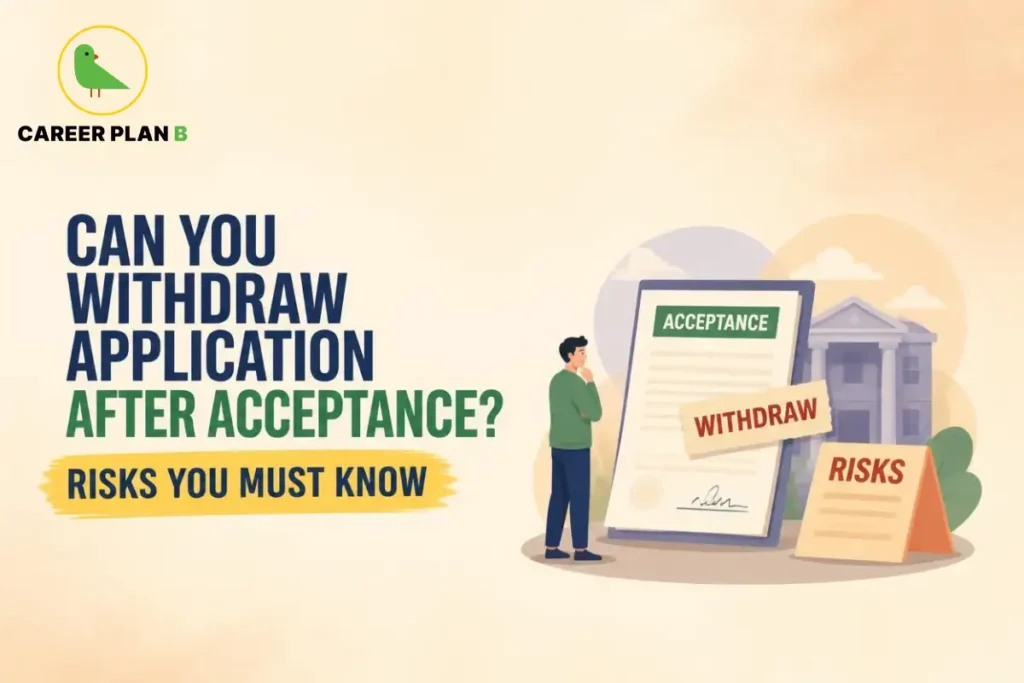
Introduction
You studied hard for months. You cleared CUET. And then, one day, the notification arrived. Your name on the allotment list. Admission confirmed. For a few seconds, everything felt perfect.
But then life happened. Maybe a better college came through. Maybe you changed your mind about the course. Maybe your parents had doubts. And now, sitting in front of your screen, you are wondering: can I actually withdraw the application after acceptance? And more importantly, what happens if I do? These are questions more students ask than you think, and the answers matter far more than most people realise before making the decision.
That “Yes, I Got In!” Moment — And Then the Doubt Crept In
Let us be honest. Getting an acceptance is one thing. Feeling at peace with it is another.
Every year, thousands of students across India go through CUET 2026 counselling, lock in their preferences, receive a seat, pay the fees and then, somewhere between the excitement and the reality check, begin second-guessing. A friend gets into a “better” college. A parent suggests a different city. A dream course suddenly seems less dreamy. These doubts are real and completely valid.
But here is where most students make a costly mistake. They act on the doubt without fully understanding what a college admission withdrawal actually costs them, not just financially, but in terms of their academic future and mental peace.
Can You Actually Withdraw Your Application After Acceptance?
The short answer is: yes, in many cases, you can. But it is never as simple as clicking “withdraw” and walking away clean.
Each university that participates in CUET has its own process for handling university seat cancellation. There is no single universal button. What you can do, when you can do it, and what you lose along the way depends entirely on the institution you have been allotted a seat in and the stage of the counselling process you are currently in.
What the University Says vs. What Students Assume
Take Delhi University’s CSAS (Common Seat Allocation System) as an example. According to the official DU admission portal, students who wish to withdraw their admission can do so through their CSAS dashboard by selecting the ‘Withdraw’ option and paying a non-refundable withdrawal fee of ₹1,000. Sounds simple enough. But read a little further and things get complicated.
Once you withdraw, you become completely ineligible for further admissions at Delhi University for that entire admission cycle. You cannot participate in any subsequent regular allocation rounds. And if Spot Admission rounds have already begun, the withdrawal option itself is not even available to you anymore. Your seat simply stays frozen.
Most students assume that withdrawing is like cancelling a food delivery. It is not. It is closer to resigning from a job with no re-application allowed for the rest of the year.
The Real Risks of Withdrawing Your Application
This is the section you need to read slowly. Not because it is scary, but because it is the part most students skip until it is too late.
1. You May Lose More Money Than You Expect
This is the most immediate and tangible risk. When you accept a seat and pay the admission fee, a portion of that money is usually non-refundable regardless of when you withdraw.
The UGC has a fee refund policy that gives students some protection. According to the University Grants Commission’s guidelines, a full refund minus a processing fee of up to ₹1,000 is available if withdrawal is made 15 days or more before the officially notified last date of admission. After that, the refund drops to 90%, then 80%, then 50%, and eventually to zero if you withdraw more than 30 days after the last date of admission.
This means timing is everything. Withdraw early and you get most of your money back. Withdraw late and you could lose the entire first-year fee. For many families, that is a sum they cannot afford to write off.
2. You Lock Yourself Out of That University’s Process
As explained earlier, a withdrawal in DU’s CSAS system does not give you a second chance. You are out of the loop entirely for that academic year. If the “better” option you were waiting for does not come through, you could end up with no seat at all.
Think of it this way: withdrawing is like leaving a queue at a government office. Once you step out, you go back to the end, except in this case, the queue closes and does not reopen.
3. The CUET 2026 Counselling Window May Have Already Closed
Here is something students often overlook. NTA only declares the CUET result. Each participating university runs its own counselling process independently. This means by the time you receive an allotment from one university, the registration window for another university may have already closed.
If you withdraw your acceptance hoping to apply elsewhere, you may discover that the other institution’s CUET 2026 counselling round has ended. There is no centralized re-entry option. You cannot call NTA and ask them to slot you back in somewhere.
4. The Emotional and Psychological Cost
This one does not show up in any official document but it is very real.
The stress of withdrawing from one place, scrambling to find another, worrying about whether you made the right call and explaining the situation to your parents takes a toll. Students who have been through this describe it as one of the most anxious periods of their lives. A hasty admission offer rejection can spiral into weeks of uncertainty, self-doubt, and pressure from all sides.
Higher education decisions made in panic rarely work out well. This is a moment that calls for clarity, not speed.
Have Any Doubts?
When Withdrawing Might Actually Make Sense
Now, to be fair, there are situations where withdrawing is the right call. Here are a few genuine ones:
- You have received a confirmed seat in a university that is significantly better suited to your career goals
- You have a documented health or family emergency that makes relocation impossible
- You have received a merit scholarship elsewhere that changes the financial picture entirely
- The course you were allotted does not match what you actually applied for due to an error
Even in these cases, the process matters. You need to act before the withdrawal window closes, have your alternative secured in writing and keep copies of every document and every communication.
Withdraw vs. Stay: A Quick Comparison
| Factor | Withdraw Option | Stay / Upgrade Option | 2026 Strategic Counseling Impact |
|---|---|---|---|
| Fee Refund | Partial or nil depending on institutional withdrawal timing | Not applicable (fees adjusted toward retained or upgraded seat) | Crucial cash-flow consideration when managing multiple university admission deposits. |
| Future Rounds Eligibility | Lost entirely for current centralized counseling pool | Retained safely via active Upgrade mechanism | Enables candidates to secure a safety backup while chasing top-tier institutional choices. |
| Psychological Stress | High (fear of losing a confirmed seat prematurely) | Lower (holding a guaranteed seat while aiming higher) | Directly impacts decision clarity during tight university window deadlines. |
| Risk Level | High (locks out further institutional mobility) | Low to moderate (tied to seat vacancy trends) | Balances aggressive placement aspirations against safety buffer requirements. |
| Recommended When | Better confirmed option exists elsewhere | Waiting for preferred college / higher preference branch | Defines optimal execution for CSAS, CUET, and independent university counseling cycles. |
What You Should Do Before Making the Final Call
Before you click anything on that dashboard, pause and work through this checklist:
Step 1: Verify the withdrawal deadline: Log into the university’s official admission portal and check the exact last date for withdrawal. Do not rely on what a friend told you or what you read on an unofficial website.
Step 2: Check the refund timeline: Read the UGC fee refund policy carefully. Understand exactly how much money you will get back based on when you withdraw. The official UGC website has the updated guidelines.
Step 3: Confirm your alternative before withdrawing: This is non-negotiable. Do not withdraw from one university until you have a confirmed seat, in writing, at another. An informal promise from a college or a “you should get in” from a counsellor is not confirmation.
Step 4: Explore the Upgrade option first: Many universities including DU allow you to choose “Upgrade” instead of “Withdraw.” This keeps your current seat safe while allowing you to be considered for a higher-preference option in the next round. This is almost always a safer choice than withdrawing outright.
Step 5: Talk to someone who knows the system: Not just your parents. Not just your friends. Talk to a career counsellor who understands how CUET 2026 counselling works across multiple universities.
How Career Plan B Helps
Career Plan B helps students navigate critical academic and career decisions with clarity, confidence, and personalized support:
- Personalized Career Counselling: Helps students evaluate important decisions such as withdrawals, university preferences, course selection, and future academic pathways based on their individual strengths and goals.
- Psycheintel & Career Assessment Tests: Provides data-backed insights into aptitude, personality traits, interests, and learning styles, helping students make decisions rooted in self-awareness rather than uncertainty.
- Admission & Academic Profile Guidance: Supports students in building strong academic profiles, understanding admission opportunities, and making informed choices throughout the application and counselling process.
- Career Roadmapping: Helps students create a structured long-term plan that connects their current academic decisions with future educational and professional aspirations.
- End-to-End Guidance: Assists students through admissions, counselling rounds, university selection, and career planning so that every major decision is thoughtful, strategic, and aligned with their long-term success.
For Latest Information
Frequently Asked Questions
Q1. Can I withdraw my CUET seat allotment after paying the admission fee?
Yes, most universities allow withdrawal after fee payment, but you will typically lose a portion of the fee depending on when you apply. DU charges a non-refundable ₹1,000 withdrawal fee and bars you from further rounds in that cycle.
Q2. Will I get a refund if I withdraw my admission?
It depends on the timing. As per UGC guidelines, if you withdraw 15 or more days before the last date of admission, you are entitled to a full refund minus a processing fee. After that, the refund decreases in stages and can reach zero.
Q3. Can I re-apply to the same university after withdrawing?
In most cases, no. DU’s CSAS system, for instance, makes you ineligible for all further rounds in the same academic year once you withdraw.
Q4. Is there a safer alternative to withdrawing?
Yes. If the university offers an “Upgrade” option, choose that. It lets you keep your current seat while being considered for higher-preference colleges in the next round, without the risk of ending up with nothing.
Q5. What happens if I miss the seat acceptance deadline without withdrawing?
Your seat gets automatically cancelled. This is different from a formal withdrawal and you may not qualify for a refund at all. Always act before the deadline.
Conclusion
The ability to withdraw application after acceptance exists for good reason. Life is unpredictable and students deserve the flexibility to change course when circumstances genuinely demand it. But flexibility is not the same as freedom from consequence.
Every higher education decision you make at this stage is a link in a much longer chain. A well-thought-out choice today, even if it feels like a compromise, can set you up better than a rushed decision made under pressure. Before you act, pause. Check the facts. Explore your options. And if you need help making sense of it all, ask someone who has helped students through exactly this kind of moment. Because the goal was never just to get in. The goal was always to end up somewhere that actually takes you forward.