Team6 · July 9, 2026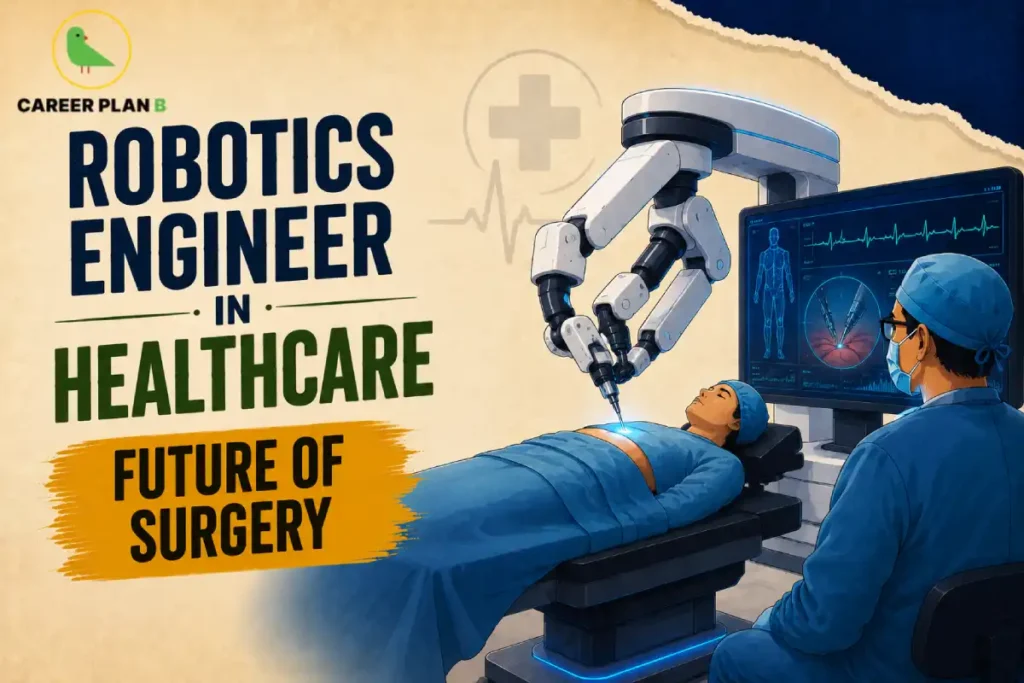
Introduction
A surgeon sits at a console a few feet away from the operating table. On the table, a patient lies under anaesthesia. But the hands performing the surgery are not human; they are four precision robotic arms, moving with a level of steadiness and accuracy no human hand can match. The surgeon guides every move, but the robot executes it.
This is not science fiction. This is robotic surgery, and it is already happening in hospitals across India and around the world.
The global medical robotics market was valued at over $14 billion in 2023 and is projected to surpass $40 billion by 2030. In India, hospitals like Apollo, Fortis, and AIIMS New Delhi have already adopted robotic surgical systems, and the adoption curve is only getting steeper. Behind every one of these systems is a robotics engineer in healthcare, the professional who designs, builds, programs, and maintains the machines that are redefining what surgery means.
For engineering graduates, especially those from ECE, mechanical, and mechatronics backgrounds, this is one of the most exciting, meaningful, and rapidly growing career frontiers available today. This blog covers everything you need to know about the robotics engineer in healthcare career path, from what they do and where they work to salary expectations, top recruiters, and the skills that open doors in this field.
How Robotics Is Transforming Healthcare and Surgery
The journey of robotics in healthcare began in the 1980s, but it was the launch of the Da Vinci Surgical System by Intuitive Surgical in 2000 that truly changed the game. The Da Vinci system allowed surgeons to perform minimally invasive procedures with robotic precision, smaller incisions, less blood loss, faster recovery, and fewer complications.
Since then, robotics in surgical procedures has expanded far beyond a single system. Today, surgical robots assist in urological, gynaecological, cardiac, orthopaedic, and neurosurgical procedures. Beyond the operation theatre, robots are being deployed for patient rehabilitation, drug dispensing, diagnostic laboratory automation, and even hospital logistics.
The shift is driven by three powerful forces: the need for precision in complex procedures, the shortage of specialist surgeons in many regions, and the relentless push of AI and sensor technology into healthcare. And engineers are at the absolute heart of this transformation. Without the teams that design the actuators, write the control algorithms, integrate the vision systems, and validate the safety protocols, none of these robotic systems would exist.
What Does a Robotics Engineer Do in Healthcare?
A medical robotics engineer is responsible for the complete lifecycle of a medical robotic system from initial concept and mechanical design to software development, integration, testing, and regulatory compliance.
Core responsibilities include:
- Designing robotic mechanisms, actuators, and end-effectors for surgical or rehabilitation applications
- Programming robot motion control systems using ROS (Robot Operating System), C++, and Python
- Integrating computer vision and AI for real-time surgical guidance and object recognition
- Developing embedded control systems for real-time robot operation
- Conducting rigorous safety testing and validation per medical device standards
- Working with clinical teams to understand surgical requirements and translate them into engineering specifications
- Ensuring compliance with medical device regulations set by CDSCO (Central Drugs Standard Control Organisation) in India and FDA internationally
The role sits at the intersection of mechanical engineering, electronics, software, and biomedical knowledge, making it one of the most intellectually demanding and rewarding roles in engineering today.
Key Applications of Robotics in Healthcare and Surgery
The future of surgical robotics in India and globally is being shaped across multiple clinical domains, each representing a distinct career opportunity for robotics engineers.
1. Robotic-Assisted Surgery (RAS)
The most prominent application of robotic arms controlled by surgeons is performing minimally invasive procedures with sub-millimetre precision. Systems like the Da Vinci, CMR Surgical’s Versius, and Medtronic’s Hugo are used in urology, gynaecology, and general surgery. Indian hospitals in metro cities are rapidly adopting these systems.
2. Rehabilitation and Exoskeleton Robots
Robotic exoskeletons help patients with spinal cord injuries, stroke, or neurological conditions regain movement through assisted therapy. Companies like ReWalk and Ekso Bionics lead globally, while Indian startups and IIT research labs are developing indigenous versions for affordable rehabilitation.
3. Diagnostic and Laboratory Automation Robots
Robotic systems are increasingly used for automated sample processing, blood analysis, pathology slide preparation, and PCR testing, dramatically improving throughput and accuracy in diagnostic labs. This segment saw explosive growth during the COVID-19 pandemic.
4. Hospital Logistics and Delivery Robots
Autonomous mobile robots (AMRs) now navigate hospital corridors to deliver medicines, meals, linens, and sterile instruments, reducing the burden on nursing staff and minimising infection risk. Hospitals in India are beginning to adopt these systems under their digital health transformation programmes.
5. AI-Powered Surgical Planning Systems
Beyond physical robots, software-driven robotic planning tools use CT and MRI scan data to create precise 3D surgical maps, helping surgeons plan complex procedures before entering the operation theatre. These systems represent a growing niche for engineers who combine robotics with AI and medical imaging expertise.
Career Scope for Robotics Engineers in Healthcare
The career scope for robotics engineers in healthcare is at a genuine inflection point driven by policy support, private investment, and demographic demand.
India’s National Digital Health Mission (NDHM), operating under the Ministry of Health and Family Welfare, Government of India, is building the digital infrastructure for a transformed healthcare system, one that increasingly incorporates robotics, AI, and automation. The mission’s framework creates a policy environment where medtech innovation, including surgical robotics, is actively encouraged.
The Department of Science and Technology (DST) under the Government of India funds robotics and biomedical engineering research across IITs and NITs, creating pathways for engineers to work on cutting-edge healthcare robotics job opportunities through government-funded research programmes.
The Department of Pharmaceuticals under the Ministry of Chemicals and Fertilizers oversees the medical devices sector, which includes surgical robots, through its National Medical Devices Policy 2023. This policy aims to make India a global hub for medical device manufacturing and innovation, directly expanding careers in medical robotics for engineers.
Globally, the career in medical robotics for engineers is even more expansive. The United States, Germany, Japan, South Korea, and Israel are global leaders in surgical robotics development. Moreover, Indian engineers with robotics expertise are increasingly attracting global medtech companies. Many of these companies recruit talent for their India-based R&D centres. In addition, they also offer opportunities for international roles. As a result, skilled robotics engineers can build successful careers in both India and global markets.
Have Any Doubts?
Top Recruiters for Robotics Engineers in Healthcare
The healthcare robotics job opportunities in India and globally span prestigious global corporations, government research institutions, and a growing startup ecosystem.
Global Medical Robotics Companies
- Intuitive Surgical, makers of the Da Vinci system and the undisputed leader in surgical robotics globally. Actively recruits robotics engineers for R&D, software development, and clinical integration. Visit Intuitive Surgical Careers
- Medtronic, one of the world’s largest medical device companies, with a growing robotics division including the Hugo RAS system. Their India engineering centre in Hyderabad recruits robotics and embedded systems engineers. Visit Medtronic Careers
- Stryker is a global leader in orthopaedic surgical robots, including the Mako robotic arm system for knee and hip replacement surgery. Visit Stryker Careers
- Johnson & Johnson MedTech develops the Ottava surgical robotic system and recruits heavily for robotics software, systems engineering, and clinical applications roles. Visit J&J MedTech Careers
- CMR Surgical, a, a UK-based maker of the Versius surgical robot, expanding rapidly across Asia, including India. Offers strong opportunities for Indian robotics engineers.
Indian Government and Research Institutions
- AIIMS New Delhi (All India Institute of Medical Sciences) India’s premier medical institution has an active robotics surgery programme and conducts collaborative engineering research with IITs on surgical robotics systems.
- DRDO (Defence Research and Development Organisation) DRDO’s biomedical engineering division works on robotic rehabilitation systems, prosthetics, and exoskeleton development for defence personnel and veterans.
- IIT Research Centres IIT Delhi, IIT Bombay, IIT Madras, and IIT Kharagpur all have active medical robotics research programmes funded by DST and industry offering research engineer and PhD positions in surgical and rehabilitation robotics.
- CSIR-CMERI (Central Mechanical Engineering Research Institute) Under CSIR, CMERI works on indigenous robotic systems, including rehabilitation robots and agricultural robots, offering research positions for engineers interested in applied robotics.
Indian Medtech Startups
India’s medtech startup ecosystem supported by Startup India and the National Biopharma Mission under the Department of Biotechnology is producing innovative companies in surgical robotics, rehabilitation technology, and hospital automation:
- Perfint Healthcare: Chennai-based company making robotic systems for cancer treatment guidance
- Synaptive Medical India works on robotic positioning systems for neurosurgery
- RoboticsPlus and other IIT-incubated startups emerging players in the Indian surgical robotics space
Robotics Engineer in Healthcare: Roles and Salary
Here is a realistic breakdown of robotic surgery engineer salaries and jobs for Indian graduates:
| Job Role | Fresher Salary (India) | Experienced (3–5 yrs) |
|---|---|---|
| Surgical Robotics Eng. | ₹6 – ₹12 LPA | ₹18 – ₹35 LPA |
| ROS Software Eng. (Health) | ₹7 – ₹12 LPA | ₹20 – ₹35 LPA |
| Rehab Robotics Eng. | ₹5 – ₹9 LPA | ₹15 – ₹25 LPA |
| Medical Device Eng. (Robotics) | ₹5 – ₹8 LPA | ₹12 – ₹22 LPA |
| Clinical Robotics App. Eng. | ₹5 – ₹9 LPA | ₹14 – ₹24 LPA |
Roles at global companies like Intuitive Surgical and Medtronic, especially in the United States, offer among the highest engineering salaries in the medtech sector. In India, the combination of domestic hospital adoption and global R&D centre expansion is steadily pushing robotic surgery engineer salaries and jobs upward.
Skills Every Robotics Engineer Needs for Healthcare Roles
Breaking into medical robotics engineer roles requires a highly specialised skill set that goes beyond standard robotics engineering because every system you build will eventually be used on a human patient.
Technical skills that are essential:
- ROS (Robot Operating System), the industry-standard framework for robotics software development; proficiency in ROS and ROS2 is non-negotiable
- C++ and Python primary programming languages for robotics control systems and algorithm development
- Computer Vision and AI: OpenCV and deep learning frameworks (TensorFlow and PyTorch) for surgical scene understanding and instrument tracking
- Embedded Systems microcontroller programming, real-time operating systems (RTOS) for robot control hardware
- Mechanical Design SolidWorks or CATIA for designing robotic mechanisms and surgical instruments
- Signal Processing for processing sensor data from force sensors, encoders, and medical imaging systems
Domain knowledge that gives you an edge:
- Basic understanding of human anatomy and surgical procedures invaluable for designing clinically relevant robotic systems
- Familiarity with medical device regulations in India CDSCO (Central Drugs Standard Control Organisation) guidelines are available at CDSCO Official Website
- Understanding of ISO 13485 (Quality Management for Medical Devices) and IEC 62304 (Medical Device Software lifecycle standards)
Certifications and learning resources:
- NPTEL courses on Robotics, Medical Instrumentation, and Control Systems from IITs available at NPTEL
- IEEE resources on medical robotics via IEEE Robotics and Automation Society
- Participate in medical robotics challenges and competitions under Smart India Hackathon at SIH Official
- Explore research internships at IIT medical robotics labs and AIIMS engineering collaboration programmes
Practical experience tips:
- Build a robotic arm project using ROS and integrate it with a camera for basic object manipulation
- Work on rehabilitation assistive device projects; even simple exoskeleton prototypes demonstrate strong domain interest to recruiters
- Follow and contribute to open-source surgical robotics projects like CISST and the Raven II open surgical robot platform
How Career Plan B Helps
The medical robotics field sits at the crossroads of engineering, healthcare, and regulation, making it one of the most complex career paths to navigate alone. Career Plan B helps engineering students explore this field with clarity through psychometric and career assessment tests that identify your aptitude for robotics and healthcare technology. Their career roadmapping sessions help you build a step-by-step plan from the right specialisation and certifications to the right companies and research programmes. With personalised career counselling from experts who understand the medtech industry, Career Plan B ensures your journey into healthcare robotics job opportunities is built on the strongest possible foundation so you spend your time building the right skills, not second-guessing your direction.
For Latest Information
Frequently Asked Questions (FAQs)
Q1. What engineering background is best for a career in medical robotics?
ECE, mechanical engineering, and mechatronics graduates are among the most suitable candidates for medical robotics roles. Meanwhile, the technology is maturing rapidly. In addition, hospitals are investing heavily in robotic systems. Furthermore, the government is introducing new policies. As a result, career opportunities continue to expand.
Q2. Is India a good place to build a career in healthcare robotics?
Yes, increasingly so. Private hospitals across India are rapidly adopting robotic surgery. The government is also investing in medtech manufacturing through the National Medical Devices Policy 2023. In addition, global companies have established R&D centres in cities like Bengaluru and Hyderabad. These developments make India an excellent place to build a healthcare robotics career. They also create strong pathways to global opportunities.
Q3. Do I need a postgraduate degree to work in medical robotics?
Not always, but it can provide a strong advantage. An M.Tech in Robotics, Mechatronics, or Biomedical Engineering from an IIT or NIT builds advanced research skills and expands your professional network. Many leading medical robotics companies value these qualifications. For global roles at companies like Intuitive Surgical and Medtronic, employers often prefer candidates with a postgraduate degree or a strong robotics project portfolio.
Q4. What regulations govern medical robots in India?
Medical robots in India are classified as medical devices and regulated by the Central Drugs Standard Control Organisation (CDSCO) under the Ministry of Health and Family Welfare. The Medical Devices Rules 2017 govern their approval, manufacturing, and clinical use. Engineers working in this space must understand these regulatory frameworks’ details available at CDSCO.
Conclusion
The operating theatre of the future will not look like the one from a decade ago. Robotic arms will assist surgeons with superhuman precision, AI will guide every incision, and patients will recover faster with fewer complications. The robotics engineer in healthcare is the professional making this future real, one algorithm, one actuator, one validated system at a time.
The robotic surgery career scope is growing at a pace that few engineering disciplines can match right now. The technology is maturing rapidly. Hospitals are investing heavily in robotic systems. Most importantly, the government is introducing policies to support India’s growing medtech industry. Furthermore, these initiatives are creating new opportunities for innovation, research, and employment. As a result, engineers have access to more career opportunities than ever before. Whether you want to work at Intuitive Surgical in Silicon Valley, Medtronic’s Hyderabad centre, or an IIT robotics lab, exciting career opportunities are available. Ultimately, this rapidly growing field offers excellent long-term career prospects. Ultimately, the industry offers multiple pathways for engineers to build successful careers in healthcare robotics.
Start with clarity. Visit Career Plan B today and take the first step toward a healthcare robotics career that is built to make a real difference in operating theatres, in rehabilitation centres, and in the lives of patients who depend on the technology you will help create.