Team6 · July 15, 2026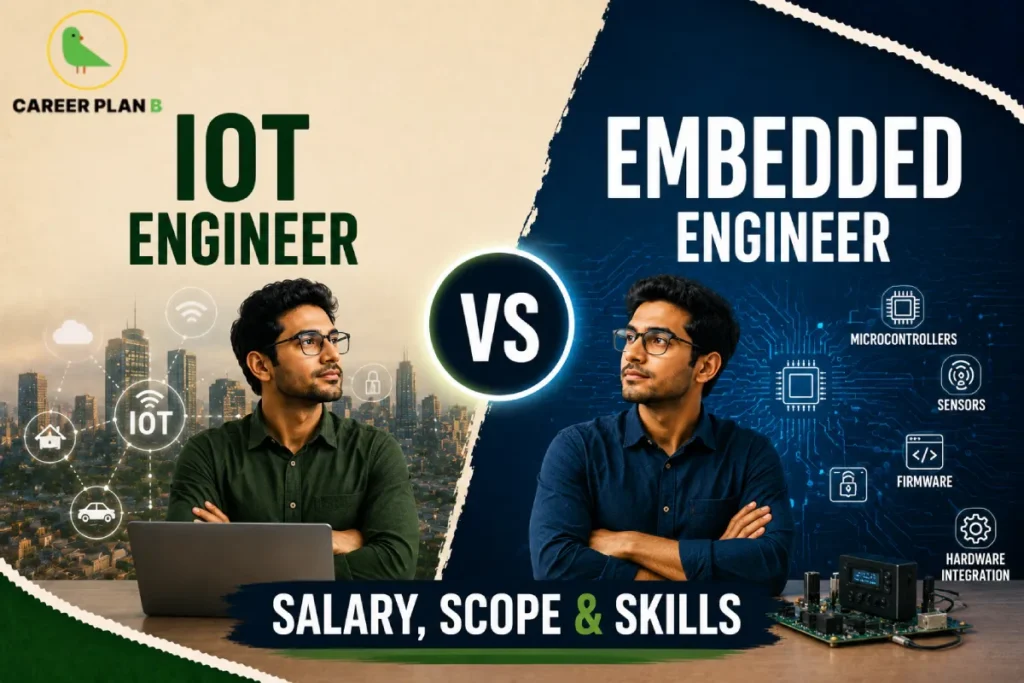
Introduction
Picture two engineers sitting in the same college lab, working on the same microcontroller project. Four years later, one is designing firmware for an electric vehicle, and the other is building a sensor network for a smart city. Same starting point, completely different careers.
This is the reality of choosing between an IoT engineer vs. an embedded engineer path. Both roles sit at the exciting intersection of hardware and software, yet they lead to very different industries, skill sets, and salary trajectories. And for most students and early-career professionals, the line between the two feels blurry at best.
According to MeitY (Ministry of Electronics and Information Technology), India’s electronics and IT sector is one of the fastest-growing in the world, with both IoT and embedded systems identified as priority technology areas under the Digital India programme. Globally, the embedded systems market is projected to reach $116 billion by 2026, while the IoT market is expected to hit $650 billion in the same period.
In this blog, we will break down the key differences in salary, scope, and skills between an IoT engineer and an embedded engineer so you can make a confident, informed career choice.
What Is an IoT Engineer?
An IoT engineer, or Internet of Things engineer, designs and manages networks of connected devices that communicate with each other and with cloud platforms. Their work focuses on the bigger picture: how devices talk to each other, how data flows, and how systems scale across cities, hospitals, or factories.
Core Responsibilities of an IoT Engineer
- Designing end-to-end connected systems using sensors, gateways, and cloud platforms
- Writing software for device communication using protocols like MQTT and CoAP
- Integrating IoT solutions with cloud services such as AWS IoT Core or Microsoft Azure IoT Hub
- Managing real-time data pipelines and dashboards for decision-making
- Ensuring cybersecurity across connected infrastructure
IoT engineers typically work in industries like smart city technology, industrial automation, precision agriculture, connected healthcare, and consumer electronics. Their world is about connectivity, data, and scale.
What Is an Embedded Engineer?
An embedded engineer, on the other hand, works deep inside the hardware. They write the firmware, the low-level software that makes a physical device function. Think of them as the people who programme the brain of a device, whether it is a car’s braking system, a medical implant, or a satellite component.
Core Responsibilities of an Embedded Engineer
- Writing firmware in Embedded C or Assembly for microcontrollers and processors
- Designing real-time operating systems (RTOS) for time-critical applications
- Performing hardware-software integration and debugging at the circuit level
- Optimising code for memory and processing constraints
- Working closely with hardware design and PCB teams
Embedded engineers are in high demand across automotive, aerospace, defence, semiconductor, and consumer electronics sectors. Their world is about precision, reliability, and hardware mastery.
IoT Engineer vs Embedded Engineer – Key Differences
Here is a clear side-by-side comparison to understand how these two roles differ across the most important parameters:
| Parameter | IoT Engineer | Embedded Engineer |
|---|---|---|
| Primary Focus | Connectivity, cloud, data flow | Firmware, hardware, real-time systems |
| Work Environment | Cloud-connected, software-heavy | Hardware labs, close to silicon |
| Programming Languages | Python, JavaScript, C | Embedded C, Assembly, C++ |
| Hardware Involvement | Moderate | High |
| Key Industries | Smart cities, healthcare, agriculture | Automotive, aerospace, defence, semiconductors |
| Connectivity Requirement | Core to the role | Secondary or minimal |
| Scalability Focus | High city or enterprise scale | Low device-level precision |
As this table shows, IoT vs embedded systems is not simply about one being better than the other. It is about which direction energises you more: working at scale across systems or working deep inside a single device with extreme precision.
Salary Comparison – Who Earns More?
Let us talk numbers, because salary is one of the biggest factors in any tech engineering career comparison.
IoT Engineer Salary in India and Globally
| Experience Level | India (LPA) | Global (USD/year) |
|---|---|---|
| Entry Level (0–2 years) | ₹4 – ₹7 LPA | $60,000 – $80,000 |
| Mid Level (3–5 years) | ₹8 – ₹15 LPA | $85,000 – $110,000 |
| Senior Level (6+ years) | ₹16 – ₹25 LPA | $115,000 – $150,000 |
Embedded Engineer Salary in India and Globally
| Experience Level | India (LPA) | Global (USD/year) |
|---|---|---|
| Entry Level (0–2 years) | ₹3.5 – ₹6.5 LPA | $55,000 – $75,000 |
| Mid-level (3–5 years) | ₹7 – ₹14 LPA | $80,000 – $105,000 |
| Senior Level (6+ years) | ₹15 – ₹24 LPA | $110,000 – $145,000 |
Both roles offer competitive and growing IoT engineer salaries and embedded engineer pay packages. IoT roles tend to carry a slight premium at senior levels due to cloud and data skills, while embedded engineers with domain expertise in automotive or defence command exceptionally high salaries in global markets.
For India-specific industry salary benchmarks, NASSCOM publishes annual reports on technology talent and compensation trends that are worth exploring.
Scope & Future – Which Career Has More Growth?
Both fields are booming, but in distinctly different directions. Here is what the future looks like for each.
Future Scope of IoT Engineers
The Internet of Things career landscape is expanding rapidly, driven by:
- India’s Smart Cities Mission covering 100 cities with large-scale IoT infrastructure investment
- Digital India Programme by MeitY actively promoting IoT skilling and deployment
- Growth of Industry 4.0, smart manufacturing, and connected agriculture
- Rising demand for IoT cybersecurity specialists as connected infrastructure scales
Future Scope of Embedded Engineers
The embedded systems job scope is equally strong, powered by:
- India’s booming Electric Vehicle (EV) sector requiring firmware engineers for battery management and control systems
- The Production Linked Incentive (PLI) Scheme for Electronics Manufacturing by MeitY, boosting domestic semiconductor and hardware production
- Growing defence and aerospace investment under Make in India
- Global semiconductor shortage driving demand for embedded design talent worldwide
Verdict
If you are drawn to large-scale urban tech solutions and data-driven systems, IoT engineering is your lane. If you love working close to hardware with precision and reliability, embedded engineering is where you will thrive. Both are future-proof; the choice comes down to where your passion lies.
Skills Required – IoT Engineer vs Embedded Engineer
Understanding the skill gap between the two roles helps you plan your learning path with clarity.
Skills for IoT Engineers
- Programming: Python, JavaScript (Node.js), C
- Protocols: MQTT, CoAP, HTTP, Zigbee, LoRaWAN
- Cloud Platforms: AWS IoT Core, Microsoft Azure IoT Hub, Google Cloud IoT
- Networking: 5G, Wi-Fi, Bluetooth, LPWAN
- Data Skills: Real-time analytics, basic machine learning integration
- Security: IoT cybersecurity fundamentals
Skills for Embedded Engineers
- Programming: Embedded C, Assembly, C++
- Systems: RTOS (FreeRTOS, VxWorks), bare-metal programming
- Hardware: ARM processors, microcontrollers (STM32, AVR), PCB basics
- Hardware-Software Integration: Debugging with oscilloscopes, logic analysers
- Tools: JTAG debuggers, Keil, IAR Embedded Workbench
Overlapping Skills Where Both Meet
- C programming fundamentals
- Microcontroller architecture (Raspberry Pi, Arduino)
- Communication protocols (SPI, I2C, UART)
- Debugging and testing methodologies
- Basic electronics and circuit understanding
This overlap means that switching between IoT and embedded engineering mid-career is absolutely possible with focused upskilling, something many engineers do successfully.
Have Any Doubts?
Which Career Is Right for You?
Here is the honest truth: no blog can answer this for you completely. The right career is the one that aligns with how your mind works, what excites you, and where your strengths naturally lie.
Choose IoT Engineering if you:
- Love working with cloud platforms and networked systems
- Enjoy seeing your work scale across cities or industries
- Are comfortable with software, data, and connectivity layers
- Want to work in smart cities, healthcare tech, or industrial IoT
Choose Embedded Engineering if you:
- Love working close to hardware and understanding how devices work at a circuit level
- Enjoy the challenge of writing tight, efficient, real-time code
- Are drawn to automotive, aerospace, defence, or semiconductor industries
- Want deep hardware-software integration expertise
If you are still unsure, that is completely normal, and that is exactly where structured career guidance makes all the difference.
How Career Plan B Helps
Choosing between an IoT engineer vs embedded engineer path is not just about salaries or job titles; it is about understanding where your aptitude and passion truly align. Career Plan B helps you make that decision with confidence through the following:
- PsycheIntel Career Assessment Tests Identify whether your natural strengths lean toward hardware precision or large-scale connected systems, giving you a data-backed direction
- Personalised Career Counselling One-on-one guidance from experts who understand the IoT vs embedded systems landscape and can map the right path for your profile
- Career Roadmapping Get a step-by-step plan covering the exact courses, certifications, projects, and internships needed to break into your chosen tech engineering career
- Admission & Academic Profile Guidance Choose the right engineering specialisation, university, and electives that align with either IoT or embedded systems career goals
Visit Career Plan B to stop guessing and start building your career with a clear, personalised plan.
For Latest Information
Frequently Asked Questions (FAQs)
Q1. Is IoT engineering a subset of embedded engineering?
Not exactly. Embedded engineering focuses on firmware and hardware-level programming, while IoT engineering focuses on connectivity, cloud integration, and networked systems. There is overlap, but they are distinct specialisations with different career trajectories.
Q2. Which has better long-term job security: IoT or embedded engineering?
Both offer strong long-term prospects. IoT engineer salary growth is driven by smart city and Industry 4.0 expansion, while embedded engineers benefit from the EV boom, semiconductor growth, and defence sector investment. Neither field is going away anytime soon.
Q3. Can I switch from embedded engineering to IoT engineering?
Yes, and many engineers do. Since both roles share fundamentals like C programming, microcontrollers, and communication protocols, transitioning requires upskilling in cloud platforms, networking, and IoT-specific tools typically achievable within 6–12 months of focused learning.
Q4. What degree do I need to become an IoT or embedded engineer?
A degree in electronics engineering, computer science, electrical engineering, or information technology is the standard entry point. Specialised certifications from NIELIT, AWS, or Microsoft can significantly strengthen your profile in either field.
Q5. Are there government job opportunities in these fields in India?
Yes. Organisations like ISRO, DRDO, BEL (Bharat Electronics Limited), and projects under Smart Cities Mission actively recruit both IoT and embedded engineers. These roles offer strong stability alongside competitive compensation.
Conclusion
The debate of IoT engineer vs embedded engineer does not have a universal winner; it has a personal answer. Both careers are deeply rewarding, genuinely future-proof, and backed by strong industry demand across India and globally.
IoT engineers are building the connected world we are all moving toward. Embedded engineers are powering the devices that make that world function. One works at scale; the other works with precision. Both matter enormously.
The smartest career move you can make right now is not choosing blindly based on salary tables; it is understanding yourself well enough to know which path will keep you engaged, growing, and thriving for decades.
Start that journey today. Visit Career Plan B and take the first step toward a tech engineering career built on clarity, not guesswork.