Careerplanb · September 19, 2026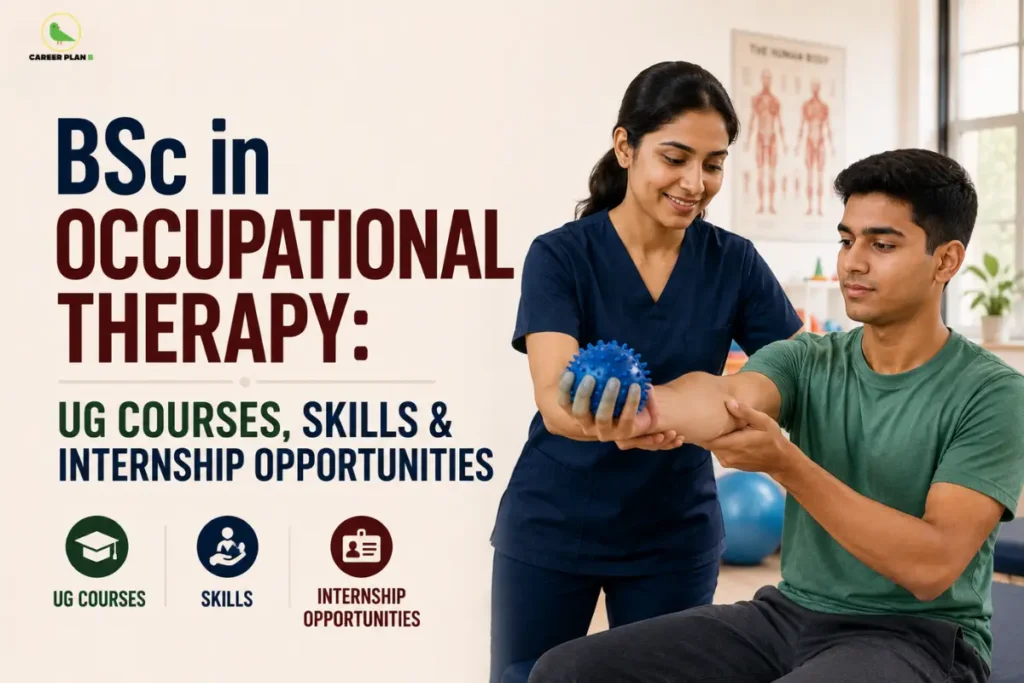
Introduction
Imagine a child with autism finally learning to hold a pencil. Or a stroke survivor regaining the ability to button a shirt independently. Even something as simple as an elderly person with arthritis making a cup of tea again can become a life-changing achievement. These milestones do not happen by accident. They happen because of an occupational therapist.
Occupational therapy (OT) is one of the most human-centred professions in healthcare — and one of the most underrecognised in India. The first department of occupational therapy in India was established at King Edward Memorial Hospital (KEM) in Mumbai in 1950. Despite more than 70 years of history, the profession has gained significant momentum only in the past two decades.
Today, with India’s rehabilitation sector expanding and a new national regulatory framework elevating OT to the same admissions standard as medicine, the BSc in Occupational Therapy is an increasingly significant and well-regarded undergraduate healthcare degree.
What Is Occupational Therapy?
Occupational therapy is a healthcare profession that helps people of all ages perform the daily activities — or “occupations” — that are meaningful to them, including self-care, work, study, and leisure.
The World Federation of Occupational Therapists (WFOT) defines the profession as working to improve the health and well-being of individuals and communities through meaningful occupational engagement. Occupational therapists address the needs of people experiencing a wide range of health conditions and disabilities and take on health promotion roles.
Source: World Federation of Occupational Therapists
In practice, OTs work with children with developmental delays and autism, adults recovering from strokes and injuries, elderly patients managing dementia or arthritis, workers with ergonomic injuries, and individuals with mental health conditions.
Have Any Doubts?
The UG Course: BSc Occupational Therapy
The Bachelor of Occupational Therapy (BOT/BOTh) is a 4–5 year undergraduate programme, the entry-level professional qualification for occupational therapy in India.
As per the National Commission for Allied and Healthcare Professions (NCAHP), established under the NCAHP Act 2021:
- Occupational therapy is regulated by the Occupational Therapy Council under NCAHP from 2025 onwards
- The entry to professional practice is a baccalaureate degree in occupational therapy of 5 years duration including internship
- Qualified occupational therapists after completing the BOT/BOTh degree are allowed the honorific prefix of “Dr.”along with the suffix “OT”
Source: National Commission for Allied and Healthcare Professions
What Does the Curriculum Cover?
The BOT curriculum includes Human Anatomy and Physiology, Neuroscience, Fundamentals of Occupational Therapy, OT in Paediatrics, OT in Neurology, OT in Orthopaedics, OT in Psychiatry and Mental Health, Ergonomics and Industrial Rehabilitation, Community-Based Rehabilitation (CBR), and Clinical Fieldwork.
Who Can Apply? Eligibility Criteria (2026–27 Onwards)
This is a critical update every student planning to apply must know.
As per the NCAHP’s official communication to the University Grants Commission (UGC), new uniform admission criteria for 15 allied and healthcare programmes have been established, to be implemented from the academic year 2026–27:
- Academic: 12th (10+2) with Physics, Chemistry, and Biology (PCB), with a minimum 50% aggregate (40% for reserved categories)
- English: Must have studied and passed English in Class 12
- Entrance Exam: NEET UG is mandatory for BOT admission from 2026–27 onwards
- Age: Minimum 17 years
This places occupational therapy on par with MBBS and BDS in terms of admission standards — a significant step in professionalising the field.
Source: National Commission for Allied and Healthcare Professions ; University Grants Commission — ugc.gov.in
| Criteria | Requirement |
|---|---|
| Academic Qualification | Class 12 with Physics, Chemistry, and Biology (PCB) and a minimum of 50% aggregate marks (40% for reserved categories) |
| Entrance Examination | NEET UG (mandatory from the 2026–27 academic session) |
| English Requirement | Must have passed English as a subject in Class 12 |
| Minimum Age | 17 years |
Top Colleges Offering BOT in India
As per official government records, the following are National Institutes under the Ministry of Social Justice and Empowerment offering OT programmes:
| Institution | Location | Type |
|---|---|---|
| National Institute for Locomotor Disabilities (NILD) | Kolkata, West Bengal | Central Government Institute |
| Swami Vivekanand National Institute of Rehabilitation Training and Research (SVNIRTAR) | Cuttack, Odisha | Central Government Institute |
| Pt. Deendayal Upadhyaya National Institute for Persons with Physical Disabilities (PDUNIPPD) | New Delhi | Central Government Institute |
| All India Institute of Physical Medicine and Rehabilitation (AIIPMR) | Mumbai, Maharashtra | Central Government Institute |
Beyond National Institutes, more than 30 colleges across India offer BOT programmes, including Manipal College of Health Professions (accredited by WFOT), Jamia Millia Islamia, and Christian Medical College, Vellore.
Source: Ministry of Social Justice and Empowerment; NCAHP
Key Skills Every Occupational Therapist Needs
Clinical Skills:
- Proficiency in standardised assessment tools
- Understanding of adaptive equipment and assistive technology
- Knowledge of anatomy, neurology, and developmental sciences
Interpersonal Skills:
- Empathy and active listening
- Communication with patients, families, and the care team
- Cultural sensitivity across India’s diverse communities
Analytical Skills:
- Clinical reasoning and goal-setting
- Treatment planning and documentation
- Outcome monitoring and modification
Internship in Occupational Therapy: Where and What
Internship is a mandatory, structured component of the BOT degree — required under the NCAHP’s curriculum framework.
Where Do OT Interns Work?
- Government and private multi-specialty hospitals
- Rehabilitation centres (physical, neurological, developmental)
- Special schools for children with autism, cerebral palsy, Down syndrome, and learning disabilities
- Mental health institutions
- NGOs and community-based rehabilitation projects
- Mainstream schools (inclusive education settings)
- Industrial ergonomics departments
What Will You Do as an Intern?
During clinical postings, students conduct functional assessments, assist in therapeutic interventions under supervision, fabricate splints and adaptive devices, participate in team case discussions, conduct home assessments, and prepare discharge and caregiver education plans.
India’s healthcare infrastructure is evolving rapidly, with hospitals, clinics, and rehabilitation centres now incorporating occupational therapy as a standard part of their care protocols — meaning OT internship placements are increasingly available across multiple settings.
Career Opportunities After BOT
As per NCAHP’s curriculum and career framework, BOT graduates can work across:
- Clinical OT Specialist (hospitals, rehabilitation centres)
- Paediatric OT Specialist (children’s hospitals, special schools)
- Community Rehabilitation Worker
- Ergonomics Consultant
- Mental Health OT Practitioner
- OT Educator / Lecturer in allied health colleges
- Independent OT Clinic Owner (after obtaining a practice licence from the state council)
The WFOT notes global demand for qualified occupational therapists, making India-trained OTs — especially from WFOT-accredited programmes — eligible for opportunities in the UK, Australia, Canada, and the Middle East.
Source: World Federation of Occupational Therapists
How Career Plan B Helps
Career Plan B’s Psycheintel and Career Assessment Tests help you assess whether the empathetic, patient-centred nature of OT aligns with your strengths. Personalised Career Counselling evaluates your fit for healthcare professions. Their Admission and Academic Profile Guidance is essential given the new NEET-based requirement from 2026–27 — students in Classes 11 and 12 must plan NEET preparation alongside board exams. Career Roadmapping builds a step-by-step plan from stream selection through NEET, college choice, and first clinical posting.
Get In Touch With Us
Frequently Asked Questions
Q1. Is NEET required for BSc Occupational Therapy admission?
Yes. As per NCAHP’s official communication to the UGC, NEET UG is mandatory for BOT admission from the academic year 2026–27 onwards. (Source: ncahp.abdm.gov.in )
Q2. Which stream should I choose in Class 12 for OT?
Physics, Chemistry, and Biology (PCB) is mandatory. English must also be passed in Class 12. (Source: NCAHP )
Q3. What is the NCAHP and why does it matter?
The National Commission for Allied and Healthcare Professions (NCAHP), established under the NCAHP Act 2021, is the apex Indian regulatory body for allied and healthcare professionals. It sets curriculum standards, regulates professional conduct, and governs admissions for OT and 14 other allied health disciplines. (Source: ncahp.abdm.gov.in)
Q4. Can I open my own OT clinic after graduation?
Yes. After obtaining a practice licence from the relevant state or union territory council, an occupational therapist can open their own clinic in specialisations such as paediatrics, neurology, orthopaedics, and others.
Q5. Are Indian OT degrees recognised internationally?
Programmes accredited by the World Federation of Occupational Therapists (WFOT) are internationally recognised. India-trained OTs from WFOT-accredited institutions are eligible to practice or seek further qualification in countries including the UK, Australia, Canada, and the Middle East. (Source: wfot.org )
Have Any Doubts?
Conclusion
A Career That Changes Lives — Including Your Own
India’s rehabilitation sector is growing. Awareness of disability, mental health, and developmental conditions is rising. Schools, hospitals, and communities are seeking trained OT professionals. With NCAHP now elevating OT to the same admissions standard as medicine, the profession has never been better positioned.
If you want a healthcare career that restores independence, dignity, and joy — occupational therapy may be exactly what you are looking for.
Ready to explore a career in healthcare that truly makes a difference? Speak with a Career Plan B counsellor today.