Careerplanb · September 19, 2026
Introduction
Walk through the corridors of the Ajanta Caves in Maharashtra. Run your fingers along the carved stone of a 2,000-year-old temple wall in Odisha. Stand inside Humayun’s Tomb in Delhi and look up at the perfectly preserved Mughal dome above you. These places are not just beautiful — they are alive. And someone, every day, is working hard to keep them that way.
India is home to 43 UNESCO World Heritage Sites and 62 more sites on UNESCO’s Tentative List, making it one of the top heritage nations in the world. The Archaeological Survey of India (ASI), functioning under the Ministry of Culture, is responsible for the conservation and maintenance of 3,697 ancient monuments and archaeological sites of national importance. In the financial year 2024–25, the Government of India spent ₹374 crore on the conservation of centrally protected monuments alone.
This is not a sector that is shrinking. It is expanding — and rapidly. New museums are being built, ancient sites are being digitised, and India is increasingly playing a leadership role in global heritage conversations. In July 2024, India hosted the 46th Session of the World Heritage Committee in Delhi, with nearly 2,900 delegates from over 140 countries. Prime Minister Modi inaugurated the event, signalling the highest levels of national commitment to this field.
If you are drawn to history, culture, architecture, or science — and want a career that connects the past to the future — heritage conservation may be the path for you. This blog walks you through why this field matters, what new-age degree options exist at the undergraduate level, and how to take your first step.
Why Heritage Conservation Is a Serious Career Choice in India
Government Investment Is Growing
Heritage conservation in India is not a niche academic pursuit. It is backed by substantial government investment and institutional infrastructure. Consider these figures from official sources:
- ₹374 crore was spent on conservation of centrally protected monuments in 2024–25 (PIB, Ministry of Culture)
- The National Mission on Monuments and Antiquities (NMMA), set up by ASI in 2007, has documented over 12.3 lakh antiquities and 11,406 heritage sites across India
- The Indian Heritage in Digital Space (IHDS) initiative is using immersive technologies to digitally preserve and present India’s cultural legacy
- India’s first Archaeological Experiential Museum, inaugurated in Vadnagar in January 2025 at a cost of ₹298 crore, spans 12,500 square metres and features over 5,000 artefacts
- A new museum at Humayun’s Tomb — spanning 1,00,000 square feet — was inaugurated in July 2024 (Ministry of Culture/PIB)
Have Any Doubts?
India’s Global Heritage Footprint Is Expanding
India’s most recent UNESCO World Heritage inscription was “Moidams: The Mound-Burial System of the Ahom Dynasty” from Assam, added in July 2024. Seven Indian natural heritage sites were also added to UNESCO’s Tentative List in 2025, with ASI leading the preparation of all nomination dossiers (Ministry of Culture). India has also retrieved 642 antiquities from foreign countries since 2014 — a total of 655 since 1976 — reflecting the diplomatic and professional complexity of modern heritage work.
The Role of Technology Is Changing the Field
Heritage conservation is no longer just about physically restoring old buildings and artefacts. Today’s conservator may work with 3D laser scanning, GIS mapping, drone photogrammetry, AI-powered documentation tools, and immersive digital experiences. The Ministry of Culture’s Museum Grant Scheme is actively funding digitisation of museum collections, improved conservation labs, and technology-driven upgrades across the country.
This shift means the field now needs professionals with interdisciplinary skills — people who combine historical knowledge with scientific methods, spatial thinking, and digital tools.
What Does a Heritage Conservation Professional Actually Do?
Before choosing a degree, it is useful to understand what work in this field looks like in practice. Heritage conservation is a broad field with several distinct sub-domains:
- Built heritage conservation — restoring and maintaining historic buildings, forts, temples, and monuments
- Archaeological conservation — excavating, documenting, and preserving artefacts, sites, and cultural layers
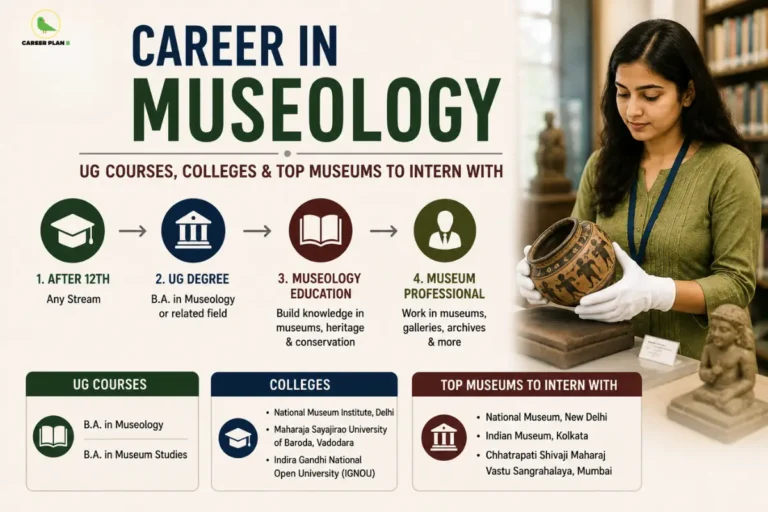
- Museum conservation and museology — managing and preserving artefact collections in museum settings
- Intangible cultural heritage — documenting and safeguarding living traditions such as folk arts, crafts, rituals, and oral histories
- Digital heritage — creating 3D models, virtual tours, and digital archives of heritage assets
- Heritage management and policy — working with government bodies, NGOs, and international organisations to develop conservation plans and cultural policies
Each of these sub-domains has a different educational entry point — and the good news is that several excellent Indian institutions now offer degree programs tailored to these pathways.
Best UG Degree Options for a Career in Heritage Conservation
B.A. (Hons.) in Ancient Indian History, Culture & Archaeology — BHU
The Banaras Hindu University (BHU) offers one of India’s most respected undergraduate programs in this field: the B.A. (Hons.) in Ancient Indian History, Culture and Archaeology (AIHCA). Offered by BHU’s Department of AIHCA — one of the oldest and most distinguished archaeology departments in the country — this three-year program covers ancient Indian history, Vedic and post-Vedic culture, epigraphy (the study of inscriptions), numismatics (the study of coins), art and architecture, and field archaeology.
What makes this program particularly valuable is its location. BHU is situated in Varanasi — one of the world’s oldest continuously inhabited cities — close to major archaeological sites like Sarnath, Rajghat, and Chunar. Students get actual fieldwork experience as part of their curriculum.
Graduates of this program can appear for ASI recruitment exams, UGC NET in Ancient Indian History, and UPSC Civil Services with History/AIHCA as an optional subject. Admission is through CUET UG scores.
Eligibility: 10+2 from any recognised board (any stream) Duration: 3 years Admission route: CUET UG
Source: BHU Department of AIHCA
B.Arch. (Bachelor of Architecture) — SPA New Delhi & Other Institutions
For students interested in the physical conservation and restoration of built heritage — forts, palaces, historic urban areas, temples — a Bachelor of Architecture (B.Arch.) is the most direct and powerful UG qualification.
The School of Planning and Architecture (SPA), New Delhi is an Institution of National Importance under the Ministry of Education. It consistently ranks first in architecture in India (NIRF Architecture Rankings 2024). At the PG level, SPA’s Department of Architectural Conservation offers a highly regarded M.Arch. in Architectural Conservation, for which a B.Arch. is the required prerequisite. Graduates from SPA’s B.Arch. have gone on to work on heritage conservation projects at ASI-protected monuments, UNESCO World Heritage Sites, and with organisations like INTACH and DRONAH.
The B.Arch. program at SPA New Delhi runs for five years. Admission is through JEE Main Paper-2 (B.Arch.), conducted by NTA, followed by JoSAA counselling.
Eligibility: 10+2 with Mathematics and a minimum of 50% marks; valid JEE Main Paper-2 score Duration: 5 yearsAdmission route: JEE Main Paper-2 → JoSAA Counselling
Source: SPA New Delhi
B.A. in History / Ancient History — Central and State Universities
A B.A. in History with a focus on ancient or medieval history is the most widely accessible undergraduate pathway into the heritage sector. Offered across central universities (including University of Delhi, Jawaharlal Nehru University, and Aligarh Muslim University) and state universities across India, this degree builds the foundational knowledge of civilisations, cultural practices, and historical methodology that underpins all heritage work.
Several universities offer combined or specialised streams such as B.A. in History and Archaeology, B.A. in Culture Studies, or B.A. in Ancient Indian History. Admission to central university programs is through CUET UG, introduced by the University Grants Commission (UGC) as a standardised entry route across all central universities.
This degree is particularly strong for those aiming to work in intangible cultural heritage, heritage documentation, cultural policy, or museum education. With a strong B.A. foundation, students can proceed to specialised postgraduate programs at institutions like the Indian Institute of Heritage (IIH) — a deemed university under the Ministry of Culture.
Eligibility: 10+2 from any recognised board; CUET UG score for central universities Duration: 3 years (or 4 years under NEP 2020 at select institutions) Admission route: CUET UG (central universities); merit/state entrance tests (state universities)
B.Sc. in Applied Sciences / Chemistry / Physics (as foundation for conservation science)
This is a less conventional but increasingly important pathway. The Indian Institute of Heritage (IIH) — formerly the National Museum Institute, a deemed university fully funded by the Ministry of Culture — requires a graduate degree in Physics, Chemistry, Geology, Biology, Biotechnology, Microbiology, or Visual/Fine Arts (with 50% marks) for admission to its M.A. in Conservation program.
This means that students with a B.Sc. in Chemistry, Geology, or Physics from a UGC-recognised university are direct candidates for India’s most prestigious postgraduate conservation training program. If you want to work as a scientific conservator — testing ancient materials, stabilising fragile artefacts, or developing conservation treatments — a science undergraduate degree is the right foundation.
UGC-recognised B.Sc. programs are available at central universities, IITs (B.Sc. Research programs), and hundreds of state university affiliated colleges across India.
Eligibility: 10+2 with Science stream Duration: 3 years (B.Sc.) or 4 years (B.Sc. Research at IITs/central universities)Admission route: CUET UG (central universities); JEE Advanced (IIT B.Sc. Research); state CETs (state universities)
Source: IIH/NMI ; Ministry of Culture
Quick Comparison: UG Degrees at a Glance
| Degree | Best For | Duration | Admission Route | Key Regulating Body |
|---|---|---|---|---|
| B.A. (Hons.) AIHCA – BHU | Archaeology, field excavation, and epigraphy | 3 Years | CUET UG | UGC |
| B.Arch. – SPA New Delhi | Architectural and built heritage conservation | 5 Years | JEE Main Paper 2 | Council of Architecture / Ministry of Education |
| B.A. History / Ancient History | Cultural heritage, museums, and heritage policy | 3–4 Years | CUET UG | UGC |
| B.Sc. (Chemistry / Physics / Geology) | Conservation science and material analysis | 3–4 Years | CUET UG / JEE | UGC / AICTE |
Always verify institution recognition at: https://www.ugc.gov.in and https://www.aicte-india.org
Key Government Institutions to Know as You Build Your Career
India’s heritage sector is largely driven by a network of official institutions. Understanding these bodies matters both for your education and for your future employment:
- Archaeological Survey of India (ASI) — Established in 1861 under the Ministry of Culture; the country’s primary body for archaeological research and conservation of nationally protected monuments. Operates under the Ancient Monuments and Archaeological Sites and Remains (AMASR) Act, 1958. Website: https://www.asi.nic.in
- Indian Institute of Heritage (IIH) — Formerly the National Museum Institute; a Deemed University under the Ministry of Culture offering M.A. and Ph.D. programs in Conservation, Museology, Archaeology, and History of Art. Website: https://www.nmi.gov.in
- Indira Gandhi National Centre for the Arts (IGNCA) — An autonomous body under the Ministry of Culture offering PG Diploma courses in Preventive Conservation, Cultural Management, Applied Museology, Manuscriptology, and more. Website: https://ignca.gov.in
- National Research Laboratory for Conservation of Cultural Property (NRLCC) — A government laboratory under the Ministry of Culture focused on scientific research for conservation
- School of Planning and Architecture (SPA), New Delhi — An Institution of National Importance offering B.Arch. and M.Arch. (Architectural Conservation). Website: https://www.spa.ac.in
Career Roles You Can Aim for After a UG Degree in Heritage Conservation
A UG degree in any of the relevant fields above opens the door to a wide range of career paths — in government, research, academia, and the creative sector:
- Assistant Conservator (ASI or State Archaeology Departments) — works on the physical preservation of monuments and artefacts
- Museum Curator / Museum Professional — manages and presents collections; accessible through IIH’s museology programs post-UG
- Archaeological Field Officer — supports excavation projects with documentation, site management, and artefact analysis
- Heritage Documentation Specialist — uses digital tools (GIS, photogrammetry, 3D scanning) to create records of heritage assets
- Cultural Heritage Policy Analyst — works with government ministries, UNESCO, or NGOs on conservation planning and cultural policy
- Architectural Conservation Associate — supports restoration projects on historic buildings and urban heritage areas (career pathway through B.Arch.)
- Heritage Tourism Officer — links conservation work with sustainable tourism development, especially in UNESCO-listed areas
For government sector roles, candidates typically appear for UPSC Civil Services (with History/AIHCA as optional), ASI direct recruitment exams, or state public service commission exams with cultural heritage portfolios.
Government Schemes and Initiatives Shaping the Heritage Sector
Understanding these programs helps you see where jobs and opportunities will emerge over the next decade:
| Initiative | Purpose | Official Body |
|---|---|---|
| National Mission on Monuments & Antiquities (NMMA) | Digitises and documents monuments, heritage sites, and antiquities across India. | Archaeological Survey of India (ASI) / Ministry of Culture |
| Indian Heritage in Digital Space (IHDS) | Uses immersive technologies to preserve and showcase India’s cultural heritage digitally. | Ministry of Culture |
| Adopt a Heritage 2.0 | Encourages public and private organisations to support monument conservation through CSR initiatives. | Ministry of Culture / ASI |
| Museum Grant Scheme | Supports museum modernisation, digitisation, infrastructure, and capacity building. | Ministry of Culture |
| Gyan Bharatam Mission | Preserves manuscripts while creating research and digital documentation opportunities. | Ministry of Culture |
Source: Ministry of Culture — https://culture.gov.in ; PIB — https://pib.gov.in
How Career Plan B Helps
Choosing the right UG degree for a heritage conservation career — between archaeology, architecture, science, or history — can feel complex. Career Plan B simplifies this through Personalised Career Counselling, Psycheintel Career Assessment Tests that match your strengths to the right stream, Admission and Academic Profile Guidance for institutions like BHU, SPA New Delhi, and IIH-feeder programs, and Career Roadmapping to help you build a step-by-step plan from UG entry to your first professional role.
Get In Touch With Us
Frequently Asked Questions
01. Can students from any stream pursue heritage conservation?
Yes. Arts students can study history and archaeology, while Science students can specialise in conservation science through subjects such as Physics, Chemistry, Geology, or Biology. Meanwhile, B.Arch. programmes in architectural conservation require Mathematics. As a result, heritage conservation offers career pathways for students from all three streams.
02. How can I get admission to the Indian Institute of Heritage (IIH)?
The Indian Institute of Heritage (IIH), formerly the National Museum Institute, is a Deemed University funded by the Ministry of Culture, Government of India. It offers M.A. and Ph.D. programmes in Conservation, Museology, Archaeology, History of Art, and Palaeography/Epigraphy. Admission involves a written test followed by a personal interview. For M.A. Conservation, you need a bachelor’s degree in Physics, Chemistry, Geology, Biology, Biotechnology, Microbiology, Visual Arts, or Architecture. For M.A. Museology and M.A. Archaeology, graduates from science, social science, or humanities disciplines are eligible. Website: https://www.nmi.gov.in
Website: https://ignca.gov.in
Have Any Doubts?
Conclusion
India’s heritage sector is not a relic of the past. It is a living, growing, professionally demanding field — backed by government investment, national policy, and global recognition. Whether you are drawn to the physical act of restoring a 500-year-old mosque, the scientific challenge of analysing ancient pigments, the intellectual work of documenting a disappearing folk tradition, or the administrative challenge of managing a UNESCO World Heritage Site — there is a career path in heritage conservation that can fit your interests and strengths.
The key is to choose the right UG degree and the right institution. Whether that is B.A. (Hons.) AIHCA at BHU, B.Arch. at SPA New Delhi, B.A. History at a central university via CUET UG, or a B.Sc. in science as a gateway to conservation science — each of these paths leads to a profession where your work genuinely matters.
India has 62 sites on UNESCO’s Tentative List waiting to be nominated. Over 12.3 lakh antiquities are being digitised. New museums are being built. Ancient manuscripts are being preserved. All of this needs trained, passionate professionals.
That future conservator could be you.
Want to find the right path into heritage conservation? Connect with Career Plan B for a personalised assessment, admission guidance, and a career roadmap built around your unique profile and goals.