Careerplanb · September 19, 2026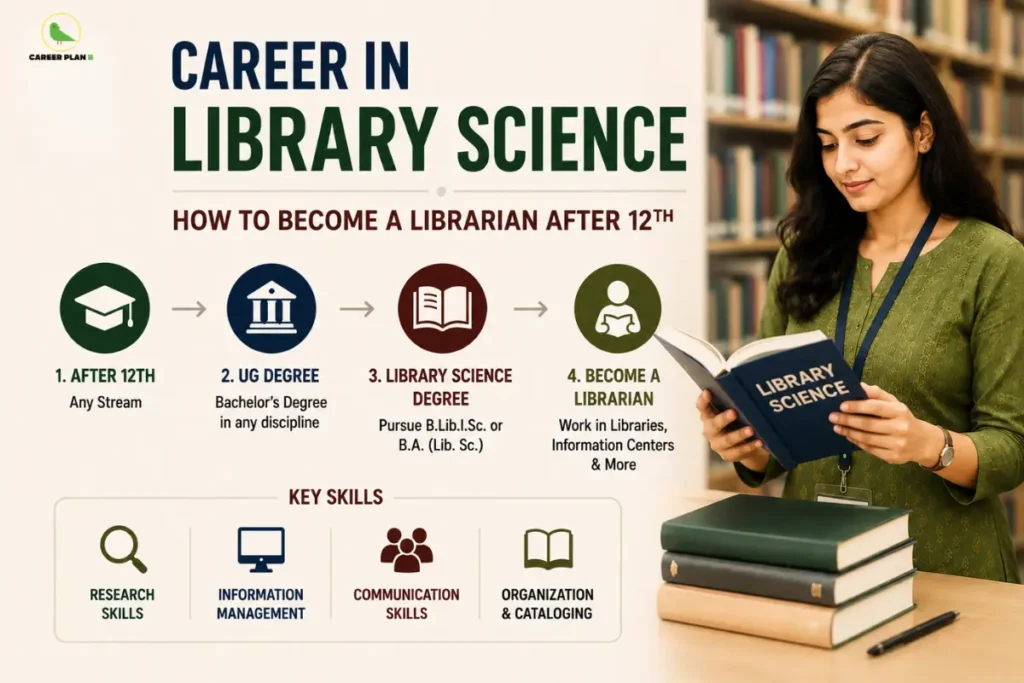
Introduction
Picture yourself as the person who connects a curious student with exactly the right research paper, helps a scholar navigate a vast digital archive, or manages thousands of rare manuscripts for a national institution. That person is a librarian — and in 21st-century India, that role is more important, more technical, and more impactful than ever.
The National Mission on Libraries (NML), launched by the President of India on 3 February 2014 under the Ministry of Culture, has a primary mandate to transform India into a knowledge-based society by modernising public library infrastructure, integrating information and communication technology (ICT), and enhancing access to digital and physical resources for diverse users — including students, researchers, professionals, children, and differently-abled individuals.
The NML works to modernise and digitally link nearly 9,000 libraries across India. It was established based on the recommendations of the National Knowledge Commission (2006–2009), which identified libraries as vital instruments for educational, cultural, social, and economic progress.
Source: Ministry of Culture, Government of India — indiaculture.gov.in ; culture.gov.in
What Is Library and Information Science?
Library and Information Science (LIS) is an academic discipline combining the management of knowledge resources with information technology to organise, preserve, retrieve, and disseminate information. It goes far beyond shelving books — modern library professionals work at the intersection of education, technology, research, and public service.
A qualified librarian today may be managing digital repositories and e-library platforms, working with AI-powered cataloguing systems, preserving rare manuscripts and archival materials, supporting researchers in academic institutions, or running community reading programmes.
Have Any Doubts?
Courses You Can Pursue: The Education Pathway
Can You Study Library Science Directly After 12th?
Yes. Some universities offer integrated 3–4 year Library and Information Science programmes after Class 12. However, most universities follow the traditional route.
The most widely recognised pathway is:
Complete a 3-year bachelor’s degree → Pursue a 1-year BLIS → Complete a 1-year MLIS → Qualify UGC-NET for senior academic and library positions
The BLIS Degree
The Bachelor of Library and Information Science (BLIS) is a one-year, two-semester professional programme. It covers library management, cataloguing, information organisation, digital library systems, archiving, indexing, and bibliographic control.
One of the most accessible options is IGNOU’s BLIS programme.
Source: IGNOU — ignouadmission.samarth.edu.in
After BLIS: The MLIS Degree
The Master of Library and Information Science (MLIS) is a 1-year postgraduate programme for BLIS graduates. It provides advanced knowledge in information management, digital libraries, research methodology, and library administration. MLIS is required for senior positions in academic and research institutions.
The UGC-NET: Your Ticket to Senior Positions
To work as a Librarian or Assistant Librarian in a university or college, qualifying the UGC National Eligibility Test (NET) in Library and Information Science is essential.
As per University Grants Commission (UGC) regulations, the NET in Library and Information Science is the national benchmark for librarian eligibility in higher education institutions. UGC also regulates the Career Advancement Scheme (CAS) for Assistant Librarians and College Librarians, linking promotions to NET qualification and academic performance.
Source: University Grants Commission — ugc.gov.in
Top Colleges and Universities Offering Library Science in India:
| Institution | Location | Programme |
|---|---|---|
| Indira Gandhi National Open University (IGNOU) | New Delhi (Distance Mode) | Bachelor of Library and Information Science (BLIS), Master of Library and Information Science (MLIS) |
| University of Delhi (Department of Library & Information Science) | New Delhi | BLIS, MLIS |
| Banaras Hindu University (BHU) | Varanasi, Uttar Pradesh | BLIS, MLIS, PhD |
| University of Calcutta | Kolkata, West Bengal | BLIS, MLIS |
| Aligarh Muslim University (AMU) | Aligarh, Uttar Pradesh | BLIS, MLIS |
| Jamia Millia Islamia | New Delhi | BLIS, MLIS |
Key Skills a Modern Librarian Must Have
Core Technical Skills:
- Cataloguing and Classification using Dewey Decimal, Library of Congress, and Universal Decimal Classification systems
- Digital Library Management — platforms like DSpace, Koha, and OPAC systems
- Database management and institutional repository maintenance
- Information retrieval and reference services
- Metadata creation and archiving
Soft Skills:
- Communication and user service
- Attention to detail for cataloguing and record-keeping
- Research aptitude and information literacy instruction
- Technology adaptability as the field evolves with AI and cloud platforms
Where Can You Do Your Internship?
1. National Library of India, Kolkata
The National Library of India, a subordinate organisation under the Ministry of Culture, Government of India, is India’s largest library. It runs a formal internship programme — the LIS Internship Programme for Young Professional Graduates — specifically designed for library science students and recent graduates.
Source: nationallibrary.gov.in
2. University and College Libraries
Academic libraries at central universities (Delhi University, BHU, JNU, AMU, Jamia) regularly accept library science students for practical placements, offering exposure to cataloguing, digital library systems, and reference services.
3. Libraries Under the National Mission on Libraries
As per the NML’s official scheme document, the Ministry of Culture provides financial assistance to upgrade State Central Libraries and District Libraries with modern technologies. Libraries upgraded under this scheme — with 1 Gbps connectivity under the National Knowledge Network and digital content access through the National Virtual Library of India (NVLI) — are ideal internship settings for students interested in digital library management.
Source: Ministry of Culture — indiaculture.gov.in ; National Mission on Libraries scheme document
4. Research Institution Libraries (ISRO, DRDO, CSIR, ICMR)
Government research bodies maintain specialised scientific and technical libraries. These are excellent for students interested in special libraries and scientific information management.
5. Raja Rammohun Roy Library Foundation (RRRLF)
The RRRLF, an autonomous body under the Ministry of Culture, is the nodal agency for the National Mission on Libraries. It provides financial assistance for library infrastructure, book procurement, and capacity building for library personnel across India.
Source: Ministry of Culture — rrrlf.gov.in
Career Opportunities
As per the UGC’s librarian recruitment and career advancement framework, library science graduates can work as:
- School Librarian — KVS, NVS, CBSE/ICSE and state board schools
- College/University Librarian — under UGC-regulated institutions
- Assistant/Deputy Librarian — in central or state government universities
- Special Librarian — in research labs (ISRO, DRDO, CSIR, ICMR)
- Digital Archivist — managing digital collections for government or private bodies
- Information Analyst — in corporate knowledge management centres
- Documentation Officer — in media, publishers, courts, and government offices
Source: University Grants Commission — ugc.gov.in
The Digital Library Revolution: Why This Is the Right Time
At the heart of the National Mission on Libraries is the National Virtual Library of India (NVLI), developed by IIT Bombay under the Ministry of Culture. The NVLI provides multilingual digital access to over 3.52 lakh digitised artefacts and 35.41 lakh bibliographic entries through an open-source platform, connected through the National Knowledge Network.
To begin with, the NML includes a nationwide survey covering more than 5,000 libraries and 7,120 citizens to identify existing needs and service gaps. In addition, the survey generates valuable data that helps strengthen library planning and policy decisions. Meanwhile, the mission supports capacity-building initiatives to professionally train librarians across India. Consequently, these combined efforts are helping build a stronger and more modern library ecosystem across the country.
As libraries continue to digitise their services, the demand for professionals who understand both traditional cataloguing systems and modern digital platforms is steadily increasing. Furthermore, the government continues to invest in modernising the profession. As a result, library and information science is emerging as an increasingly promising career for graduates.
Source: Ministry of Culture, NML Scheme Document — indiaculture.gov.in
How Career Plan B Helps
Library science suits specific strengths — a love of research, meticulous organisation, a methodical temperament, and a genuine interest in knowledge systems. Career Plan B’s Psycheintel and Career Assessment Tests help you identify whether these strengths align with your profile. Personalised Career Counselling maps the most efficient route — BA then BLIS, or integrated programmes. Admission and Academic Profile Guidance supports applications to top institutions like IGNOU, Delhi University, and BHU. Career Roadmapping builds a structured plan all the way to UGC-NET qualification and your first government librarian appointment.
Get In Touch With Us
Frequently Asked Questions
Q1. Can I do a library science course directly after 12th?
Some universities offer 3–4 year integrated programmes after 12th. In most cases, students first complete a three-year bachelor’s degree. After that, they pursue the one-year Bachelor of Library and Information Science (BLIS) programme. Either route is valid.
Q2. Is the IGNOU BLIS degree valid for government jobs?
Yes. As per IGNOU’s official programme information, the BLIS degree is UGC-recognised from a Central University and is valid for government librarian posts in schools, colleges, and public libraries. (Source: ignouadmission.samarth.edu.in )
Q3. What is UGC-NET in Library Science?
The UGC-NET in Library and Information Science, conducted by the National Testing Agency (NTA), is the national eligibility benchmark for librarians in UGC-regulated higher education institutions. It is required for appointment as Assistant Librarian or Librarian in universities and colleges. (Source: ugc.gov.in )
Q4. What is the National Virtual Library of India?
The NVLI, developed by IIT Bombay for the Ministry of Culture, provides multilingual digital access to over 3.52 lakh digitised artefacts and 35.41 lakh bibliographic entries through an open-source platform, as part of the National Mission on Libraries. (Source: Ministry of Culture — indiaculture.gov.in )
Q5. What stream should I choose in Class 12 for library science?
No specific stream is required for library science. Students from Arts, Science, or Commerce backgrounds are eligible. The minimum qualification for BLIS at most universities is a bachelor’s degree in any discipline.
Q6. What is the Raja Rammohun Roy Library Foundation?
The RRRLF is an autonomous body under the Ministry of Culture that acts as the nodal agency for the National Mission on Libraries, providing financial assistance to public libraries for infrastructure, book procurement, and librarian capacity-building. (Source: rrrlf.gov.in )
Have Any Doubts?
Conclusion
Every Great Civilisation Needs Its Keepers of Knowledge
From the ancient libraries of Nalanda and Takshashila to the National Virtual Library of India today, India has always understood that knowledge must be organised, preserved, and made accessible. That is the timeless purpose of a librarian.
Today, as the Ministry of Culture invests in connecting 9,000 libraries digitally, as universities expand their repositories, and as research institutions build vast information systems, the career has never been more relevant. It is stable, purposeful, intellectually stimulating, and increasingly backed by sustained government investment.
Discover whether library science is the right path for you. Take Career Plan B’s Career Assessment Test today.