Careerplanb · November 2, 2026
Introduction
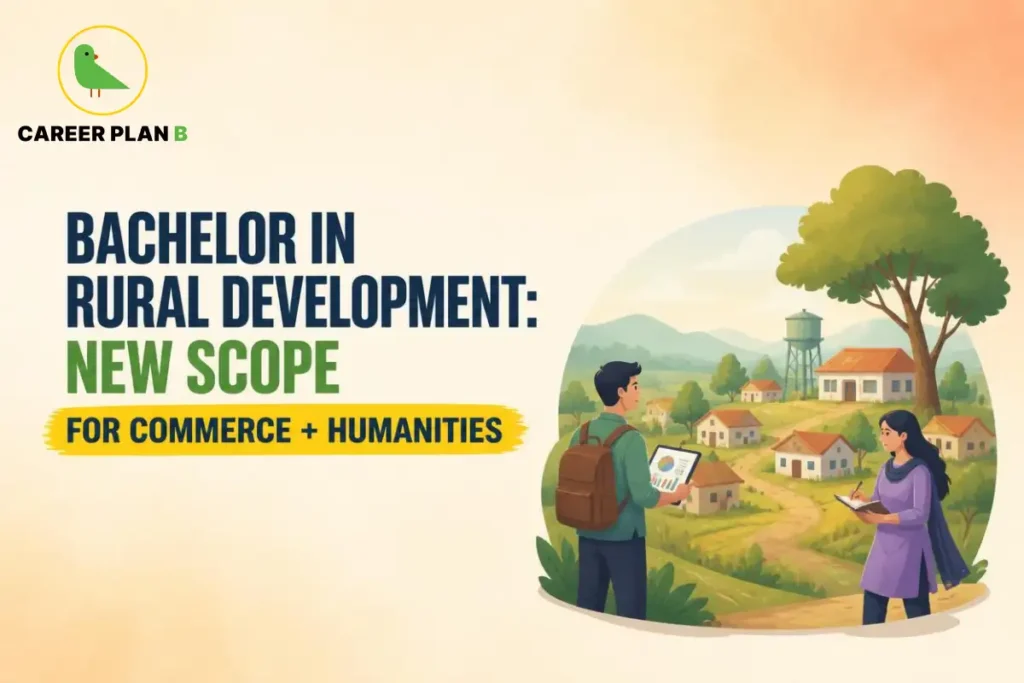
India is a country where nearly 65% of the population lives in rural areas. Every government scheme — from PM Awas Yojana to MGNREGA, from Jal Jeevan Mission to Digital India — needs educated professionals on the ground to plan, implement, monitor, and evaluate. Yet the demand for trained rural development professionals far exceeds the supply.
For students from Commerce or Humanities backgrounds who want a career that is both stable and socially meaningful, a degree in Rural Development offers a direct route into one of India’s most policy-driven and employment-rich sectors.
The Ministry of Rural Development (MoRD), Government of India, oversees the largest portfolio of welfare and infrastructure programmes in the country — from MGNREGS and PMGSY to PMAY-Gramin and the National Rural Livelihood Mission (NRLM). All of these programmes require trained professionals at district, block, and village levels for implementation and management.
Source: Ministry of Rural Development
What Is Rural Development as an Academic Discipline?
Rural Development as an academic field combines the study of:
- Rural society, economy, and governance structures
- Agricultural and non-farm livelihood systems
- Rural infrastructure and public administration
- Community development and social work
- Government policies and schemes for rural transformation
- Panchayati Raj institutions and decentralised governance
- Microfinance, cooperative banking, and rural credit systems
It is a discipline particularly suited to students from Humanities (Sociology, History, Political Science) and Commerce backgrounds, as the field integrates social analysis, policy understanding, and economic management.
Have Any Doubts?
Courses and Pathways After 12th
IGNOU: The Most Accessible and Widely Recognised Route
Indira Gandhi National Open University (IGNOU) offers the most comprehensive suite of Rural Development programmes in India, available through Open Distance Learning (ODL) mode — making them accessible to students across the country.
As per IGNOU’s official programme catalogue:
Certificate in Rural Development (CRD)
- Duration: 6 months
- Eligibility: 10+2 pass from a recognised board
- Covers: Socio-economic factors affecting rural society, rural development fundamentals
- This is the most accessible entry point — available directly after 12th
Post-Graduate Diploma in Rural Development (PGDRD) / PGDRDOL (Online)
- Duration: 1 year
- Eligibility: Bachelor’s degree in any discipline
- Covers: Rural policies and programmes, Panchayati Raj institutions, development planning, and evaluation of rural development projects
- Career relevance: Government departments, DRDAs, NABARD, CAPART, PMAY, NRLM, NGOs, CSR initiatives, and international development projects
MA in Rural Development (MARD)
- Duration: 2 years
- Eligibility: Bachelor’s degree from a recognised university
- Includes a mandatory dissertation based on empirical research in rural areas
- Designed for personnel working in government departments, NGOs, cooperative banks, and rural development agencies, or fresh graduates seeking a career in the discipline
Source: IGNOU — ignou.ac.in ; ignouadmission.samarth.edu.in
Other UG Pathways
Several state universities across India, particularly in states with strong rural development focus such as Bihar, Rajasthan, Uttar Pradesh, and Madhya Pradesh, offer BA programmes in Rural Development or Development Studies. Check with your state’s higher education department for locally available options.
The Tata Institute of Social Sciences (TISS) offers postgraduate programmes in Development Studies and Rural Development — with an entrance examination (TISSNET) — for students with a bachelor’s degree.
Key Government Bodies and Employers in Rural Development
Understanding who employs rural development professionals helps students appreciate the scale of opportunity in this field:
| Organisation | Role |
|---|---|
| Ministry of Rural Development (MoRD) | Formulates rural development policies and oversees the implementation of national schemes. |
| District Rural Development Agencies (DRDAs) | Implement rural development programmes and government schemes at the district level. |
| National Rural Livelihood Mission (NRLM) / Aajeevika | Promotes sustainable livelihoods through Self-Help Group (SHG) formation, skill development, and financial inclusion. |
| National Bank for Agriculture and Rural Development (NABARD) | Provides rural credit, development finance, and support for agriculture and rural infrastructure projects. |
| Panchayati Raj Institutions (PRIs) | Strengthen local self-governance and facilitate community-led rural development initiatives. |
| CAPART (Council for Advancement of People’s Action and Rural Technology) | Supports voluntary organisations and rural technology initiatives to reduce poverty and improve livelihoods. |
| Ministry of Housing and Urban Affairs (PMAY) | Implements housing initiatives under the Pradhan Mantri Awas Yojana (PMAY) to improve housing access for eligible beneficiaries. |
Source: Ministry of Rural Development ; NABARD
Career Opportunities After Rural Development Programmes
Trained rural development professionals are employed across:
Government Sector:
- Rural Development Officer (State Public Service Commission)
- Block Development Officer (BDO) — through state PSC examinations
- District Programme Coordinator under MGNREGS, PMAY, NRLM
- NABARD Development Assistant / Officer
- Panchayati Raj functionary
- Staff Selection Commission (SSC) posts in rural and agricultural ministries
Non-Government and International Sector:
- Programme Officer / Project Coordinator at NGOs
- CSR project manager at corporate foundations
- Field Researcher for development think-tanks
- International development programme associate (UN agencies, World Bank projects)
Entrepreneurship:
- Rural microenterprise facilitator
- Agri-tech startup founder
- Community development consultant
Why Commerce and Humanities Students Are Ideal
Rural development combines policy analysis, community engagement, economic management, and social research — skills that Commerce and Humanities students naturally develop. Specifically:
- Commerce students bring budgeting, financial management, microfinance, and accounting skills valuable in DRDAs and NABARD
- Humanities students (Sociology, Political Science, Geography, History) bring analytical frameworks for understanding rural society, governance, and development policy
This field does not require PCM — making it one of the most viable and purposeful career pathways for non-science students.
How Career Plan B Helps
Rural development is a purpose-driven career — but choosing the right academic pathway requires strategic planning. Career Plan B’s Psycheintel and Career Assessment Tests help identify whether you have the empathy, analytical thinking, and public service orientation that rural development careers demand. Personalised Career Counselling helps you choose between IGNOU’s distance programmes, state university BA courses, or TISS PG entry. Admission and Academic Profile Guidance ensures your application to IGNOU or state universities is complete and timely. And Career Roadmapping maps your journey from 12th to your first NABARD or government rural development posting.
Get In Touch With Us
Frequently asked Questions
Q1. Is there a direct bachelor’s degree in rural development after 12th?
IGNOU offers a Certificate in Rural Development (CRD) directly after 12th, and some state universities offer BA programmes in Rural Development. The most recognised PG pathways (PGDRD, MARD) require a bachelor’s degree first. (Source: ignou.ac.in)
Q2. What is IGNOU’s MA in Rural Development about?
As per IGNOU’s official programme description, the MARD programme covers socio-economic factors in rural society, rural governance, development policy, and includes a mandatory dissertation based on empirical field research. It is designed for those working in or aspiring to careers in government departments, NGOs, cooperative banks, and development agencies. (Source: ignouadmission.samarth.edu.in)
Q3. What jobs can I get with a rural development qualification?
Career options include Rural Development Officer, Block Development Officer, NABARD officer, NGO Programme Coordinator, Panchayati Raj functionary, CSR manager, and international development associate. (Source: Ministry of Rural Development
Q4. Is rural development relevant for UPSC preparation?
Yes. Rural development is a paper in the UPSC Civil Services Mains examination, and knowledge of rural governance, MGNREGS, PMAY, NRLM, and Panchayati Raj systems is directly testable. An academic background in rural development is a strong asset for civil services aspirants.
Q5. Does IGNOU’s PGDRD qualify for government jobs?
As per IGNOU’s official programme description, the PGDRD equips learners for roles in government departments, Panchayati Raj institutions, DRDAs, NABARD, CAPART, PMAY, and NRLM. (Source: ignou.ac.in)
Have Any Doubts?
Conclusion
India’s Villages Are Its Future — And They Need You
The Indian government’s investment in rural infrastructure, digital connectivity, and welfare delivery is unprecedented. Behind every successful village-level scheme is a trained professional who planned it, executed it, and ensured it reached the right people. That professional could be you. Whether you want to serve in government, work with an NGO, or build a rural enterprise, a career in rural development is as meaningful as it is full of opportunity.
Find out if rural development is the right path for you. Take Career Plan B’s assessment today.