Deepti · August 12, 2026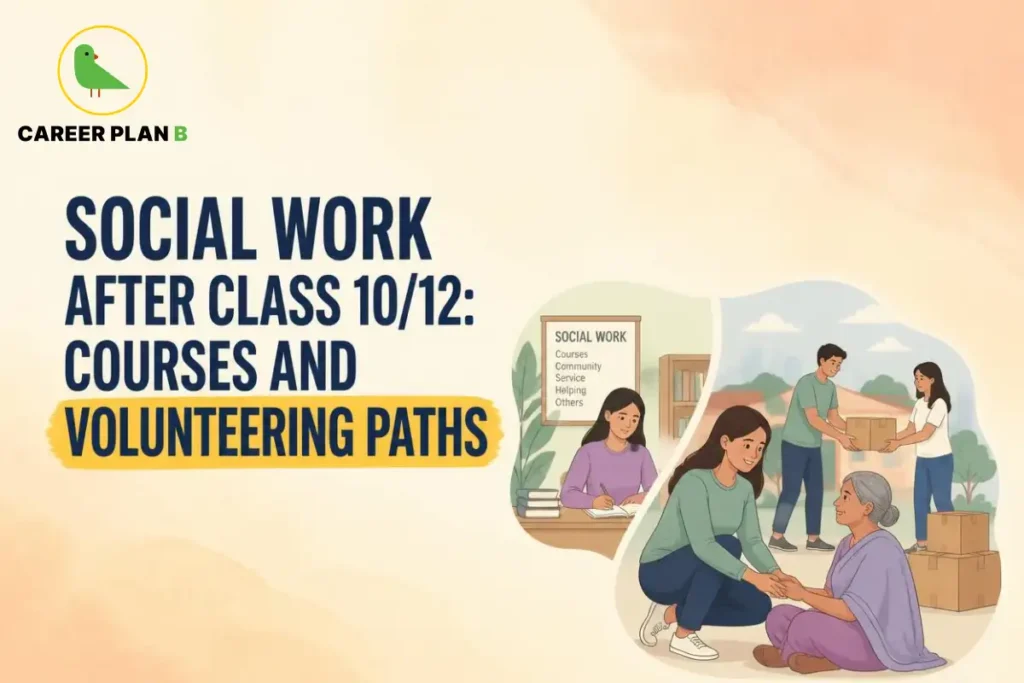
Introduction
Social work after class 10/12 is a genuine, structured academic and career path — not just an informal calling for “good-hearted” people, as it’s sometimes casually described. It combines real coursework in sociology, psychology, and social policy with hands-on fieldwork, and it leads to actual professional roles across NGOs, government welfare programmes, healthcare, and corporate social responsibility teams. This guide walks through the courses, eligibility, and genuine volunteering paths available to students right now.
Social Work After Class 10/12: Understanding It as a Formal Discipline
Social work is a practice-based academic discipline focused on social change, community empowerment, and addressing structural social problems — poverty, inequality, mental health access, and more. It’s distinct from general volunteering in that it involves structured theory (social policy, human behaviour, research methods) alongside supervised fieldwork, culminating in a recognised degree that qualifies you for professional roles.
BSW Course Eligibility: Getting the Basics Right
BSW course eligibility (Bachelor of Social Work) is refreshingly accessible compared to many other undergraduate paths — you can apply after Class 12 from any stream (Arts, Commerce, or Science), typically needing an aggregate around 45–55% depending on the specific institution and category. Admission is generally either merit-based (using Class 12 marks directly) or through an entrance exam, with CUET-UG being the most widely accepted route, alongside institution-specific tests like TISSNET for TISS or BHU’s PET for postgraduate social work admission.
The BSW Programme: What You’ll Actually Study
A typical BSW programme (3 to 4 years depending on the university and whether it follows the newer NEP-compliant structure) covers:
- Introduction to Social Work and its theoretical foundations
- Human Behaviour and Social Environment
- Sociology and Psychology fundamentals
- Social Policy and the Indian Legal System
- Social Work Methods (casework, group work, community organisation)
- Substantial fieldwork and internship components with NGOs, hospitals, or government welfare agencies
Fieldwork is genuinely central to this degree — most programmes treat it as a credited, mandatory component, not an optional add-on, since practical exposure to real community work is core to the discipline itself.
TISS Admission Process: India’s Leading Social Work Institution
The TISS admission process — for the Tata Institute of Social Sciences, India’s most established name in this field — is worth understanding in detail if this is your target institution. TISS now offers a four-year, NEP-compliant BSW at its Tuljapur campus (with a major in Social Work and minors in Rural Development or Micro Practices) and a BA in Social Work at its Mumbai campus. Eligibility requires a Class 12 pass (any stream) from a recognised board, with CUET-UG serving as the qualifying entrance exam for TISS undergraduate admission. Age limits apply (typically up to 20 for General category, with relaxations for reserved categories), so check the exact current-year notification for specifics.
Other Established Institutions to Consider
Beyond TISS, several credible institutions offer BSW and related programmes: Delhi School of Social Work, Madras School of Social Work, Rajagiri College of Social Sciences, and various state university-affiliated social work departments. Always verify UGC recognition and check the strength of each institution’s fieldwork and placement network before shortlisting, since practical exposure quality varies considerably between institutions.
For Personalized Guidance
NGO Volunteering for Students: Building Experience Before College
You don’t need to wait for a formal degree to start building genuine experience. NGO volunteering for students — even while still in Class 11 or 12 — is one of the most valuable things you can do if you’re seriously considering this field:
- Reach out directly to local NGOs working in areas you’re genuinely interested in (education, healthcare access, environmental work, child welfare)
- Start with short-term or weekend volunteering commitments rather than overcommitting alongside board exam pressure
- Keep a simple record of your volunteering experience — organisations, duration, and specific work done — since this genuinely strengthens both college applications and your own clarity about which specific area of social work interests you most
- Be honest with yourself about whether you find the work personally sustaining, since social work can be emotionally demanding, and it’s better to discover this through short-term volunteering than after committing to a full degree
MSW Career Scope: What Comes After the Undergraduate Degree
MSW career scope (Master of Social Work) opens up considerably more specialised and senior roles compared to a BSW alone — including clinical/medical social work, psychiatric social work, human resource management, policy research, and senior positions within NGOs, UN agencies, and government welfare programmes. An MSW is often the more meaningful qualifying credential for specialised or clinical social work roles, so many BSW graduates pursue it directly rather than entering the workforce immediately, though this depends on your specific career direction.
Social Work Career Options India: The Realistic Range
Social work career options India-wide extend well beyond the common image of grassroots-only NGO work:
| Sector | Typical Roles |
|---|---|
| NGOs & Non-Profits | Programme officer, community mobiliser, project coordinator |
| Government Welfare Schemes | Social welfare officer, district-level programme roles |
| Healthcare | Medical/psychiatric social worker, patient support coordinator |
| Corporate CSR | CSR programme manager, community engagement specialist |
| Education | School counsellor, education programme coordinator |
| Research & Policy | Social policy researcher, monitoring & evaluation specialist |
Starting compensation in the NGO and grassroots sector tends to be modest, though it typically improves with specialisation, postgraduate qualification, and moving into programme management, CSR, or policy research roles over time.
How Career Plan B Helps
Deciding whether social work is a genuine long-term fit — beyond just wanting to “do good” — benefits from honest self-reflection on whether you’re drawn more to direct community work, policy research, or organisational/CSR roles within this broad field. Career Plan B‘s Psycheintel and Career Assessment Tests can help clarify this before you commit to a specific degree. Our Admission and Academic Profile Guidance helps you evaluate BSW programmes and their fieldwork quality, and our Career Roadmapping service helps you plan whether an MSW or direct entry into the workforce makes more sense for your specific goals.
Get In Touch With Us
FAQs
Q1. Can I apply for a BSW course with any Class 12 stream?
Yes, BSW admission is open to Arts, Commerce, and Science stream students, with no specific subject requirement in most institutions.
Q2. Is CUET mandatory for BSW admission?
CUET-UG is the most widely accepted entrance route, including for TISS, though some institutions also admit through their own entrance tests or purely on Class 12 merit.
Q3. Is an MSW necessary for a career in social work?
Not always — some entry-level NGO and grassroots roles are accessible with just a BSW, but clinical, psychiatric, and senior policy roles generally require an MSW.
Q4. How can I start gaining social work experience while still in school?
Reach out to local NGOs for short-term or weekend volunteering opportunities and keep a simple record of your involvement to inform both future applications and your own career clarity.
Q5. What is the realistic salary range in social work careers in India?
Entry-level NGO roles tend to offer modest compensation, generally improving with postgraduate qualification, specialisation, and movement into CSR, programme management, or policy research roles over time.
Conclusion
Social work after Class 10/12 is a genuine, structured academic path with real fieldwork, recognised degrees, and diverse career outcomes — from grassroots NGO work to CSR and policy research. Start by testing your genuine interest through school-level NGO volunteering, then evaluate BSW programmes based on fieldwork quality and institutional credibility, keeping an MSW in mind for more specialised roles later. If you’d like structured help figuring out whether this field genuinely fits your strengths, Career Plan B’s counsellors can help you think it through.