Deepti · August 12, 2026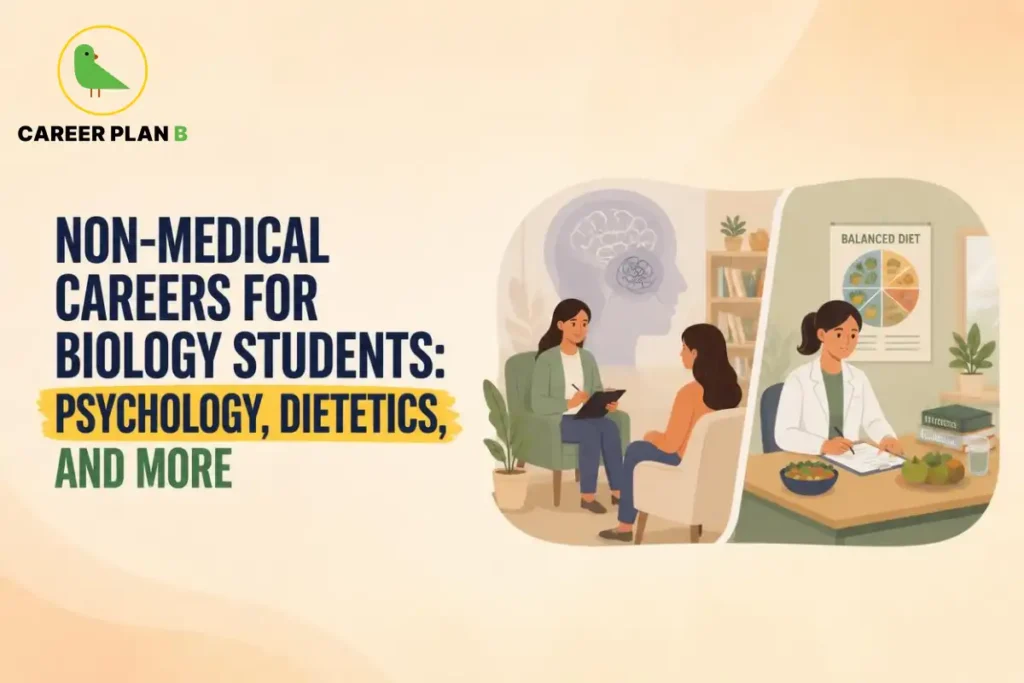
Introduction
Non-medical careers for biology students are far more numerous than most students realise — the common assumption that Biology in Class 12 only leads to MBBS or a handful of paramedical options overlooks a genuinely wide field of options across research, applied science, and even social sciences. Whether NEET didn’t work out, or you simply never intended to pursue clinical medicine, this guide walks through credible, well-established alternative paths.
Non-Medical Careers for Biology Students: Why the Options Are Wider Than You Think
A Biology background (especially with Chemistry) builds a genuinely versatile foundation — understanding of living systems, data analysis, and scientific methodology — that extends well beyond clinical medicine into psychology, nutrition, biotechnology, forensic science, environmental science, and more. The key mental shift is recognising that “medical” and “science” aren’t the same category; most of these paths are still deeply scientific, just not clinical.
Career Options After 12th Biology Non-Medical: The Full Landscape
Here’s a structured view of the genuine career options after 12th biology non-medical students should seriously evaluate:
| Field | Degree Route | What It Leads To |
|---|---|---|
| Psychology | BA/B.Sc Psychology | Clinical psychology, counselling, HR, research |
| Dietetics & Nutrition | B.Sc Food Science/Nutrition & Dietetics | Clinical dietitian, sports nutrition, public health |
| Biotechnology | B.Sc/B.Tech Biotechnology | Research, pharma, agri-biotech, genetic engineering |
| Forensic Science | B.Sc Forensic Science | Crime labs, forensic labs under state police/CFSL |
| Environmental Science | B.Sc Environmental Science | Conservation, policy, environmental consulting |
| Microbiology | B.Sc Microbiology | Research, pharma quality control, food safety |
| Genetics | B.Sc Genetics | Research, genetic counselling, biotech |
| Agriculture | B.Sc Agriculture | Agribusiness, agri-research, government agricultural services |
Colleges by Field: Quick Reference
| Field | Institution | Official Link |
|---|---|---|
| Psychology | University of Delhi (Lady Shri Ram College, Miranda House) | du.a1c.in |
| Psychology | Christ University, Bengaluru | christuniversity.in |
| Psychology | Banaras Hindu University | bhu.ac.in |
| Dietetics & Nutrition | Lady Irwin College (University of Delhi) | ladyirwin.edu.in |
| Dietetics & Nutrition | All India Institute of Medical Sciences (AIIMS), New Delhi — Dietetics dept. | aiims.edu |
| Biotechnology | Jawaharlal Nehru University (JNU) — School of Biotechnology | jnu.ac.in |
| Biotechnology | Vellore Institute of Technology (VIT) | vit.ac.in |
| Forensic Science | National Forensic Sciences University (NFSU), Gandhinagar — under Ministry of Home Affairs | nfsu.ac.in |
| Forensic Science | Lok Nayak Jayaprakash National Institute of Criminology & Forensic Science (LNJN NICFS), Delhi | nicfs.nfsu.ac.in |
| Environmental Science | TERI School of Advanced Studies, New Delhi | terisas.ac.in |
| Environmental Science | Punjab University — Dept. of Environment Studies | puchd.ac.in |
| Microbiology | Fergusson College, Pune | fergusson.edu |
| Microbiology | St. Xavier’s College, Mumbai | xaviers.edu |
| Genetics | University of Delhi (South Campus) — Dept. of Genetics | du.ac.in |
| Genetics | Osmania University, Hyderabad | osmania.ac.in |
| Agriculture | Indian Agricultural Research Institute (IARI), New Delhi — under ICAR | iari.res.in |
| Agriculture | Punjab Agricultural University (PAU), Ludhiana | pau.edu |
| Agriculture | Govind Ballabh Pant University of Agriculture & Technology | gbpuat-tech.ac.in |
Psychology Career After Biology: A Strong, Underexplored Option
A psychology career after biology is a particularly strong fit for students who enjoyed the human biology components of their Class 12 syllabus but don’t want a purely clinical medical path. Psychology offers routes into clinical and counselling psychology (with further RCI-recognised postgraduate training), organisational psychology, HR, and research — and your Biology background actually helps with the neuroscience and physiological components of psychology coursework.
Dietetics and Nutrition Career: Where Biology Meets Applied Science
A dietetics and nutrition career is one of the most direct extensions of a Biology background into a non-clinical (or semi-clinical, depending on specialisation) health field. Clinical dietitians work within hospitals and healthcare settings but aren’t doctors; the field also extends into sports nutrition, public health nutrition programmes, and the growing wellness and food industry. This path typically requires registration recognition depending on your specific practice setting, so it’s worth checking current NCAHP-linked requirements for the specific specialisation you’re considering.
For Personalized Guidance
Biotechnology Careers India: A Research-Driven Path
Biotechnology careers India-wide have expanded considerably alongside growth in the pharmaceutical, agricultural biotech, and genetic research sectors. A biotechnology degree opens doors to research roles (often requiring a postgraduate degree for meaningful research positions), pharmaceutical company R&D, agricultural biotechnology, and increasingly, biotech startups working on genomics and personalised medicine. This path rewards students who genuinely enjoy laboratory-based, experimental science over patient-facing clinical work.
Forensic Science Career Path: A Distinct, Specialised Direction
A forensic science career path appeals to Biology students interested in applying scientific method to criminal investigation rather than patient care. Forensic scientists typically work within state Forensic Science Laboratories, the Central Forensic Science Laboratory (CFSL) under the government, or increasingly, private forensic consulting. This field usually requires a B.Sc in Forensic Science followed by relevant specialisation, and government forensic lab positions are often filled through specific state or central recruitment exams rather than open hiring — worth researching early if this is your target.
Other Genuinely Viable Paths Worth Considering
- Environmental Science: for students interested in conservation, sustainability, and environmental policy work, increasingly relevant given growing corporate and government focus on this area
- Genetics and Genomics: overlapping with biotechnology but with a sharper focus on hereditary and genomic research, typically requiring postgraduate specialisation for research-level roles
- Microbiology: a strong fit for lab-oriented students, with career paths in pharmaceutical quality control, food safety testing, and academic research
- Science Journalism or Science Communication: for Biology students who also enjoy writing and communication, translating complex science for general audiences
A Word on Choosing Between These Options
Don’t choose based on which field sounds most “impressive” or has the highest assumed salary — these paths differ significantly in required further study (some need a strong postgraduate specialisation to access good roles, others don’t), work environment (lab-based vs. field-based vs. patient/client-facing), and day-to-day nature of work. Spend time genuinely researching what a typical week looks like in each field before committing.
How Career Plan B Helps
With this many credible options branching from a single Biology background, figuring out which one genuinely fits your interests and strengths — rather than defaulting to whichever option feels most familiar — takes structured self-assessment. Career Plan B‘s Psycheintel and Career Assessment Tests help identify which of these non-medical paths genuinely aligns with your natural strengths. Our Admission and Academic Profile Guidance helps you evaluate specific degree programmes and institutions for your chosen field, and our Career Roadmapping service maps the full multi-year path — including any postgraduate specialisation needed — for the direction you choose.
Get In Touch With Us
FAQs
Q1. Is Biology without Physics and Chemistry still useful for non-medical careers?
Most of these paths require Physics and Chemistry alongside Biology for undergraduate eligibility, so check your specific target course’s requirements, though psychology programmes are more flexible on this.
Q2. Do all these non-medical biology careers require a postgraduate degree?
Not all — some entry-level roles are accessible with just an undergraduate degree, but research-focused, clinical, or specialised positions (forensic labs, clinical dietetics, genetic research) generally benefit from or require postgraduate specialisation.
Q3. Which non-medical biology career has the best job security in India?
This varies by sector and depends heavily on your specific specialisation and geography; rather than chasing a generic “most secure” field, evaluate the actual demand and growth trajectory in your specific area of interest.
Q4. Can I switch from a non-medical biology career to a medical one later?
It’s difficult but not impossible — you’d generally need to separately qualify through NEET for MBBS/BDS, since these non-medical degrees don’t substitute for that specific admission requirement.
Q5. Is a biotechnology degree only useful for research roles?
No — biotechnology graduates also work in quality control, regulatory affairs, sales and technical roles within pharma and biotech companies, beyond pure research positions.
Conclusion
Non-medical careers for Biology students span a genuinely wide, credible landscape — psychology, dietetics, biotechnology, forensic science, and more — each offering real, scientifically grounded career paths distinct from clinical medicine. The right choice depends on your specific interests (lab-based vs. people-facing, research vs. applied) and willingness to pursue further specialisation where needed. If you’d like structured help figuring out which of these paths genuinely fits you, Career Plan B’s counsellors can help you build that clarity.