Deepti · August 12, 2026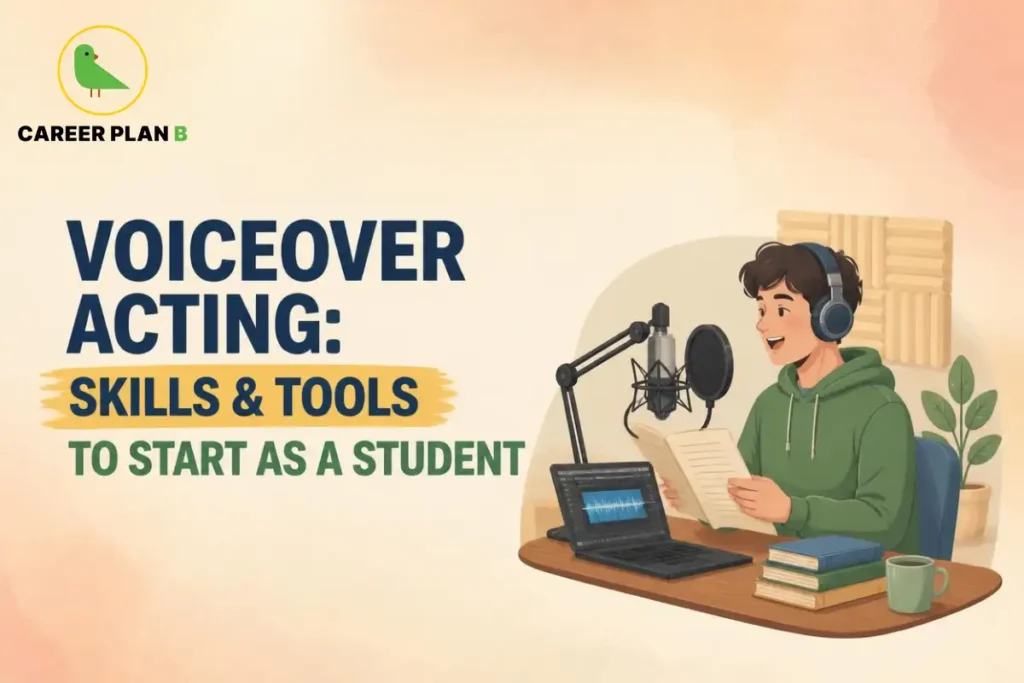
Introduction
Voiceover acting has quietly become one of the more accessible entertainment careers for students to start exploring early — largely because the barrier to entry has dropped dramatically with affordable home recording setups and a growing demand for dubbed content, audiobooks, animation, and digital advertising in India. Unlike on-camera acting, voiceover work doesn’t require a specific look, location, or even leaving your city to begin building a portfolio. This blog covers exactly what skills and tools a student needs to realistically start, and where this path can lead.
What Does Voiceover Acting Actually Involve?
Voiceover work spans a genuinely broad range of formats, each demanding a slightly different skill set:
- Animation and character voicing — for domestic and international animated content, requiring strong character range and comedic or dramatic timing
- Dubbing — converting foreign-language films, shows, and content into Indian languages (and vice versa), requiring precise lip-sync timing alongside acting skill
- Audiobook narration — long-form reading with sustained vocal consistency and pacing across hours of content
- Commercial and advertising voiceover — short, punchy reads requiring a distinct, memorable vocal identity
- Corporate and e-learning narration — clear, neutral delivery for training videos, IVR systems, and educational content
- Video game voicing — a growing segment in India as gaming content localisation increases, requiring adaptability across character types
Is There Formal Training for Voiceover Acting?
There’s no single mandatory degree for voiceover work, but there are meaningful institutional touchpoints worth knowing about. The Film and Television Institute of India (FTII), an autonomous institute under the Ministry of Information and Broadcasting, offers acting and related media courses that build foundational performance skills directly transferable to voiceover work, even though it doesn’t offer a dedicated standalone voiceover programme. Additionally, the Media and Entertainment Skills Council (MESC), under the Ministry of Skill Development and Entrepreneurship, governs skilling standards across media sub-sectors, including areas like dubbing and audio production that intersect closely with voiceover careers.
Building Voiceover Skills as a Student
Vocal control and range — Practising varied pitch, pace, tone, and emotional delivery is foundational; most working voice actors can convincingly shift between several distinct vocal “characters.”
Script interpretation and acting fundamentals — Voiceover is still acting — understanding character motivation, subtext, and emotional beats matters just as much as it does for on-camera performance, even though the audience never sees your face.
Breath control and vocal health — Sustained recording sessions demand proper breathing technique and vocal care to avoid strain, especially for audiobook narration or long dubbing sessions.
Basic audio editing — Understanding how to clean up and edit your own recordings (removing breaths, background noise, mouth clicks) is now a near-essential skill, since many freelance opportunities expect submission-ready audio, not just a raw take.
Accent and language versatility — For India’s dubbing and localisation market specifically, comfort across multiple Indian languages or strong command of neutral, regionally-unplaceable English/Hindi delivery significantly expands opportunity.
For Personalized Guidance
Essential Tools to Start (Even on a Student Budget)
| Tool Category | Entry-Level Option | Why It Matters |
|---|---|---|
| Microphone | USB condenser mic | Dramatically improves clarity over a phone or laptop mic |
| Recording software | Free DAW (Digital Audio Workstation) software | Let you record, edit, and export clean audio files |
| Acoustic treatment | Blankets, foam padding, a closet space | Reduces echo and background noise without expensive studio treatment |
| Headphones | Closed-back monitoring headphones | Allows accurate self-review of recordings while tracking |
| Portfolio hosting | A simple personal website or platform profile | Let’s casting directors and clients sample your voice range quickly |
Notably, none of this requires a professional studio to start — many working voice actors began with a home setup built for a modest budget, upgrading equipment gradually as paid work increased.
Building a Portfolio and Finding Early Work
Demo reels — A short, well-produced sample showcasing your vocal range across two or three formats (commercial, character, narration) is the single most important tool for getting noticed, and can be self-produced with a decent home setup.
Freelance platforms — Several online freelance and voice-casting platforms connect voice actors directly with clients needing commercial, e-learning, or narration work, offering a realistic starting point for building paid experience.
College and student media projects — Student films, YouTube content, and college radio or podcast projects offer low-stakes opportunities to practise and build an initial body of recorded work.
Local dubbing studios and production houses — Reaching out directly to regional dubbing studios, particularly in cities with strong film and OTT production activity, can open doors to entry-level or trainee dubbing work.
Career Scope and Income Reality
Entry-level voiceover work, especially through freelance platforms, tends to pay modestly per project initially, with income scaling as a voice actor builds a reputation, a broader client base, and higher-value work like established character roles in animation or dubbing for major productions. Full-time, salaried voiceover roles are relatively rare; most established voice actors work as freelancers juggling multiple clients and project types simultaneously, which offers flexibility but requires strong self-management and consistent outreach to sustain income.
How Career Plan B Helps
Voiceover acting is one of the more accessible entertainment careers to start exploring as a student, but building genuine vocal range, technical audio skills, and a compelling portfolio takes deliberate practice rather than just natural talent. Career Plan B uses Psycheintel and Career Assessment Tests to help assess whether your aptitude and temperament suit a performance-based, largely freelance career like voiceover work. Our Personalised Career Counselling helps you think through which voiceover niches (dubbing, narration, commercial, gaming) best fit your strengths, and Career Roadmapping lays out a realistic path from your first home-recorded demo reel to sustainable freelance income, including how to balance this alongside your ongoing studies.
Get In Touch With Us
FAQs
Q1. Do I need to go to acting school to become a voiceover artist?
Not necessarily, though acting fundamentals — taught at institutions like FTII or through drama/theatre training — meaningfully strengthen voiceover performance, since it’s still fundamentally an acting skill.
Q2. What’s the minimum equipment I need to start as a student?
A decent USB condenser microphone, free recording software, and a quiet, echo-dampened space (even a closet) are enough to begin building a demo reel and early portfolio.
Q3. Is dubbing or commercial voiceover more accessible for beginners?
Both are accessible starting points, but commercial and freelance narration work is often easier to break into initially, since dubbing frequently requires location-specific studio relationships and precise lip-sync skill.
Q4. Can I do voiceover work part-time while studying?
Yes — voiceover work is one of the more schedule-flexible entertainment careers, making it genuinely compatible with ongoing academic commitments, especially through freelance platform work.
Q5. How important is having a demo reel?
Extremely important — a well-produced demo reel showcasing your vocal range is typically the first thing clients or casting directors review and can be self-produced without professional studio access.
Q6. Is there steady, salaried employment in voiceover acting, or is it mostly freelance?
Most voiceover work in India is freelance and project-based; full-time, salaried voiceover positions are relatively uncommon, so building a stable freelance client base is the more realistic long-term structure.
Conclusion
Voiceover acting offers students a genuinely low-barrier entry point into the entertainment industry, requiring vocal skill, acting fundamentals, and basic audio tools rather than a specific look or formal degree. Starting with a modest home setup, a well-crafted demo reel, and consistent freelance outreach can realistically build toward a sustainable career over time. If you’re drawn to performance but prefer working behind the mic rather than in front of a camera, this is a path worth exploring seriously while still in school.