Team Career Plan B · July 22, 2026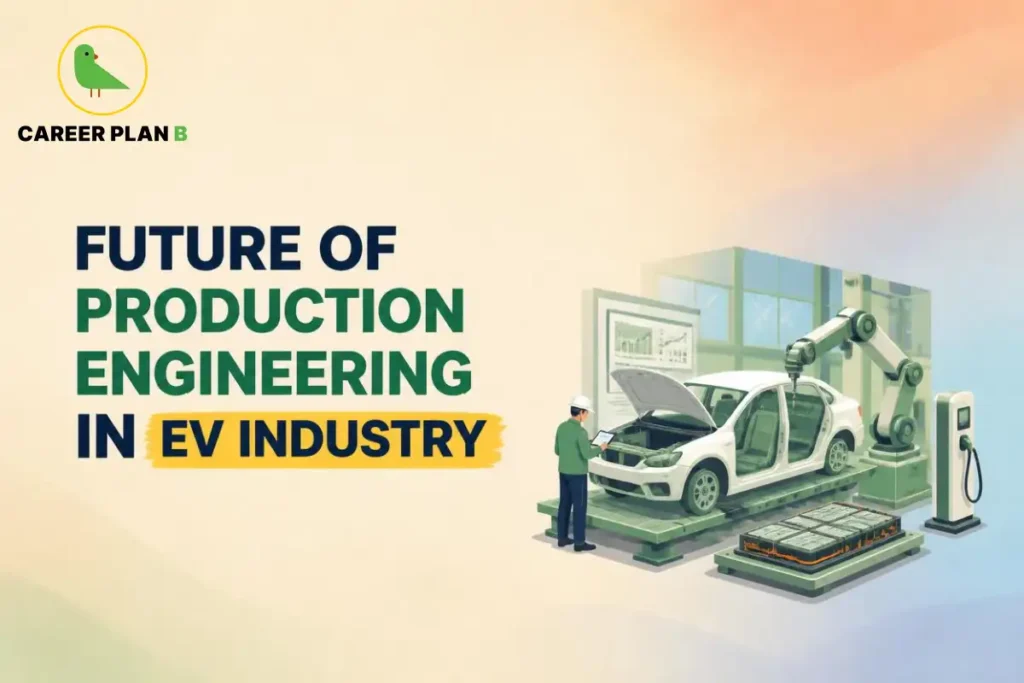
Introduction
India’s PLI-Auto scheme has already generated nearly 49,000 jobs and driven ₹35,657 crore in cumulative investment toward electric vehicle manufacturing. This rapid expansion points directly to the future of production engineering in the EV industry, a shift many engineering students haven’t fully registered yet. Most students still picture production engineering as a traditional manufacturing role tied to internal combustion engines and conventional assembly lines. However, India’s EV transition is fundamentally reshaping what this career looks like day to day. This blog explains exactly how the future of production engineering in the EV industry is taking shape and what it means for your career.
How Big Is India’s EV Manufacturing Push, Really?
PLI-Auto Scheme and Investment Growth
The PLI Scheme for the Automobile and Auto Component Industry, run by the Ministry of Heavy Industries, carries a total outlay of ₹25,938 crore focused specifically on zero-emission vehicles. As of December 2025, the scheme had recorded cumulative investments of ₹35,657 crore and supported over 13.6 lakh electric vehicles. Additionally, eight Champion OEM applicants, including Tata Motors, Mahindra & Mahindra, and Ola Electric Technologies, have already received Domestic Value Addition certification under this scheme.
Battery Cell Manufacturing Comes to India
Beyond vehicle assembly, India is now producing lithium-ion battery cells domestically for the first time at a meaningful scale. Companies like Ola Electric and Amara Raja have begun operating gigafactories, with the government’s Advanced Chemistry Cell PLI scheme carrying an outlay of ₹18,100 crore to accelerate this local production. Consequently, EV manufacturing in India now spans far more than final vehicle assembly, extending deep into battery and component manufacturing.
How Is the Future of Production Engineering in the EV Industry Taking Shape?
Is this really a fundamental shift, or simply new products on the same old assembly lines? The evidence suggests something more structural. Traditional production engineering focused heavily on internal combustion engine components, transmission systems, and fuel delivery mechanisms. In the EV industry, however, production engineers now work with battery packs, electric motors, and power electronics, requiring genuinely different manufacturing processes and quality standards.
Core Areas Where Production Engineers Are Shaping EV Manufacturing
Battery Cell and Pack Assembly Lines
Production engineers in this space design and optimize battery cell manufacturing lines, managing precise chemical handling, thermal safety protocols, and cell-to-pack assembly processes. For example, Ola Electric’s Gigafactory produces lithium-ion cells using 4680 form factor technology, requiring production engineers who understand both traditional manufacturing principles and battery-specific chemistry. This work demands considerably more precision than conventional automotive assembly, since even minor defects in battery cells can create serious safety risks.
Motor and Power Electronics Production
Beyond batteries, production engineers also oversee manufacturing lines for electric motors and power electronics systems that control vehicle performance. Sona Comstar, for instance, received PLI certifications for three separate EV traction motor variants, reflecting the growing complexity within this specific manufacturing segment. Therefore, production engineering scope in this space now spans mechanical, electrical, and thermal engineering knowledge simultaneously.
Which Companies and Clusters Are Driving This Shift?
Regional EV manufacturing clusters are emerging strongly in Tamil Nadu, Maharashtra, and Gujarat, with these states expected to evolve into vertically integrated EV megaclusters over the coming years. Major players like Tata Motors, Mahindra & Mahindra, Bajaj Auto, and TVS Motor Company continue expanding their EV production capacity under PLI-Auto benefits. Moreover, global entrants like Tesla and BYD are establishing India-based manufacturing operations, further strengthening electric vehicle careers across these emerging industrial hubs.
Skills Production Engineers Need for the EV Transition
Battery Chemistry and Thermal Management Knowledge
Succeeding in EV manufacturing increasingly requires understanding battery chemistry types, such as lithium iron phosphate cells favoured for their thermal safety in high-temperature Indian conditions. Additionally, thermal management expertise has become essential, since battery packs generate significant heat during charging and discharging cycles that production systems must manage safely.
Precision Assembly and Quality Certification
EV components also demand stricter precision and certification standards than conventional automotive parts, particularly given domestic value addition requirements under the PLI Auto scheme. Consequently, production engineers who understand these compliance frameworks alongside core manufacturing principles are increasingly valuable to companies navigating this certification process.
Have Any Doubts?
Career Roles and Growth Path
| Career Stage | Typical Role | What You’ll Do |
|---|---|---|
| Entry-Level | Junior Production Engineer (EV) | Support battery/motor assembly lines and quality checks |
| Mid-Level | EV Manufacturing Engineer | Optimize cell/pack production and manage thermal safety systems |
| Senior-Level | Plant Manager / EV Production Head | Oversee full manufacturing strategy, DVA compliance |
Given that the PLI-Auto scheme alone has already generated nearly 49,000 jobs, professionals who combine core production engineering career fundamentals with battery manufacturing expertise are well positioned for strong, sustained demand.
How Career Plan B Helps
Career Plan B helps students and professionals make informed career decisions by providing personalized guidance, assessments, and structured career planning for emerging fields like EV manufacturing, battery technology, and advanced production engineering.
Personalized Career Counselling: Provides expert guidance based on individual interests, skills, career goals, and understanding of evolving opportunities in electric vehicle manufacturing and production engineering.
Psychometric & Career Assessment Tests: Helps identify strengths, technical interests, personality traits, and suitable career opportunities aligned with EV manufacturing, battery production, and future engineering roles.
Career Roadmapping: Creates a clear step-by-step plan covering skill development, certifications, internships, and career strategies required to build a successful career in the EV industry.
Admission & Academic Profile Guidance: Helps students select the right engineering courses, colleges, and specialization pathways while improving their academic profile for better opportunities in electric vehicle manufacturing and advanced manufacturing industries.
Get In Touch With Us
Frequently Asked Questions
- Is EV manufacturing creating real production engineering jobs in India?
Yes, the PLI-Auto scheme alone has generated nearly 49,000 jobs, with continued growth expected as battery and component manufacturing scales further.
- What skills do production engineers need for battery manufacturing specifically?
Understanding battery chemistry, thermal management, and precision assembly standards significantly strengthens a production engineer’s profile in this space.
- Which Indian states are leading EV manufacturing clusters?
Tamil Nadu, Maharashtra, and Gujarat are emerging as the strongest EV manufacturing clusters, with vertically integrated supply chains developing rapidly.
- Do I need a specialized degree to work in EV production engineering?
A core mechanical or production engineering degree is generally sufficient, though additional knowledge of battery systems strengthens your profile considerably.
- Is this a stable, long-term career direction?
Yes, backed by sustained government investment through PLI schemes and continued private sector expansion across battery and EV component manufacturing.
Conclusion
Understanding the future of production engineering in the EV industry makes it clear that this career is evolving well beyond traditional automotive manufacturing into a genuinely specialized, technology-driven profession. As India’s PLI Auto scheme continues driving investment toward battery cells, motors, and power electronics, production engineers who build expertise in these specific areas are positioned for strong, long-term career growth. This shift represents a genuine opportunity for engineering students who want their core production engineering scope to stay relevant as India’s manufacturing base continues its electric transition.
If you’d like help figuring out how to position yourself for this specific career direction, a conversation with a Career Plan B counsellor can help you plan the right path forward.