Team Career Plan B · August 13, 2026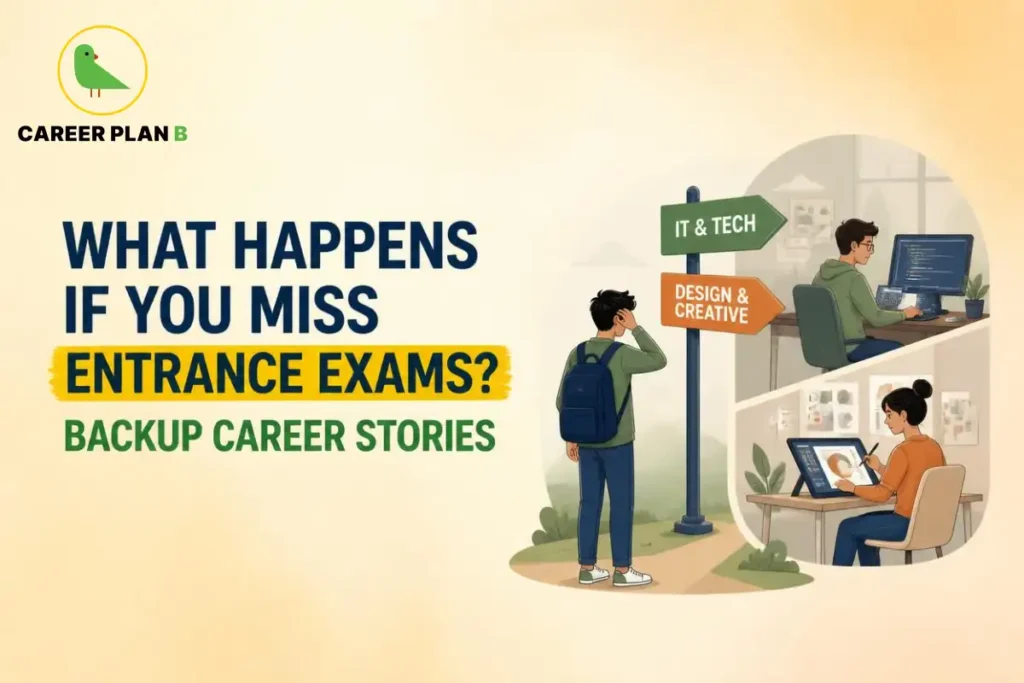
Introduction
If you miss entrance exams feels like the end of a plan you’d built for years. For many students, that one exam day has been the single focus of at least two years of preparation. So when it goes wrong, whether from illness, a scheduling mix-up, or a low score, it can feel like everything after it collapses too.
It doesn’t. Thousands of students miss JEE, NEET, or CUET every single year. Often, the reason is entirely outside their control. Many of them still go on to build stable, genuinely fulfilling careers. It’s just not through the exact door they’d originally planned.
This guide covers what actually happens if you miss entrance exams, in practical terms, not just reassurance. It walks through the real backup paths students use, what each one involves, and how to spot a productive gap year.
What Actually Happens When You Miss an Entrance Exam
Nothing catastrophic happens on paper. You simply don’t get a rank or score for that cycle. But the practical fallout depends on which exam, and how the miss happened.
If you miss the registration window entirely, you wait for the next cycle. For CUET specifically, missing the 2026 registration window means waiting for CUET 2027, which typically opens in January. If you registered but missed exam day, most exams don’t offer a makeup date. Documented emergencies are decided case by case.
If you sat the exam but scored below your target, you technically didn’t “miss” it. But the backup decisions that follow are the same ones covered below.
Backup Story 1: The Bridge-Course Route
Consider a composite, illustrative case. A student misses JEE Main registration, distracted by a family emergency during the window. With no engineering entrance score, they enroll in a CUET-linked BSc programme at a state university instead.
CUET UG allows admission to BSc courses at many central and state universities, without requiring JEE. A year later, this student transfers focus toward a data science specialisation within their BSc. They never wrote JEE again, and still built a technical career.
Backup Story 2: The Structured Gap Year
Take another illustrative case. A student misses their NEET UG target score by a small margin. Instead of accepting a low-preference private seat, they take a planned gap year.
Rather than open-ended studying, they combine NSDC-aligned certification work with monthly mock tests and weekly review sessions. This kind of structured gap year holds up far better in later conversations. That’s true whether the conversation is academic or professional.
Backup Story 3: The Open University Path
A third illustrative case: a student misses their college’s admission deadline entirely, after a slow board-result verification process. Rather than lose a full year, they enroll in a UGC-recognised open university programme.
IGNOU degrees carry full UGC recognition, and are accepted by both public and private employers. A BA or BSc from IGNOU holds the same formal standing as one from any other UGC-recognised university. This student completed their degree on a flexible timeline, while working part-time, and moved into a stable career afterward.
The Real Options on the Table
Strip away the specific stories, and the backup paths fall into a few clear categories.
- Alternate entrance exams: many private and state universities run their own admission tests, separate from JEE, NEET, or CUET.
- CUET-linked BSc or BA programmes: a well-established route into central and state universities, without needing an engineering or medical score.
- Open and distance learning: IGNOU and similar UGC-recognised institutions let you complete a degree on a flexible timeline.
- Vocational and skill certification routes: NSDC-aligned certifications build a credential while you decide your next academic step.
- A structured gap year: reattempting the same exam, but only if the year includes measurable, trackable preparation.
Comparing the Backup Paths
| Path | Best Suited For | Time to Outcome | Formal Recognition |
|---|---|---|---|
| CUET-linked BSc/BA | Missed JEE/NEET but want a related field | Immediate admission | Full university degree |
| Structured Gap Year | Close miss, strong reattempt potential | 1 year, then re-exam | Depends on re-exam result |
| Open University (IGNOU) | Missed all admission windows | Flexible, self-paced | UGC-recognised degree |
| Vocational/Skill Certification | Want to start earning sooner | A few months to a year | Industry-recognised, not a degree |
| Alternate University Entrance Exam | Have a backup college shortlist ready | Same admission cycle | Full university degree |
What a Gap Year Actually Requires
A gap year isn’t automatically productive just because you intend to study. Structured activity, with verifiable output, is what makes it defensible later. That applies whether you’re answering to yourself or an interviewer.
That means setting a study schedule, tracking mock scores, and ideally adding a certification alongside re-preparation. It also means checking age limits or eligibility rules for your target exam. Do this before committing a full year to it.
Have Any Doubts?
Benefits, Challenges, and What the Data Says
The genuine benefit across all these paths is real: none of them are academic dead ends. CUET-linked degrees, IGNOU qualifications, and well-used gap years all carry formal recognition or a documented outcome.
To be transparent about a limitation: there’s no official, consolidated dataset tracking outcomes for students who take each backup path. Claims like “many students improved significantly after a gap year” come from counseling observations, not a government study. Treat specific success-rate claims with caution.
The real challenge is decision paralysis in the weeks right after a missed exam. Acting on a clear plan, even an imperfect one, tends to matter more than waiting for a perfect option.
How Career Plan B Helps
Deciding what to do after a missed exam is easier with a second, calmer perspective. Career Plan B helps through:
Personalised Career Counselling: working through your specific situation, not a generic list of backup options. Psychometric and Career Assessment Tests: checking whether a related field might suit you better than your original target. Career Roadmapping: a clear plan, whether that’s a structured gap year, an open university degree, or an alternate entrance exam. Admission and Academic Profile Guidance: support building a strong profile for whichever path you choose.
If you’ve missed an entrance exam and aren’t sure what’s next, Career Plan B is a reasonable place to start.
For Latest Information
Frequenlty Asked Questions
Q1. What happens if I miss the CUET registration window?
You’ll need to wait for the next cycle, which typically opens in January. This extends your gap year by a full year, so early planning matters.
Q2. Is a degree from IGNOU as valid as a regular university degree?
Yes. IGNOU is a UGC-recognised central university. Its degrees are accepted by employers and for further studies, on par with any accredited university.
Q3. Can I take a gap year after accepting a CUET seat, and reappear later?
Yes. You can decline an allotted seat and reappear the next year. You’ll need to redo the full admission process, including the exam.
Q4. Does a gap year hurt my chances in interviews or future admissions?
Not if it’s structured. A gap year with certifications, mock tests, and a clear plan reads very differently from an unstructured year off.
Q5. What if I miss the exam entirely due to an emergency?
Some exams offer a re-test in documented emergency cases, though this isn’t guaranteed. Check the specific exam authority’s policy, and act quickly with evidence.
Conclusion
Missing an entrance exam doesn’t close off your career, whatever it feels like in the moment. It can feel that way, especially in the first few days. A missed registration, a bad exam day, or a low score all sting. But the paths covered here, CUET-linked degrees, open universities, structured gap years, and vocational routes, are not consolation prizes. They’re real, recognised, and used by large numbers of students every single year.
What actually separates a wasted year from a genuinely useful one isn’t which backup path you choose. It’s whether you choose one deliberately, with a clear plan and a way to measure progress. Drifting for months rarely works out.
If you’re in that position right now, the most useful thing you can do isn’t to panic-decide today. It’s to get a second, calmer perspective on what your situation actually allows for. Then commit to it fully.
Connect with Career Plan B today to build your own backup plan, with a clear head and a real strategy.