Team6 · November 2, 2026
Introduction
India is rapidly shifting towards electric mobility. Electric two-wheelers, cars, buses, and commercial vehicles are becoming increasingly common on Indian roads. At the heart of this transformation is the battery, especially lithium-ion technology, which determines vehicle performance, driving range, and charging speed.
Many people think batteries are purely electrical systems. In reality, they are complex chemical systems that rely on electrochemistry, materials science, thermal management, and precision manufacturing. This is where chemical engineers in the battery and EV industry play a critical role.
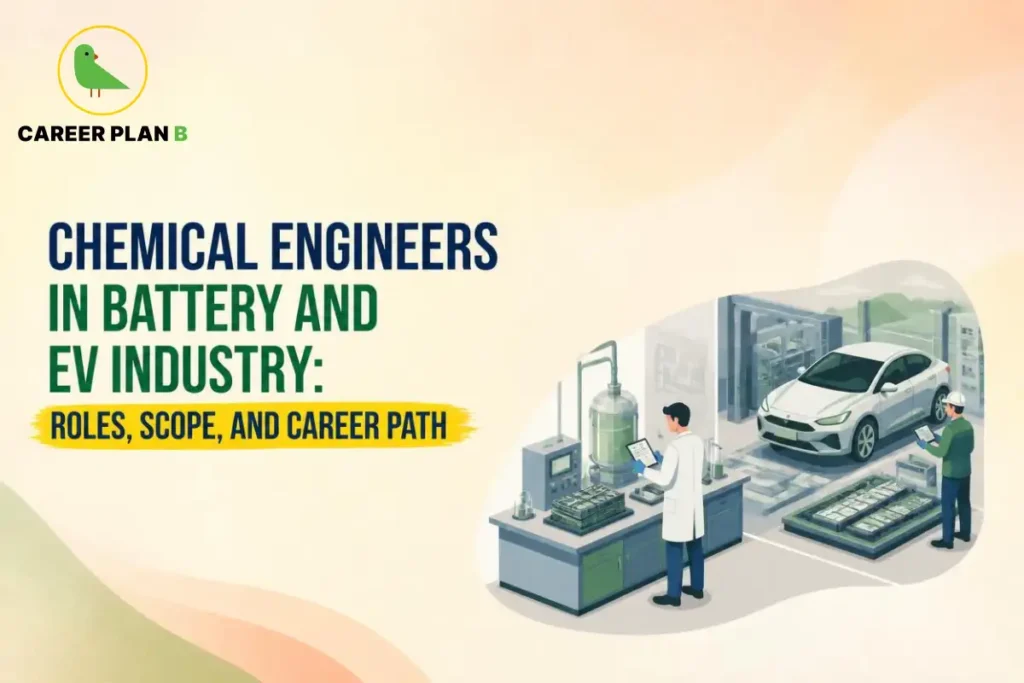
Chemical engineers develop advanced electrolytes and electrode materials to improve battery efficiency, safety, and lifespan. They also optimise manufacturing processes in gigafactories, increase energy density, and reduce battery degradation over repeated charging cycles.
Their contribution goes beyond battery production. Chemical engineers also work on thermal management, battery recycling, and sustainable energy storage solutions. As India moves towards cleaner transportation and greater energy independence, the demand for skilled professionals in this field is expected to grow rapidly.
For chemical engineering students, the battery and EV sector offers one of the most exciting and future-ready career paths. It combines core chemical engineering principles with advanced energy technologies, innovation, and sustainable mobility.
Why the EV Industry Needs Chemical Engineers
Most people think of EVs as an electrical or mechanical engineering domain. The motors, the chassis, the software those parts are visible. What is less visible but equally critical is the battery chemistry that powers the entire vehicle. Battery technology for chemical engineers is a natural fit because batteries are fundamentally electrochemical devices. The reactions happening inside a lithium-ion cell ion movement, electrode degradation, and electrolyte stability all fall squarely within the domain of chemical engineering. Without chemical engineers, scaling battery production from lab prototypes to mass manufacturing would be nearly impossible.
Key Roles of Chemical Engineers in the Battery and EV Sector
Battery Cell Design and Electrochemistry
At the heart of every EV is a battery pack made up of individual cells. Chemical engineers work on the electrochemical design of these cells, selecting the right cathode and anode materials, understanding charge-discharge cycles, and improving energy density. A lithium-ion battery chemical engineer studies how materials like lithium iron phosphate (LFP) or nickel manganese cobalt (NMC) behave under real-world conditions and works to maximise both performance and lifespan. This is highly research-orientated work that combines thermodynamics, reaction kinetics, and materials science.
Electrolyte and Material Development
The electrolyte is the medium through which ions travel between electrodes inside a battery. Chemical engineers are responsible for developing electrolytes that remain stable across wide temperature ranges, do not degrade quickly, and reduce the risk of thermal runaway. This is a particularly active research area as the industry moves from liquid electrolytes toward solid-state alternatives, which promise safer and more energy-dense batteries.
Battery Management and Safety
Chemical engineers also work on battery management systems from a chemistry perspective, monitoring cell health, preventing overcharging, and managing heat generation. The chemical engineer role in energy storage extends to understanding failure modes, designing safer cell architectures, and ensuring batteries meet international safety standards before they go into vehicles.
Manufacturing Process Engineering
Scaling battery production requires precise process control. Electrode coating, cell assembly, electrolyte filling, and quality testing all need robust engineering systems. Chemical engineers design and optimise these manufacturing processes, ensuring consistent quality at high volumes. This is similar to process engineering in chemical plants but applied to the highly precise world of battery fabrication.
India’s EV Push: What It Means for Chemical Engineers
The Indian government has put significant policy weight behind the EV transition, which directly translates into job creation for engineers. Two major schemes are driving this momentum:
FAME II (Faster Adoption and Manufacturing of Electric Vehicles): Launched by the Ministry of Heavy Industries, FAME II provides demand incentives for electric two-wheelers, three-wheelers, four-wheelers, and buses. This policy has been instrumental in boosting EV adoption across India and encouraging domestic manufacturing.
PLI Scheme for Advanced Chemistry Cell (ACC) Battery Storage: The Production Linked Incentive scheme for ACC battery storage, administered by NITI Aayog and the Ministry of Heavy Industries, aims to build domestic battery manufacturing capacity of 50 GWh in India. This scheme directly creates demand for chemical engineers in battery and EV industry roles across R&D, manufacturing, and process design.
India’s national EV targets under the National Electric Mobility Mission Plan also reinforce long-term demand for battery engineers and researchers.
Top Companies and Organisations Hiring Chemical Engineers in EVs
EV industry jobs for engineers in India are available across both private companies and government-backed research bodies:
- ISRO (Indian Space Research Organisation): ISRO’s battery and energy storage research is relevant to both space and terrestrial EV applications. Chemical engineers working here contribute to advanced cell development.
- DRDO (Defence Research and Development Organisation): Several DRDO labs work on energy storage and battery technologies for defence applications with potential civilian crossover.
- NTPC Limited: India’s largest power company is expanding into EV charging infrastructure and battery storage, creating roles for chemical engineers in energy storage systems.
- BHEL (Bharat Heavy Electricals Limited): BHEL is involved in battery storage projects and electric transportation, offering roles for chemical and materials engineers.
- Tata Motors and Tata Chemicals: Both companies under the Tata Group are investing heavily in EV platforms and battery materials, offering chemical engineering roles in R&D and manufacturing.
- Ola Electric and other startups are also building battery manufacturing facilities in India, where process and electrochemical engineering talent are in demand.
Have Any Doubts?
Skills Chemical Engineers Need for EV and Battery Careers
To build a strong career in chemical engineering careers in electric vehicles, students and professionals should focus on developing the following skills:
- Electrochemistry and Cell Chemistry: Deep understanding of redox reactions, ion transport, and electrode kinetics
- Materials Science: Knowledge of cathode, anode, and separator materials, including lithium compounds and graphite
- Process Safety and Scale-Up: Ability to design safe, scalable manufacturing processes for battery cells
- Thermal Management: Understanding heat generation and dissipation in battery packs
- Simulation Tools: Proficiency in tools like MATLAB, COMSOL, or ANSYS for battery modelling
- Knowledge of Standards and Regulations: Familiarity with AIS-048 and AIS-156 battery safety standards for EVs in India.
The future of EVs and chemical engineering is deeply intertwined. Students who build interdisciplinary skills combining chemistry, materials, and process engineering will find themselves in high demand as India scales its battery manufacturing ecosystem.
How Career Plan B Helps
Navigating a career shift into the battery and EV industry requires more than just technical knowledge; it requires a focused plan. Career Plan B offers personalised career counselling, psychometric assessments, and career roadmapping tailored for engineering students. Whether you are a chemical engineering student exploring EV roles or a professional looking to pivot into energy storage, Career Plan B helps you chart a clear, informed path forward.
For Latest Information
Frequently Asked Questions (FAQs)
Q1. Can chemical engineers work in the EV industry?
Absolutely. Chemical engineers are essential to the EV industry, particularly in battery cell design, electrolyte development, manufacturing process engineering, and energy storage systems. As India scales domestic battery production, demand for chemical engineers in this sector will grow significantly.
Q2. What is the role of a chemical engineer in lithium-ion battery development?
A lithium ion battery chemical engineer works on electrode material selection, electrolyte formulation, cell chemistry optimisation, and safety testing. They also handle scale-up from laboratory-level prototypes to mass manufacturing processes.
Q3. Which government schemes are supporting EV and battery careers in India?
The FAME II scheme and the PLI scheme for Advanced Chemistry Cell battery storage are the two major government initiatives driving EV adoption and domestic battery manufacturing in India, both of which create significant engineering employment.
Q4. What skills should a chemical engineer develop to enter the EV sector?
Focus on electrochemistry, materials science, thermal management, process safety, and simulation tools. Familiarity with Indian EV battery safety standards from BIS is also an added advantage for roles in manufacturing and quality assurance.
Conclusion
The EV revolution is not just an automotive story; it is a chemistry story. Chemical engineers in battery and EV industry roles are at the centre of one of the most important industrial transitions of this generation. From designing better lithium-ion cells to scaling battery factories under India’s PLI scheme, the opportunities are real, growing, and well-paying. If you are a chemical engineering student looking beyond the traditional oil and pharma route, the battery and EV sector deserves your serious attention. Start building the right skills today, and you could be shaping the future of clean mobility in India tomorrow.