Team6 · November 2, 2026
Introduction
Choosing between chemical engineering and food technology engineering is a dilemma many students overlook during admissions, yet it can significantly shape long-term career direction. Both fields are rooted in chemistry, biology, and process engineering, but they apply these principles in very different industrial contexts.
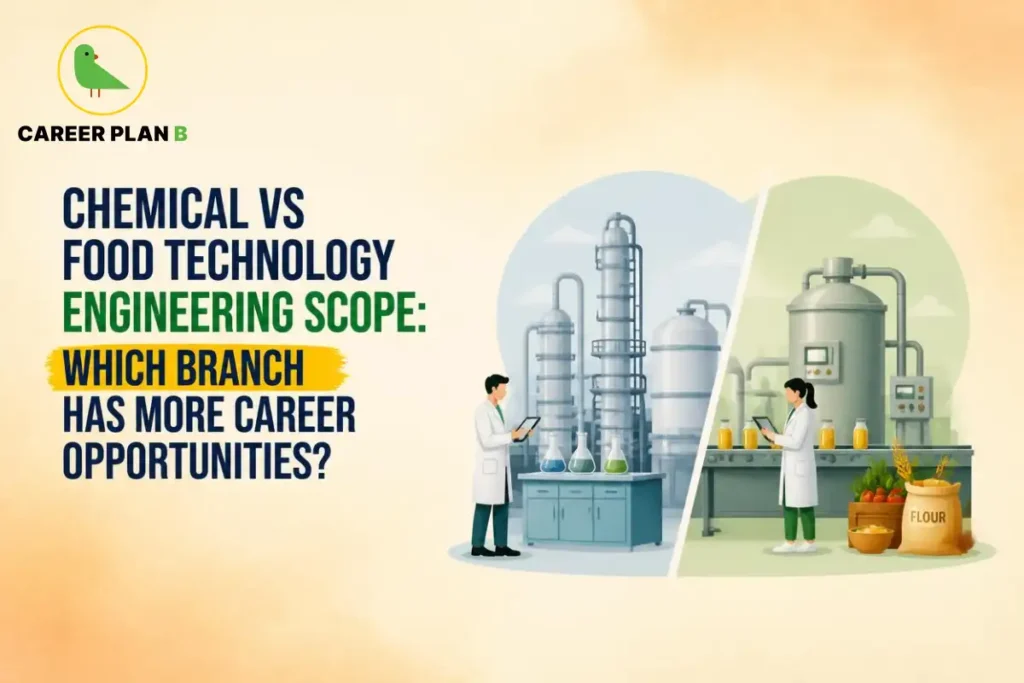
Chemical Engineering focuses broadly on designing and optimizing large-scale industrial processes used in sectors like energy, petrochemicals, materials, pharmaceuticals, and emerging technologies. It deals with transforming raw materials into valuable products through controlled chemical, physical, and biological processes at an industrial scale.
In contrast, Food Technology Engineering is more specialized, concentrating on food processing, preservation, packaging, quality control, and safety. It applies engineering and scientific principles specifically to ensure that food products are safe, nutritious, scalable, and suitable for mass consumption.
While both branches offer solid career opportunities, they differ in industry reach, job roles, and growth pathways. This comparison helps clarify how each field aligns with different career interests and what students can realistically expect from each in the Indian job market.
Understanding the Two Branches: What Do They Actually Study?
Chemical engineering focuses on designing and operating processes that transform raw materials into useful products. Core subjects include thermodynamics, reaction engineering, fluid mechanics, heat and mass transfer, process control, and chemical plant design. Graduates are equipped to work across oil and gas, pharmaceuticals, speciality chemicals, polymers, and emerging sectors like EV batteries and nanotechnology.
Food technology engineering, on the other hand, applies similar process engineering principles specifically to the production, preservation, packaging, and safety of food products. Core subjects include food chemistry, microbiology, food processing technology, food safety regulations, and quality management. Graduates are equipped to work in FMCG companies, food processing plants, regulatory bodies, and research institutions focused on nutrition and food science.
Both branches develop strong process thinking, but they apply it in very different industrial contexts.
Career Scope for Chemical Engineers in India
The chemical engineering scope in India is wide and spans multiple high-value industries. This breadth is one of chemical engineering’s biggest advantages over more specialised branches.
Key sectors hiring chemical engineers include:
- Oil, Gas, and Petrochemicals: Companies like ONGC, IOCL, BPCL, GAIL, and HPCL are among the largest employers, offering high salaries and structured career growth
- Pharmaceuticals and Specialty Chemicals: A large and stable sector with consistent demand for process and quality engineers
- EV and Battery Technology: A rapidly emerging sector where chemical engineers work on lithium-ion cell chemistry and battery manufacturing under India’s PLI scheme
- Nanotechnology and Advanced Materials: Research and industrial roles in DRDO, ISRO, and CSIR laboratories
- Water Treatment and Environmental Engineering: Public and private sector roles in water infrastructure and pollution control
- PSU and Government Roles: Through GATE and UPSC ESE, chemical engineers access some of the most secure and well-paying government positions in India
The diversity of sectors available to chemical engineers means that even if one industry faces a slowdown, multiple alternatives remain open, a significant career safety net.
Career Scope for Food Technology Engineers in India
The scope of food technology after BTech is more focused but increasingly relevant as India’s food processing sector grows. India is one of the world’s largest food producers, and the government has been actively promoting food processing as a priority sector under the Pradhan Mantri Kisan Sampada Yojana and the PLI scheme for food processing.
Key sectors hiring food technology engineers include:
- FMCG and Food Processing Companies: Large employers like Nestlé India, ITC, Britannia, Amul, and Hindustan Unilever hire food technologists for production, quality, and R&D roles
- Food Safety and Regulatory Affairs: Roles in companies ensuring compliance with FSSAI regulations and international food safety standards
- Cold Chain and Packaging Industry: A growing sector driven by organised retail and e-commerce food delivery
- Research and Development: Academic and industrial R&D in food fortification, functional foods, and nutraceuticals
- Government Bodies: FSSAI, APEDA, AGMARK, BIS, and state food testing laboratories regularly recruit food technology graduates
Food technology careers in India are growing steadily, but the total number of industries and roles available is narrower compared to chemical engineering, which limits flexibility if a student’s interests evolve over time.
Government Jobs: Chemical vs Food Technology
Government Jobs for Chemical Engineers
Chemical engineers have access to a wide range of central and state government roles. The UPSC Engineering Services Examination (ESE) includes chemical engineering as a discipline, placing successful candidates in Group A central government positions. Major PSUs recruiting chemical engineers through GATE include ONGC, IOCL, BPCL, GAIL, HPCL, DRDO, and BARC. State government departments in pollution control, water treatment, and industrial safety also hire chemical engineers regularly through state public service commissions.
Government Jobs for Food Technology Engineers
Government jobs in food technology are more concentrated but still meaningful. The key recruiting bodies include:
- FSSAI (Food Safety and Standards Authority of India): The primary regulatory body for food safety in India recruits food technologists as technical officers and food analysts.
- APEDA (Agricultural and Processed Food Products Export Development Authority): Recruits for roles related to food export standards and quality certification.
- AGMARK and Directorate of Marketing and Inspection: Hires food technology graduates for quality grading and standardisation roles.
- BIS (Bureau of Indian Standards): Recruits food technologists for food product standardisation and testing.
- State Food Testing Laboratories: Every state has government food laboratories that employ food technologists for analytical and safety testing roles
In terms of government job volume, chemical engineering holds the advantage due to its broader departmental reach and the higher number of PSUs accepting GATE CH scores compared to GATE XE.
Have Any Doubts?
Salary Comparison: Chemical vs Food Technology
Food tech vs chemical engineering salary shows a consistent pattern across career stages; chemical engineers generally earn more, particularly at the entry level and in PSU roles. However, food technology professionals in senior FMCG or R&D roles can close the gap significantly.
| Career Stage | Chemical Engineering | Food Technology Engineering |
|---|---|---|
| Fresher (0–2 years) | ₹4–₹16 LPA (sector-dependent) | ₹3–₹5 LPA |
| Mid-Level (3–5 years) | ₹10–₹25 LPA | ₹6–₹12 LPA |
| Senior Level (10+ years) | ₹20–₹35 LPA | ₹14–₹22 LPA |
| PSU / Govt Roles | ₹12–₹16 LPA (incl. benefits) | ₹5–₹9 LPA |
Note: LPA = Lakhs Per Annum. Figures are indicative and vary by company, location, and individual performance. Chemical engineering’s oil and gas PSU roles significantly pull up the average at the fresher level.
The salary gap narrows for food technology professionals who move into quality leadership, regulatory affairs, or R&D roles in large FMCG companies. However, the ceiling for chemical engineers, particularly those in oil PSUs, speciality chemicals, or EV sectors, remains higher across most career stages.
GATE Prospects: Which Branch Has More PSU Options?
For students planning to use GATE as their route to PSU jobs, the chemical engineering vs food tech for GATE comparison is important.
Chemical engineers appear for GATE CH (Chemical Engineering), which is accepted by over 15 major PSUs, including ONGC, IOCL, BPCL, GAIL, HPCL, and DRDO. Chemical engineers can also appear for UPSC ESE in the chemical engineering discipline.
Food technology engineers appear for GATE XE (Engineering Sciences Food Technology section) or the dedicated GATE XL paper, depending on their specialisation. The number of PSUs accepting GATE XE or XL scores for food technology is significantly smaller than those accepting GATE CH. FSSAI recruitment and some state food laboratory roles may consider GATE scores, but the PSU recruitment pipeline for food technology is narrower.
For students whose primary goal is a PSU or central government job, chemical engineering offers a considerably stronger GATE-to-job conversion pathway.
How Career Plan B Helps
Deciding between chemical and food technology engineering is not just about which branch sounds better; it depends on your interests, strengths, and long-term career goals. Career Plan B offers personalised career counselling, psychometric and career assessment tests, and structured career roadmapping to help engineering students make this decision with clarity and confidence. Whether you are aiming for a PSU through GATE, a role in FMCG, or a research career in food science or chemical engineering, Career Plan B helps you build a focused, informed plan tailored to your unique profile.
For Latest Information
Frequently Asked Questions (FAQs)
Q1. Which is better: chemical or food technology engineering for career scope?
Chemical engineering offers a broader career scope across more industries, including oil and gas, pharma, EV, nanotechnology, and PSUs. Food technology engineering offers focused scope in the food processing and regulatory sector, which is growing but narrower. The better choice depends on your interests. If you are passionate about food science, food tech is a great fit; if you want flexibility across multiple high-paying industries, chemical engineering has the edge.
Q2. What are the government job options for food technology engineers in India?
Food technology engineers can apply for roles in FSSAI, APEDA, BIS, state food testing laboratories, and AGMARK-related quality certification bodies. GATE XE scores may be considered for some government research institution roles as well.
Q3. Does chemical engineering have more PSU options than food technology through GATE?
Yes, significantly. GATE CH is accepted by over 15 major PSUs, including ONGC, IOCL, BPCL, GAIL, and HPCL. Food technology graduates appearing for GATE XE have access to a much smaller set of PSU and government recruitment options.
Q4. Can a food technology engineer switch to chemical engineering roles later?
Cross-overs are possible in areas like process engineering, quality management, and environmental roles, but direct entry into core chemical engineering PSU roles requires the GATE CH paper. Students interested in both domains should explore interdisciplinary roles in speciality chemicals, food-grade polymer packaging, or regulatory affairs where both backgrounds are valued.
Conclusion
When comparing chemical vs food technology engineering scope, chemical engineering offers a broader range of career opportunities. It has an advantage in industry diversity, salary potential, PSU recruitment, and GATE career pathways.
Food technology engineering, however, is a strong and fast-growing field. It is an excellent choice for students who are passionate about food science, nutrition, and regulatory careers. India’s continued investment in the food processing sector is also creating new opportunities.
The right branch is not the one that sounds more impressive. It is the one that matches your interests, career goals, and the type of work you want to do every day. Choose wisely, prepare with focus, and long-term career success will follow.