Team Career Plan B · November 2, 2026
Introduction
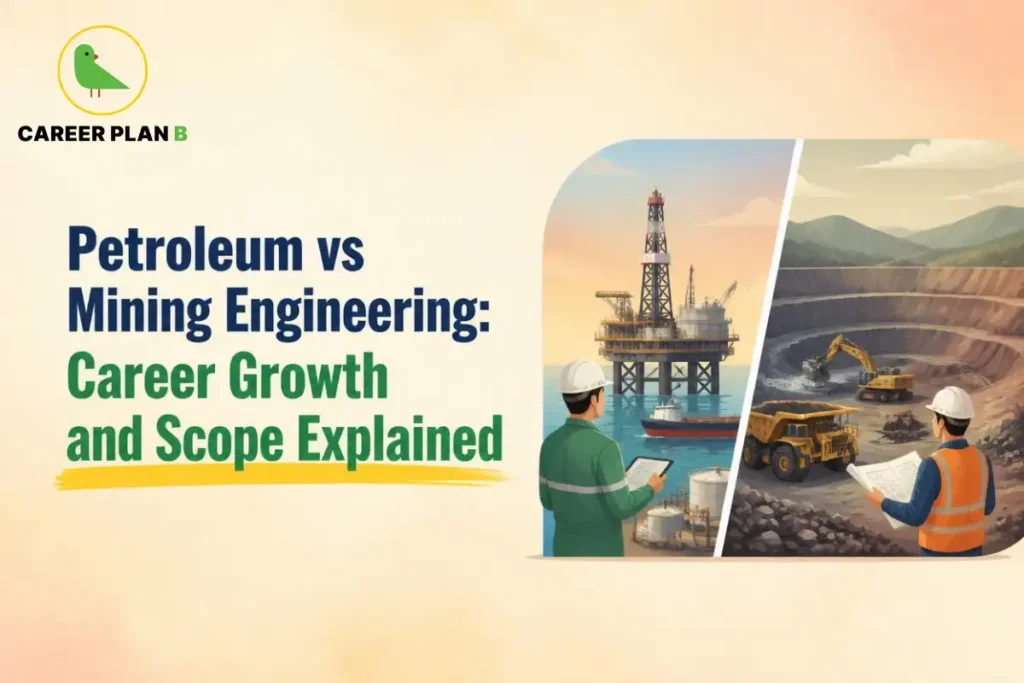
India sits on some of the largest coal and mineral reserves in the world, and at the same time runs one of Asia’s most active oil and gas sectors. Yet when engineering aspirants compare petroleum vs mining engineering, most do not know enough about either branch to make a confident choice.
Both branches deal with extracting what lies underground. Both feed into industries that power India’s economy. But the career paths, growth trajectories, and long-term scope are quite different.
This blog gives you a clear, honest comparison so you can decide which branch fits your goals not just for your first job, but for the next twenty years.
What Does a Petroleum Engineer Do?
Petroleum engineering focuses on locating and extracting oil and natural gas from subsurface reservoirs. It combines geology, thermodynamics, fluid mechanics, and drilling technology to get hydrocarbons out of the ground efficiently and safely.
Key work areas include:
- Reservoir modelling and analysis
- Drilling and well design
- Production optimisation
- Enhanced oil recovery
- Offshore and onshore field operations
The biggest employers in India are ONGC and Oil India Limited, alongside multinational oilfield service companies operating in Indian basins and abroad.
Core Job Roles in Petroleum Engineering
- Reservoir Engineer
- Drilling Engineer
- Production Engineer
- Well Intervention Specialist
- Petroleum Geoscientist
What Does a Mining Engineer Do?
Mining engineering covers the science and practice of extracting coal, metals, and minerals from the earth. It includes mine design, excavation planning, ground control, ventilation, safety systems, and mineral processing.
India is rich in coal, iron ore, bauxite, limestone, and increasingly, critical minerals like lithium and cobalt. Mining engineers are at the centre of extracting these resources responsibly.
Key work areas include:
- Mine planning and design
- Blasting and excavation operations
- Mine safety and hazard management
- Mineral beneficiation and processing
- Environmental reclamation of mined land
Major employers include Coal India Limited, NMDC Limited, SAIL, and Mineral Exploration and Consultancy Limited or MECL.
Core Job Roles in Mining Engineering
- Mine Planning Engineer
- Blasting and Explosives Engineer
- Mine Safety Officer
- Mineral Processing Engineer
- Geotechnical Engineer
Career Growth How Fast Can You Move Up?
This is where the two branches start to look quite different.
In petroleum engineering job opportunities, early career growth is fast especially if you land in a PSU like ONGC or move into international oil and gas markets. The work is technically demanding, and specialised skills are rewarded quickly. However, your growth is closely tied to the health of the oil and gas sector. When oil prices fall globally, hiring slows and promotions stall.
In mining engineering career growth in India, the pace is steadier. Coal India alone employs tens of thousands of engineers across its subsidiaries. PSU mining roles offer regular promotions tied to seniority and performance, with clear Grade E structures. Private sector mining, however, tends to be slower in promotions compared to oil and gas.
Both branches offer paths into senior management, project leadership, and eventually executive roles. International exposure is stronger in petroleum Middle Eastern and Southeast Asian markets actively recruit Indian petroleum engineers. Mining engineers find international opportunities mainly in Australia, Africa, and Canada.
Salary Comparison Petroleum vs Mining Engineering
| Experience Level | Petroleum Engineer | Mining Engineer |
|---|---|---|
| Entry Level (0–3 Years) | ₹8–15 LPA (PSU); ₹5–8 LPA (Private) | ₹6–10 LPA (PSU); ₹4–7 LPA (Private) |
| Mid Level (4–8 Years) | ₹15–30 LPA | ₹10–18 LPA |
| Senior Level (9+ Years) | ₹30–60 LPA (International Roles) | ₹18–30 LPA |
Mining engineer salary India is competitive within PSUs, especially with Coal India’s pay scales and benefits. But petroleum engineers working in international oil and gas sector jobs India and abroad tend to earn significantly more over a career.
Industry Scope Which Sector Is Growing?
Petroleum
India’s Ministry of Petroleum and Natural Gas has consistently projected strong domestic demand for hydrocarbons through 2047. India is also expanding its refining capacity, which means more petroleum engineering job opportunities in the coming decade. The energy transition is real, but India’s oil demand is still rising making this a viable sector for at least the next 25 years.
Mining
The Ministry of Mines has prioritised the development of critical minerals under India’s Critical Mineral Mission. With the push for electric vehicles, solar infrastructure, and electronics manufacturing, demand for lithium, cobalt, nickel, and rare earth elements is rising sharply. Coal and mineral industry jobs are not just about coal anymore they are expanding into the minerals that power the new economy.
This gives mining engineering a surprisingly strong future scope, one that many aspirants overlook.
Have Any Doubts?
GATE and Higher Studies Which Branch Wins?
Both branches have dedicated GATE papers.
GATE Mining Engineering (MN)
- Smaller candidate pool, making it less competitive
- PSUs recruiting through GATE MN: Coal India subsidiaries, NMDC, MECL, SAIL
- M.Tech seats available at IIT (ISM) Dhanbad, IIT Kharagpur, NIT Rourkela
- Also opens doors to BARC and DRDO in some technical divisions
GATE Petroleum Engineering (PE)
- Niche paper with fewer takers
- PSUs recruiting through GATE PE: ONGC, Oil India
- M.Tech seats at IIT (ISM) Dhanbad, IIT Bombay, IIT Kharagpur
- Strong for those targeting upstream oil and gas PSUs
In terms of engineering branch scope comparison through GATE, mining offers more PSU options in number, while petroleum offers higher-paying PSU roles.
Future Scope Which Branch Has a Longer Runway?
Petroleum engineering is tied to a sector that will remain relevant but is slowly being reshaped by renewables. The next 20–25 years still look strong for petroleum engineers in India, especially in refining and petrochemicals.
Mining engineering is entering a new chapter. Beyond coal, engineers with skills in critical mineral extraction, mine automation, and sustainable mining practices will be in demand as India races to secure its supply chain for green technologies. The government’s push under the National Mineral Policy also means more organised investment in this sector.
Both branches have a solid runway the question is which direction you want to grow in.
How Career Plan B Helps
Deciding between petroleum and mining engineering requires more than just reading comparisons it requires knowing your own strengths and interests. Career Plan B offers personalised career counselling, PsycheIntel aptitude assessments, GATE guidance, and admission support to help you choose the branch that fits your profile and long-term goals with complete clarity.
For Latest Information
Frequently Asked Questions
- Which is better for PSU jobs petroleum or mining engineering?
Both offer strong PSU options. Petroleum engineers are recruited by ONGC and Oil India, while mining engineers have access to Coal India, NMDC, MECL, and SAIL. Mining has more PSU openings overall.
- Is mining engineering a good career in India?
Yes. With India’s focus on critical minerals, EV infrastructure, and the National Mineral Policy, mining engineering career growth in India is set to accelerate beyond traditional coal roles.
- Which branch offers better international career opportunities?
Petroleum engineering has stronger international demand, particularly in the Middle East and Southeast Asia. Mining engineers find opportunities in Australia, Africa, and Canada.
- What is the scope of GATE mining engineering?
GATE MN qualifies you for M.Tech admissions and PSU recruitment through Coal India, NMDC, MECL, and SAIL. It is a relatively less competitive paper with solid returns.
- Can a petroleum engineer work in the mining sector?
There is some overlap in subsurface engineering and drilling, but the two branches require distinct skill sets. Lateral movement is limited without additional training or qualifications.
Conclusion
The petroleum vs mining engineering debate comes down to one core question do you want to chase the high-paying but niche oil and gas path, or build a career in a sector that is quietly becoming critical to India’s future?
Petroleum offers faster salary growth and international exposure. Mining offers stability, a strong PSU ecosystem, and an exciting new frontier in critical minerals.
Neither choice is wrong. Both choices need clarity.
If you are still weighing your options, Career Plan B can help you figure out which path is truly right for you.