Team Career Plan B · November 2, 2026
Introduction
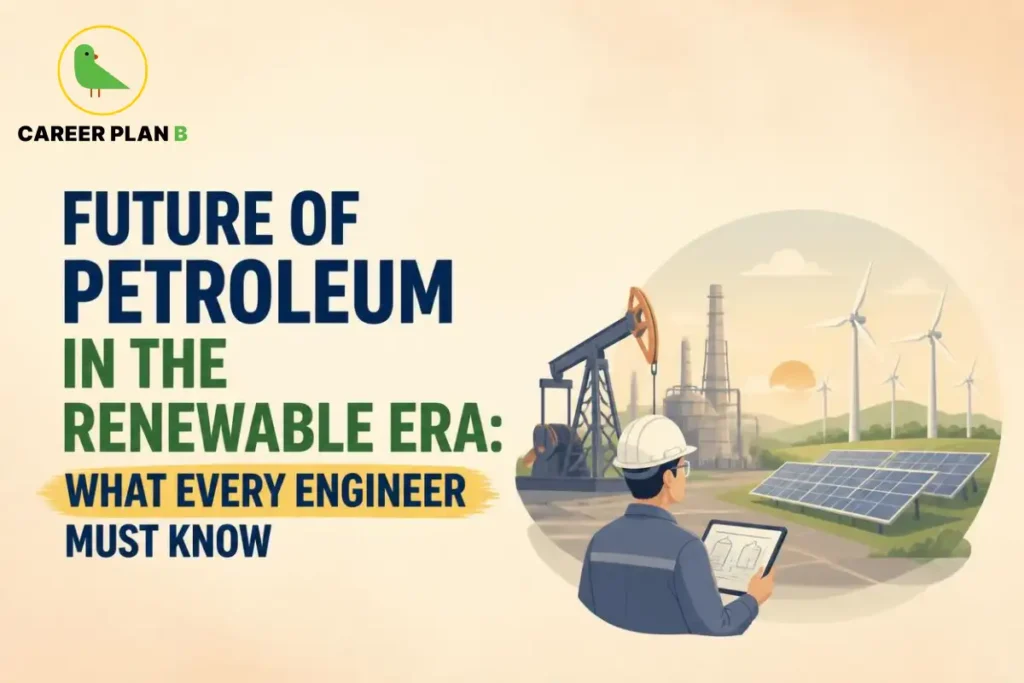
Every few years, someone announces the end of oil. Renewable energy is rising, electric vehicles are on the roads, and solar panels are appearing on rooftops across India. And yet, India’s fuel demand keeps climbing year after year.
So what is the real future of petroleum in the renewable era especially for engineers building their careers today?
The answer is more nuanced than the headlines suggest. Oil and gas are not disappearing overnight. But the industry is changing, and petroleum engineers who understand that change will be the ones who thrive. This blog unpacks where petroleum stands today, how the industry is evolving, and what it all means for your career.
Where Does India Stand on Energy Today?
To understand the future, you first need to understand the present.
India is the world’s third-largest energy consumer. Despite significant growth in solar and wind capacity, petroleum and coal still account for the majority of India’s total energy consumption. As per data from the Ministry of Petroleum and Natural Gas, India imports over 85 percent of its crude oil requirements, making the oil and gas industry future in India both strategically and economically critical.
NITI Aayog’s energy reports consistently highlight that India’s energy demand will nearly double by 2047 as the economy grows, urbanisation accelerates, and the middle class expands. Renewables will grow but they will add to the energy mix, not immediately replace hydrocarbons.
India’s current energy reality includes:
- Over 5 million barrels per day of crude oil processed in refineries
- A rapidly expanding city gas distribution network across 300-plus districts
- LNG imports growing to meet industrial and transport fuel demand
- Petrochemicals becoming a major non-fuel use of petroleum products
Is the Oil and Gas Industry Really Dying?
The short answer is no not in India, and not anytime soon.
Globally, the International Energy Agency projects that oil demand will peak sometime in the 2030s. But India operates on a different timeline. The India hydrocarbon demand forecast from government sources points to continued growth in petroleum consumption through at least 2040, driven by aviation fuel, petrochemical feedstocks, and road transport.
The key distinction is this renewable energy vs fossil fuels is not a battle where one side wins and the other disappears. It is a gradual shift where renewables take on more of the electricity generation load while petroleum continues to dominate transport, industrial processes, and chemical manufacturing for decades to come.
What is dying is the idea that oil and gas will grow unchecked forever. What is very much alive is a leaner, more strategic petroleum industry that will remain essential to India’s economy well into the second half of this century.
How Is the Petroleum Industry Adapting to the Renewable Era?
The smartest players in the oil and gas sector are not waiting for the energy transition India they are leading it.
ONGC has launched its own renewable energy subsidiary and has set targets for green hydrogen production and solar power capacity. Oil India Limited has invested in biofuels and wind energy projects. Even the refining majors are pivoting.
Here is how the petroleum industry is adapting:
- Refineries are integrating petrochemical units to produce plastics, fertilisers, and specialty chemicals rather than just fuels
- Oil companies are investing in green hydrogen, which uses many of the same compression and distribution technologies as natural gas
- Carbon capture and storage projects are being piloted to reduce emissions from existing oil and gas operations
- LNG and compressed natural gas are being positioned as transition fuels to bridge the gap between coal and renewables
Sustainable energy and petroleum industry are no longer opposites. They are increasingly converging and that convergence is creating new career opportunities for engineers who are ready for it.
What Does Energy Transition Mean for Petroleum Engineers?
Here is the honest truth the role of a petroleum engineer is shifting.
The traditional image of a petroleum engineer working exclusively on oil wells in remote fields is becoming one part of a much larger picture. Energy transition India is creating demand for engineers who understand subsurface systems, fluid dynamics, and process engineering skills that petroleum engineers already have but who can apply them in new contexts.
Emerging roles at the intersection of oil and clean energy include:
- Green hydrogen production and compression systems
- Carbon capture, utilisation, and storage projects
- Underground energy storage including compressed air and natural gas
- Geothermal energy exploration using drilling and reservoir techniques
- Offshore wind foundation design using subsea engineering knowledge
Petroleum engineers are not becoming obsolete. They are being asked to evolve and those who do will find themselves at the forefront of India’s energy future.
Have Any Doubts?
Petroleum Engineering Scope After 2030 in India
The petroleum engineering scope after 2030 in India looks different from the previous decade but it is far from bleak.
Key growth areas include:
Refinery Expansion: India is building new refineries and expanding existing ones. The government’s plan to increase refining capacity to 450–500 million metric tonnes per annum by 2030, as highlighted in Ministry of Petroleum reports, will require thousands of petroleum and process engineers.
City Gas Distribution: The Petroleum and Natural Gas Regulatory Board oversees India’s rapidly expanding city gas distribution network, which aims to connect over 400 districts. This creates sustained demand for gas engineers and pipeline specialists.
LNG Infrastructure: India is investing heavily in LNG import terminals and regasification facilities to support its gas-based economy ambitions.
Petrochemicals: Non-fuel petroleum applications from plastics to agrochemicals to synthetic fibres are growing faster than fuel demand, creating new engineering roles in process and chemical plant operations.
Can Petroleum Engineers Work in Renewable Energy?
Absolutely and more of them are doing exactly that.
The petroleum engineer career in green energy is a growing reality. Skills developed in oil and gas translate directly into several renewable energy domains:
- Reservoir and subsurface engineering applies directly to geothermal energy projects
- Drilling expertise is needed for geothermal wells and underground hydrogen storage
- Fluid mechanics and thermodynamics underpin hydrogen production and fuel cell systems
- Pipeline and compression knowledge is essential for green hydrogen distribution networks
- Offshore engineering skills are valuable for floating wind turbine foundations
For petroleum engineers looking to transition, upskilling in areas like hydrogen technology, carbon capture systems, or renewable process engineering through programmes recognised by AICTE can open doors to entirely new sectors without starting from scratch.
How Career Plan B Helps
Navigating the future of petroleum in the renewable era requires more than technical knowledge it requires a clear career strategy. Career Plan B offers personalised career counselling, PsycheIntel aptitude assessments, and expert guidance on upskilling pathways, PSU career planning, and higher education options to help petroleum engineers build future-ready careers with confidence.
For Latest Information
Frequently Asked Questions
- Is petroleum engineering still a good career choice in the renewable era?
Yes. India’s hydrocarbon demand forecast points to continued growth through 2040, and the industry is evolving into petrochemicals, green hydrogen, and LNG all of which need petroleum engineers.
- Will renewable energy replace petroleum in India?
Not in the near future. Renewables are growing rapidly in electricity generation, but petroleum will continue to dominate transport fuels, petrochemicals, and industrial energy for several more decades.
- What new roles are available for petroleum engineers in the energy transition?
Petroleum engineers can transition into green hydrogen systems, carbon capture projects, geothermal energy, underground energy storage, and LNG infrastructure roles using their existing technical skills.
- What is the scope of petroleum engineering after 2030?
Strong scope remains in refinery expansion, city gas distribution, LNG infrastructure, and petrochemicals all growing sectors backed by government investment and policy support.
- How can petroleum engineers prepare for the energy transition?
By upskilling in hydrogen technology, carbon capture, and renewable process systems through AICTE-recognised programmes, and by staying updated on India’s evolving energy policy landscape.
Conclusion
The future of petroleum in the renewable era is not a story of decline it is a story of transformation.
Oil and gas will not vanish from India’s energy system for decades. But the industry is evolving, and the most successful petroleum engineers will be those who evolve with it building skills that bridge the old energy economy and the new.
India needs engineers who understand both worlds. The question is whether you are ready to be one of them.
Take the first step with clarity visit Career Plan B to map out your path in the energy sector of tomorrow.