Team Career Plan B · September 3, 2026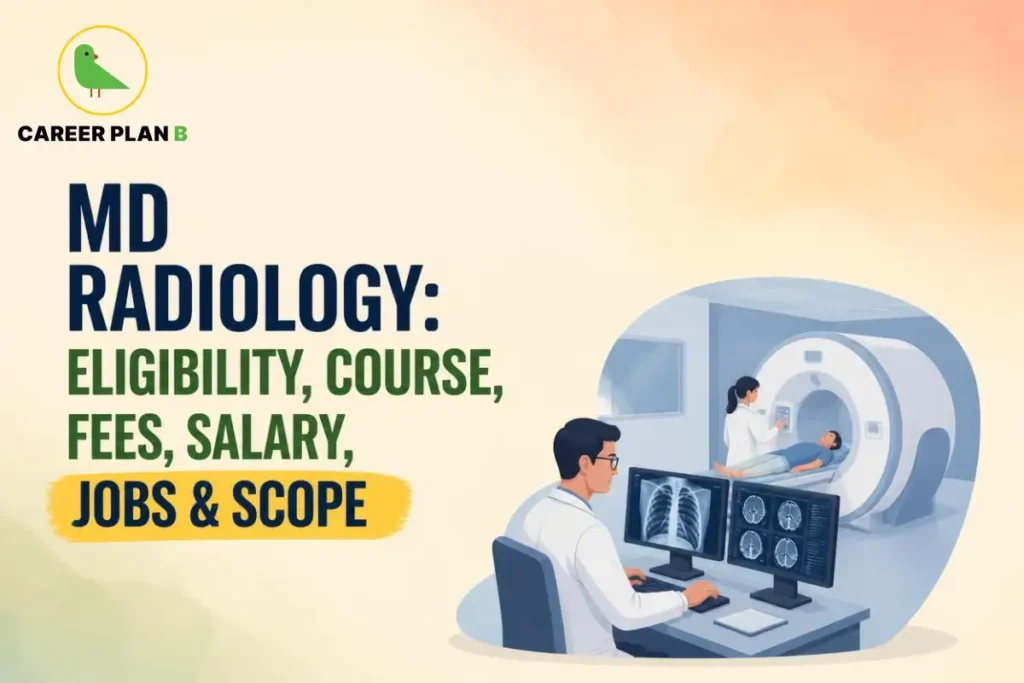
Introduction
Diagnostic precision is the backbone of modern clinical decision-making. Among all clinical postgraduate medical specializations, MD radiology consistently ranks as the most sought-after discipline for top-ranking medical graduates across India.
The field combines clinical acumen, cross-sectional anatomy, advanced computing, and physics to diagnose and manage complex pathologies. Medical graduates regularly seek clear insights into the Admission Process for MD Radio Diagnosis, md radiology eligibility, md radiology syllabus, and the overall md radiology scope in India.
Postgraduate medical qualifications are regulated under the statutory guidelines of the National Medical Commission (NMC) and directives from the Ministry of Health and Family Welfare (MoHFW). Centralized counseling allocations are administered by the Medical Counselling Committee (MCC) under the Directorate General of Health Services (DGHS).
This comprehensive guide delivers a detailed breakdown of course curriculum, fees, career pathways, expected earnings, institutional rankings, and NRI admission parameters.
What is MD Radiology? (Radiology vs Radiodiagnosis)
Doctor of Medicine in Radiodiagnosis, commonly referred to as MD radiology, is a three-year postgraduate broad-specialty degree. The program trains medical doctors in image interpretation, radiation safety, and minimally invasive image-guided interventions.
A common point of clarification among aspirants is radiology vs radiodiagnosis. In the Indian medical framework, the National Medical Commission officially designates the broad-specialty postgraduate curriculum as “MD in Radiodiagnosis”. Internationally, and across everyday clinical practice, it is referred to as “Radiology”.
While traditional radiodiagnosis focused solely on diagnostic imaging, modern practice encompasses both non-invasive diagnostics and therapeutic image-guided procedures.
MD Radiology Course Details & Duration
The standard md radiology duration and md radiology course duration is 3 years (36 months) for candidates holding a recognized MBBS degree. The curriculum operates on a residency model integrating didactic lectures, departmental reporting sessions, emergency duty shifts, interdepartmental clinico-radiological meetings, and a mandatory clinical dissertation thesis.
MD Radiodiagnosis Core Imaging Modalities
- Conventional Radiography & Fluoroscopy (X-Ray, Barium, IVP, HSG)
- Ultrasonography & Color Doppler (Abdominal, Pelvic, Obstetric, Small Parts)
- Computed Tomography (Multi-slice CT, Angiography, Trauma Triage)
- Magnetic Resonance Imaging (Neuro, MSK, Cardiac, Diffusion, Spectroscopy)
- Interventional Radiology (Biopsies, FNAC, Drainage, Vascular Stenting)</span>
- Nuclear Medicine & Molecular Imaging (PET-CT, SPECT Basics)
MD Radiology Eligibility Criteria
To meet the statutory MD radiology eligibility criteria in India, medical candidates must fulfill specific academic and regulatory prerequisites:
- Primary Medical Qualification: The candidate must hold an MBBS degree recognized by the National Medical Commission (NMC) or the erstwhile Medical Council of India (MCI).
- Rotary Internship: The applicant must complete their 12-month Compulsory Rotating Medical Internship on or before the official national cutoff date.
- Medical Registration: The doctor must possess a valid Permanent or Provisional Medical Registration Certificate issued by the NMC or a State Medical Council.
- National Entrance Qualification: The aspirant must achieve the minimum qualifying percentile in the National Eligibility cum Entrance Test for Postgraduates conducted by the National Board of Examinations in Medical Sciences (NBEMS) or the INI-CET for central institutes.
- Foreign Medical Graduates (FMGs): Indian graduates holding primary medical qualifications from foreign universities must clear the FMGE or NExT screening examination and complete the mandatory supervised internship in an NMC-approved hospital before seeking admission.
Admission Process for MD Radio Diagnosis & Cutoff Trends
The MD radiology admission process operates entirely through merit-based centralized counseling based on entrance test performance.
| Step | Counselling Stage | Key Action |
|---|---|---|
| 1 | Registration & Choice Filling | Register on the applicable MCC/state portal and submit your preferred colleges, specialties, and quota choices. |
| 2 | Seat Allotment & Verification | Seats are allotted based on merit, category, preferences, and availability, followed by document verification. |
| 3 | Reporting & Admission | Report to the allotted medical college, submit original documents, pay the required fees, and confirm admission. |
Because of its high clinical demand and favorable work-life balance, the radiology NEET PG rank requirement is the most competitive among all specialties.
The MD radiology cutoff for general category candidates in the 50% All India Quota for top government medical colleges typically closes within the top 1,500 to 2,500 ranks nationwide. DNB Radiodiagnosis seats in premier corporate and trust hospitals generally close within rank 4,000 to 7,000.
In Deemed Universities and private management quotas, closing ranks range from 15,000 to over 45,000 depending on institutional reputation and fee structure.
Comprehensive MD Radiology Syllabus
The MD radiology syllabus prescribed by the National Medical Commission covers applied basic sciences, diagnostic modalities, system-wise pathologies, and procedural interventions.
| Year / Phase | Theoretical Curriculum Focus | Practical Clinical Rotations |
|---|---|---|
| Year 1 (Foundations) | Radiological Physics, Radiation Protection, Radiation Biology, Normal Radiographic Anatomy, Contrast Media Physics, Principles of X-Ray, Ultrasound, and CT. | Conventional Radiography reporting, fluoroscopic investigations (Barium studies, IVU), basic abdominal and pelvic ultrasound, emergency radiography triage. |
| Year 2 (Systemic Imaging) | Systemic Pathology and Imaging: Neuroradiology, Chest and Cardiovascular Imaging, Musculoskeletal System, Gastrointestinal and Genitourinary Tracts, Mammography, MRI Physics. | Contrast CT reporting, cross-sectional anatomy interpretation, Color Doppler sonography, obstetric ultrasound, basic MRI console operation, thesis data collection. |
| Year 3 (Advanced & Interventional) | Pediatric Radiology, Fetal Imaging, Interventional Radiology, Nuclear Medicine (PET-CT/SPECT), Recent Diagnostic Advances, Quality Assurance, Medico-legal Aspects. | Advanced MRI interpretation (fMRI, MR Spectroscopy), assisting in image-guided biopsies, drainages, vascular interventions, independent emergency reporting, dissertation defense. |
At the end of the 3-year radiology pg course, candidates must pass four written theory examination papers: Applied Basic Sciences, Principles and Practice of Radiodiagnosis, Systemic Imaging, and Recent Advances. They must also clear clinical/practical spotter examinations and viva voce tests.
MD Radiology Fees in India
The fee structure for the md radiology course varies considerably depending on the administrative classification of the institution.
| College / Institution Type | Average Annual Tuition Fee (INR) | Approximate Total 3-Year Fee (INR) |
|---|---|---|
| Central Institutes (AIIMS, PGI, JIPMER) | ₹2,000 – ₹10,000 per year | ₹10,000 – ₹30,000 (Nominal) |
| State Government Medical Colleges | ₹30,000 – ₹2,50,000 per year | ₹1,00,000 – ₹7,50,000 |
| DNB Radiodiagnosis (NBEMS Hospitals) | ₹1,25,000 per year (Standardized) | ₹3,75,000 (Standardized) |
| Private Medical Colleges (State Merit Quota) | ₹8,00,000 – ₹18,00,000 per year | ₹24,00,000 – ₹54,00,000 |
| Deemed Universities (Management Quota) | ₹25,00,000 – ₹45,00,000 per year | ₹75,00,000 – ₹1,35,00,000 |
| Deemed Universities (NRI Quota) | $60,000 – $110,000 per year | ₹1,50,00,000 – ₹2,75,00,000 |
Note: In government medical colleges, DNB hospitals, and most private universities, residents receive a monthly stipend ranging from 45,000 INR to over 1,15,000 INR depending on state government rules and institutional policies.
Documents Required for NEET PG NRI Quota in MD Radiology
For candidates applying for NRI quota seats in Deemed Universities and private medical colleges, documentation compliance is critical. Candidates must submit the following verified documents required for NEET PG NRI quota:
- Consular NRI Status Certificate: Original certificate issued specifically by the Indian Embassy or Consulate in the sponsor’s country of residence, validated for the current academic session.
- Sponsor’s Passport and Visa: Notarized copies of the sponsor’s valid Indian passport, foreign visa stamps, work permit, Green Card, or foreign residence documentation.
- NRI Sponsorship Undertaking / Affidavit: An official legal affidavit executed by the sponsor committing to finance the candidate’s tuition fees for the entire 3-year MD course.
- Family Lineage Proof: A relationship certificate issued by a competent revenue authority (such as a Sub-Divisional Magistrate or Tahsildar) or a family tree certificate establishing the blood relation between the candidate and the sponsor.
- Supporting Birth Records: Birth certificates of the candidate, parents, and sponsor to establish common lineage.
- Financial Proof: Non-Resident External (NRE) or foreign bank statement of the sponsor demonstrating sufficient liquidity.
- Candidate’s Academic Credentials: NEET PG Scorecard, Admit Card, MBBS Degree Certificate, Internship Completion Certificate, Medical Registration Certificate, and Class 10 Certificate.
Top MD Radiology Colleges in India
India houses several world-class medical institutions offering residency programs in Radiodiagnosis with high case volumes and modern imaging infrastructure:
Top Government & Central Medical Colleges
- All India Institute of Medical Sciences (AIIMS), New Delhi
- Post Graduate Institute of Medical Education and Research (PGIMER), Chandigarh
- Maulana Azad Medical College (MAMC), New Delhi
- King George’s Medical University (KGMU), Lucknow
- Christian Medical College (CMC), Vellore
- Seth GS Medical College & KEM Hospital, Mumbai
- Madras Medical College (MMC), Chennai
- Sanjay Gandhi Postgraduate Institute of Medical Sciences (SGPGIMS), Lucknow
Top Deemed & Private Medical Colleges
- Kasturba Medical College (KMC), Manipal & Mangalore
- JSS Medical College, Mysuru
- Sri Ramachandra Institute of Higher Education and Research, Chennai
- Dr. D.Y. Patil Medical College, Hospital and Research Centre, Pune
- K.S. Hegde Medical Academy, Mangalore
- Amrita Institute of Medical Sciences, Kochi & Faridabad
- Dayanand Medical College & Hospital (DMCH), Ludhiana
MD Radiology Salary & Earnings in India
Radiology is among the most financially rewarding medical specialties in India. MD radiology salary scales with diagnostic expertise, subspecialty skills (such as interventional radiology or fetal imaging), modality mastery (MRI/CT), and professional experience.
| Career Stage / Designation | Average Annual Salary (INR) | Average Monthly Compensation |
|---|---|---|
| Junior Resident (MD / DNB Trainee) | ₹6,00,000 – ₹13,50,000 | ₹50,000 – ₹1,15,000 (Stipend) |
| Senior Resident (Post-MD 1–3 Years) | ₹12,00,000 – ₹18,00,000 | ₹1,00,000 – ₹1,50,000 |
| Consultant Radiologist (Corporate Hospital) | ₹24,00,000 – ₹45,00,000 | ₹2,00,000 – ₹3,75,00,000 |
| Interventional Radiologist (Subspecialist) | ₹35,00,000 – ₹70,00,000+ | ₹3,00,000 – ₹6,00,000+ |
| Chief Radiologist / Center Director | ₹50,00,000 – ₹1,00,00,000+ | ₹4,20,000 – ₹8,50,000+ |
| Independent Diagnostic Center Owner | ₹80,00,000 – ₹2,50,00,000+ | Variable Enterprise Revenue |
Note: The salary figures are indicative and may vary based on experience, location, employer, workload, specialization, and practice model. Independent diagnostic centre earnings represent business revenue, not personal salary.
MD Radiology Jobs, Career Pathways & Scope in India
The md radiology scope and overall md radiology scope in India are expanding due to advancements in imaging technologies, corporate hospital chains, and the growth of standalone diagnostic networks.
Hospital Consultant Radiologist
Specialists work in multi-specialty and corporate tertiary care centers, reporting conventional X-rays, multi-slice CT scans, MRIs, and performing real-time ultrasound evaluations.
Subspecialist: Interventional Radiology
Interventional radiology is one of the fastest-growing surgical-diagnostic subspecialties. Interventional radiologists perform minimally invasive, image-guided therapeutic procedures such as endovascular stenting, tumor embolization, percutaneous biliary drainages, and aneurysm coilings. Candidates can pursue a 3-year DM in Interventional Radiology or post-doctoral clinical fellowships.
Teleradiology & Remote Reporting
Teleradiology allows radiologists to report CT and MRI scans from anywhere using secure PACS networks. This offers flexible working hours, home workstations, and supplementary consultation income from international healthcare facilities.
Fetal Medicine & Women’s Imaging
Focusing on obstetric sonography, Level-II targeted anomaly scans, fetal Doppler, and digital mammography, this subspecialty operates in high-volume maternity hospitals and fertility centers.
Private Diagnostic Center Entrepreneurship
Radiologists with business acumen can establish independent diagnostic and imaging centers equipped with digital radiography, ultrasound, and CT/MRI scanners.
How Career Plan B Helps
Choosing the right MD Radiology pathway, institution, and career direction requires careful evaluation of your rank, clinical interests, training environment, and long-term goals. Career Plan B supports medical aspirants through:
- Personalized Career Counselling: Align your NEET PG/INI-CET rank, specialty interests, career goals, and budget with realistic MD Radiology and DNB options.
- Psycheintel and Career Assessment Tests: Evaluate your aptitude, interests, strengths, and professional preferences to assess your suitability for radiology and potential subspecialties.
- Career Roadmapping: Plan your progression across MD Radiology, interventional radiology, teleradiology, fetal imaging, and private diagnostic practice based on your long-term ambitions.
- Admission and Academic Profile Guidance: Compare institutions based on case volumes, imaging infrastructure, clinical exposure, academic environment, fees, and stipend, while strategically planning choices across counselling rounds.
Get In Touch With Us
Frequently Asked Questions
Q1. What is the major difference between MD Radiology and DMRD?
MD in Radiology is a 3-year master’s degree that includes a research thesis and qualifies graduates for consultant posts, academic teaching, and DM superspecialties. DMRD is a 2-year diploma focusing primarily on basic diagnostic imaging.
Q2. Is MD Radiology better than DNB Radiodiagnosis?
Both qualifications are recognized as equivalent by the National Medical Commission for consultant appointments and clinical practice. MD programs are university-based, while DNB programs take place in corporate and tertiary care hospitals with modern equipment and standardized national exit examinations.
Q3. Can a radiologist prescribe medications to patients?
Yes. Radiologists are licensed medical doctors holding an MBBS degree and can prescribe emergency medications, contrast media premedications, analgesics, and post-procedural treatments.
Q4. What is the expected NEET PG rank needed for MD Radiology in government colleges?
For General/Unreserved category candidates, securing an MD Radiology seat under the 50% All India Quota in government medical colleges typically requires an All India Rank within the top 1,500 to 2,500.
Q5. Does artificial intelligence (AI) threaten the career of radiologists?
AI serves as an assistive tool that improves diagnostic speed, triages critical scans, and reduces reporting errors. It complements the radiologist’s workflow rather than replacing the clinical judgment required for complex case synthesis.
Conclusion
Pursuing MD Radiology offers medical graduates a dynamic and rewarding clinical career, combining advanced diagnostic technology with opportunities across imaging, interventional radiology, fetal imaging, and teleradiology. With strong long-term career prospects, evolving subspecialties, and diverse practice settings, radiology can offer both professional growth and flexibility.
If MD Radiology is your goal, prepare strategically for NEET PG or INI-CET, review previous institutional cutoffs, compare case volumes and training infrastructure, and build your choice list carefully during counselling. Want expert guidance on choosing the right postgraduate pathway? Connect with Career Plan B for personalized counselling support and career planning.