Team6 · September 16, 2026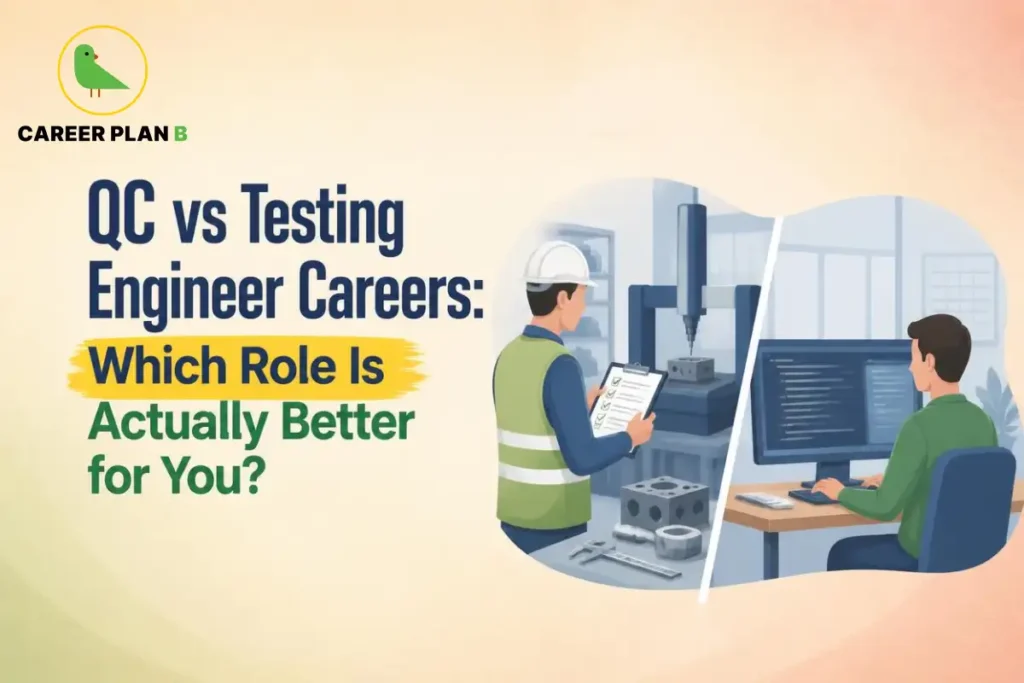
Introduction
Every product that reaches your hands, the car you drive, the phone you use, the medicine you take, and the aircraft you board, has passed through at least one of these two engineers before it ever reached you. One made sure it was built correctly. The other made sure it actually works.
The QC vs testing engineer career debate is one that rarely gets the attention it deserves in engineering career conversations. Most students focus on design, software, or manufacturing, while quality and testing roles quietly attract some of the most detail-orientated, analytically rigorous engineers in the industry. And increasingly, they are among the best-compensated ones too.
According to the International Organisation for Standardisation (ISO), poor product quality costs the global industry an estimated 5–30% of gross revenues annually, making quality and testing engineering is not just a career but a business-critical function in every manufacturing and product development organisation. (Source: ISO – Quality Management)
This blog gives you a complete, honest comparison of the QC vs testing engineer careers, covering what each role involves, the skills required, salary expectations, career trajectories, and how to decide which one is right for you.
What Does a Quality Control Engineer Actually Do?
A Quality Control (QC) engineer is responsible for ensuring that products manufactured in a facility meet defined specifications, standards, and customer requirements. Their primary domain is the production floor; they work during and after the manufacturing process to detect, document, and eliminate defects before a product leaves the facility.
Quality control engineer job roles typically involve:
- Conducting in-process and final inspections of manufactured components and assemblies
- Operating and interpreting results from precision measurement equipment, Coordinate Measuring Machines (CMM), micrometres, gauges, and optical comparators
- Applying Statistical Process Control (SPC) techniques to monitor production variability and detect drift before defects occur
- Documenting non-conformances, initiating corrective actions, and tracking resolution
- Auditing manufacturing processes against quality standards ISO 9001, IATF 16949 for automotive, AS9100 for aerospace
- Managing incoming quality inspections of raw materials and components from suppliers
- Preparing quality reports, First Article Inspection (FAI) documentation, and Control Plans
- Training production teams on quality standards and inspection procedures
QC engineers are the last line of defence between a defective product and a customer, and in industries like aerospace, defence, and medical devices, that responsibility carries enormous weight.
Key Industries Where QC Engineers Are Most Needed
- Automotive: Ensuring every component meets dimensional, functional, and safety specifications at scale
- Aerospace and Defence: Where quality failures can be catastrophic, a zero-defect culture is mandatory
- Pharmaceuticals: GMP (Good Manufacturing Practice) compliance requires rigorous QC at every production stage (Source: Central Drugs Standard Control Organisation – CDSCO)
- FMCG and Consumer Goods: High-volume, high-consistency production requiring constant quality monitoring
- Electronics Manufacturing: PCB inspection, solder quality, and component verification at high production rates
What Does a Testing Engineer Actually Do?
A Testing Engineer is responsible for validating and verifying that a product performs as designed under real-world and often extreme operating conditions. While QC engineers work primarily during manufacturing, testing engineers work primarily during product development and validation before the product goes into production.
A testing engineer’s career in India spans several distinct activity types:
- Designing and executing test plans to validate product performance against design specifications
- Building or specifying test rigs, fixtures, and instrumentation setups
- Conducting environmental tests, including temperature cycling, humidity, vibration, shock, and salt spray, to simulate real-world operating conditions
- Running durability and reliability tests to predict product life and identify failure modes
- Performing Failure Mode and Effects Analysis (FMEA) to proactively identify and mitigate potential failure risks
- Analysing test data stress-strain curves, fatigue data, and thermal profiles to draw engineering conclusions
- Writing test reports and presenting findings to design and engineering teams
- Supporting design iterations based on test failures, working closely with R&D and product development
Testing engineers are the engineers who find out what breaks, how it breaks, and why, so that design engineers can fix it before mass production begins.
Types of Testing: Engineering Roles: Functional, Performance, Reliability
- Functional Testing: Verifying that a product does what it is supposed to do under normal operating conditions
- Performance Testing: Measuring how well a product performs, including power output, efficiency, load capacity, and response time
- Environmental Testing: Validating that a product survives and operates across its intended environmental range
- Reliability and Durability Testing: Predicting product lifespan through accelerated life testing and fatigue analysis
- Safety and Regulatory Testing: Ensuring products meet mandatory safety standards before market launch, particularly in automotive, medical, and electrical products
Core Difference Between QC and Testing Engineer Roles
Understanding the difference between QC and testing engineer roles is the foundation of making the right career choice.
| Aspect | Quality Control Engineer | Testing Engineer |
|---|---|---|
| Primary Function | Ensuring manufactured products meet specifications | Validating product performance and reliability |
| Process Stage | During and after manufacturing | During product development and validation |
| Work Environment | Production floor, inspection lab, supplier facilities | Test laboratory, R&D centre, proving ground |
| Key Tools | CMM, SPC software, gauges, inspection instruments | Test rigs, environmental chambers, data acquisition systems, FMEA tools |
| Core Output | Inspection reports, NCRs, corrective action plans, and Control Plans | Test reports, FMEA documents, validation sign-offs, and reliability data |
| Key Standards | ISO 9001, IATF 16949, AS9100, GMP | ISO 16750 (automotive), MIL-STD (defence), IEC standards (electronics) |
| Thinking Style | Process-oriented, systematic, compliance-focused | Analytical, experimental, problem-solving focused |
| Industries | Automotive, aerospace, pharma, FMCG, electronics | Automotive R&D, aerospace, defence, medical devices, electronics |
| Collaboration | Production, supply chain, quality management | Design engineering, R&D, project management |
The most important distinction is the stage of the product lifecycle each role operates in. QC is about production quality, making sure the manufacturing process delivers what it should. Testing is about design validation, making sure the product design actually works in the real world.
In many organisations, particularly smaller ones, the same engineer does both. But as companies grow, these functions specialise significantly.
QC vs Testing Engineer Salary in India and Globally
The quality control engineer salary in India and the testing engineer salary in India comparison reveals a nuanced picture that changes significantly with experience and specialisation.
Quality Control Engineer Salary in India:
- Entry-level (0–2 years): ₹3–5 LPA at smaller manufacturing firms; ₹4.5–7 LPA at automotive Tier-1 and aerospace companies
- Mid-level (3–6 years): ₹7–13 LPA with ISO/IATF auditor certification and SPC expertise
- Senior QC Engineer / Quality Manager (7+ years): ₹14–22 LPA at top OEMs and aerospace manufacturers
- Head of Quality / Director of Quality: ₹25–40 LPA at leading manufacturing companies
Testing Engineer Salary in India:
- Entry-level (0–2 years): ₹3.5–6 LPA at product validation labs and automotive R&D centres
- Mid-level (3–6 years): ₹8–15 LPA with reliability engineering and FMEA expertise
- Senior Test Engineer / Validation Lead (7+ years): ₹16–28 LPA at automotive OEMs, aerospace firms, and medical device companies
- R&D Testing Manager: ₹28–45 LPA at top-tier automotive and defence R&D organisations
Government Sector Pay: Both QC and testing engineers are employed across PSUs, DRDO, HAL, ISRO, BEL, and BHEL, which maintain quality assurance and product validation departments. Pay scales follow the IDA pattern for PSUs and the 7th Pay Commission for central government roles. (Source: Ministry of Finance – Pay Commission)
The Bureau of Indian Standards (BIS) also employs quality engineers in standard-setting and product certification roles. (Source: BIS)
Global Salary Benchmarks:
According to the U.S. Bureau of Labour Statistics, quality control inspectors and engineers earn a median of approximately $43,000–$75,000 annually, depending on industry and seniority, while industrial and reliability test engineers earn a median of $85,000–$103,000 per year. (Source: BLS – Quality Control Inspectors) (Source: BLS – Industrial Engineers)
In Germany, QC and testing engineers in automotive and aerospace earn €45,000–€72,000 per year. In the UAE, quality and testing engineering roles in oil and gas and industrial manufacturing offer AED 120,000–180,000 annually, tax-free.
Career Growth: Where Does Each Role Take You?
Quality Control Engineer Career Progression:
A career in quality assurance and testing on the QC track typically follows this path:
- Quality Inspector / Junior QC Engineer (0–2 years): Learning inspection methods, measurement tools, and quality documentation
- QC Engineer (2–5 years): Independent inspection, SPC monitoring, supplier audits, and corrective action management
- Senior QC Engineer / Quality Assurance Engineer (5–8 years): Leading quality programmes, managing supplier quality, conducting ISO/IATF internal audits
- Quality Manager (8–12 years): Owning the entire quality management system for a facility or product line
- Head of Quality / VP Quality (12+ years): Strategic leadership of quality across an entire organisation or business unit
Specialisation paths include Six Sigma Black Belt, one of the most valued quality certifications globally; Certified Quality Engineer (CQE) by ASQ; and Lead Auditor certification for ISO 9001 or IATF 16949.
Testing Engineer Career Progression:
- Junior Test Engineer (0–2 years): Executing test procedures, operating test equipment, and documenting results
- Test Engineer (2–5 years): Designing test plans, building test fixtures, analysing failure data
- Senior Test Engineer / Validation Engineer (5–8 years): Leading complete product validation programmes, writing FMEA, managing test schedules
- Validation Lead / Reliability Engineer (8–12 years): Owning product validation strategy across entire platforms
- R&D Manager / Head of Testing (12+ years): Strategic leadership of product development validation and reliability engineering
Emerging Opportunities in Quality and Testing With Industry 4.0
Both roles are being transformed by digital manufacturing trends:
- AI-Powered Visual Inspection: Machine learning systems replacing manual visual QC inspection. QC engineers who understand and manage these systems are in growing demand
- Digital FMEA and Model-Based Testing: Testing engineers using digital twin technology to simulate failure modes before physical testing begins
- Automated Test Equipment (ATE): Highly automated test rigs that require testing engineers to programme, validate, and interpret, not just operate
- Predictive Quality Analytics: Using production sensor data and machine learning to predict defects before they occur a rapidly growing specialisation at the intersection of QC and data engineering
The National Manufacturing Competitiveness Programme (NMCP) under the Ministry of Heavy Industries supports quality and testing capability development across India’s manufacturing sector. (Source: Ministry of Heavy Industries)
Have Any Doubts?
QC Engineer Skills and Testing Engineer Skills You Must Build
QC Engineer Skills for Manufacturing Core Technical Skills:
- GD&T (Geometric Dimensioning and Tolerancing): The universal language of engineering drawings, essential for every QC engineer
- CMM Operation and Programming: Coordinate Measuring Machine proficiency is a significant differentiator in precision manufacturing QC roles
- Statistical Process Control (SPC): Using Minitab or similar tools to monitor production processes and detect quality drift
- ISO 9001 / IATF 16949 / AS9100 Knowledge: Understanding the quality management standards that govern your industry
- Root Cause Analysis Tools: 8D problem-solving, Fishbone diagrams, 5 Why analysis, the toolkit of corrective action
- Measurement System Analysis (MSA): Validating that your measurement tools and methods are accurate and repeatable
Testing Engineer Core Technical Skills:
- FMEA (Failure Mode and Effects Analysis): The foundational risk analysis tool of every product validation programme
- Test Rig Design and Instrumentation: Building and specifying physical test setups with appropriate sensors and data acquisition systems
- Reliability Engineering: Weibull analysis, accelerated life testing, and failure rate prediction
- Data Acquisition and Analysis: LabVIEW, MATLAB, and Python for collecting and interpreting test data
- Environmental and EMC Testing Standards: Understanding IEC, MIL-STD, and automotive testing standards
Certifications Worth Pursuing:
- Six Sigma Green Belt / Black Belt is universally valued across QC and testing roles (Source: ASQ – American Society for Quality)
- Certified Quality Engineer (CQE) by ASQ, a globally recognised QC credential
- IATF 16949 Internal Auditor is essential for automotive QC careers
- NPTEL courses in Quality Engineering, Metrology, and reliability engineering are free for Indian students (Source: NPTEL)
- NSDC-aligned quality and testing certification programmes for formal skilling credentials (Source: NSDC)
- BIS Certification Courses for engineers working in standards and product compliance roles (Source: BIS)
Which Role Is Right for You: QC or Testing Engineer?
Here is a practical decision framework for the QC vs testing engineer career choice:
Choose Quality Control Engineering if you:
- Are energised by systematic, process-driven work, finding patterns, enforcing standards, and driving consistency
- Enjoy working close to the production floor and the physical manufacturing environment
- Are naturally detail-oriented and find satisfaction in getting things exactly right every time
- Are interested in supplier quality, auditing, and quality management systems
- Want a clear, well-structured career path that leads to quality management leadership
- Are drawn to industries like automotive, aerospace, pharmaceuticals, or FMCG, where quality compliance is non-negotiable
Choose Testing Engineering if you:
- Are more drawn to the experimental and investigative side of engineering, finding out what breaks and why
- Enjoy designing experiments, building test setups, and analysing data to draw engineering conclusions
- Being comfortable with ambiguity testing often involves unexpected failures that require creative problem-solving
- Are interested in working closely with design and R&D teams during product development
- Want a career that keeps you at the cutting edge of new product development rather than established production
- Are drawn to reliability engineering, FMEA, and predictive analysis as long-term specialisations
The honest answer for many engineers: both roles are more similar than they appear from the outside; both require precision, analytical thinking, and a commitment to getting it right. If you are genuinely unsure, look at which stage of the product lifecycle energises you more: production and manufacturing consistency or design validation and failure analysis.
How Career Plan B Helps
Choosing between a QC vs testing engineer career is more than a job title decision; it reflects your thinking style, work environment preferences, and long-term career ambitions. Career Plan B offers Psycheintel-based career assessment tests that identify whether your cognitive profile and problem-solving approach align better with the systematic precision of QC engineering or the analytical experimentation of testing engineering. Through personalised career counselling, certification pathway guidance, and structured career roadmapping, Career Plan B helps quality-focused engineers choose the right specialisation and build toward it with clarity and confidence rather than guesswork.
For Latest Information
Frequently Asked Questions (FAQs)
1. What is the main difference between a QC engineer and a testing engineer?
A QC engineer primarily works during and after the manufacturing process, ensuring that products are built to specification through inspection, process monitoring, and corrective action. A testing engineer primarily works during product development and validation, designing and executing tests to verify that the product performs correctly and reliably under real-world conditions. QC is about production quality; testing is about design validation.
2. Which has better salary growth: QC engineering or testing engineering?
Both offer strong salary growth, but testing engineering, particularly in reliability engineering, automotive R&D, and medical device validation, tends to command higher compensation at the senior level due to the specialised analytical skills and direct R&D contribution involved. QC engineering offers more predictable, structured growth and broader industry applicability across manufacturing sectors.
3. What certifications are most valuable for a QC engineer in India?
Six Sigma Green Belt or Black Belt; Certified Quality Engineer (CQE) by ASQ; IATF 16949 Internal Auditor for automotive roles; and ISO 9001 Lead Auditor certification are the most valued. NPTEL courses in Quality Engineering and Metrology provide a strong academic foundation. BIS certification programmes are particularly relevant for engineers working in product compliance and standards roles.
4. Do government organisations in India hire QC and testing engineers?
Yes. DRDO, HAL, ISRO, BEL, BHEL, and BARC all maintain quality assurance and product testing departments. HAL specifically requires both QC engineers for aircraft component inspection and testing engineers for aircraft system validation. The Bureau of Indian Standards (BIS) employs quality engineers in product certification and standards development roles. Recruitment typically occurs through GATE scores or organisation-specific examinations.
Conclusion
The QC vs testing engineer career debate does not have a universal winner; it has a right answer for each engineer based on how they think, what environments energise them, and what kinds of problems they want to spend their careers solving.
Quality control engineering gives you a systematic, process-driven career at the heart of manufacturing, ensuring that the products the world depends on are built right, every time. Testing engineering gives you an experimental, analytical career at the front edge of product development, ensuring that what gets built actually works.
Make that decision with honest self-assessment and expert guidance. Visit Career Plan B today to assess your strengths, explore your options, and build a quality engineering career that is genuinely aligned with who you are.