Team6 · October 7, 2026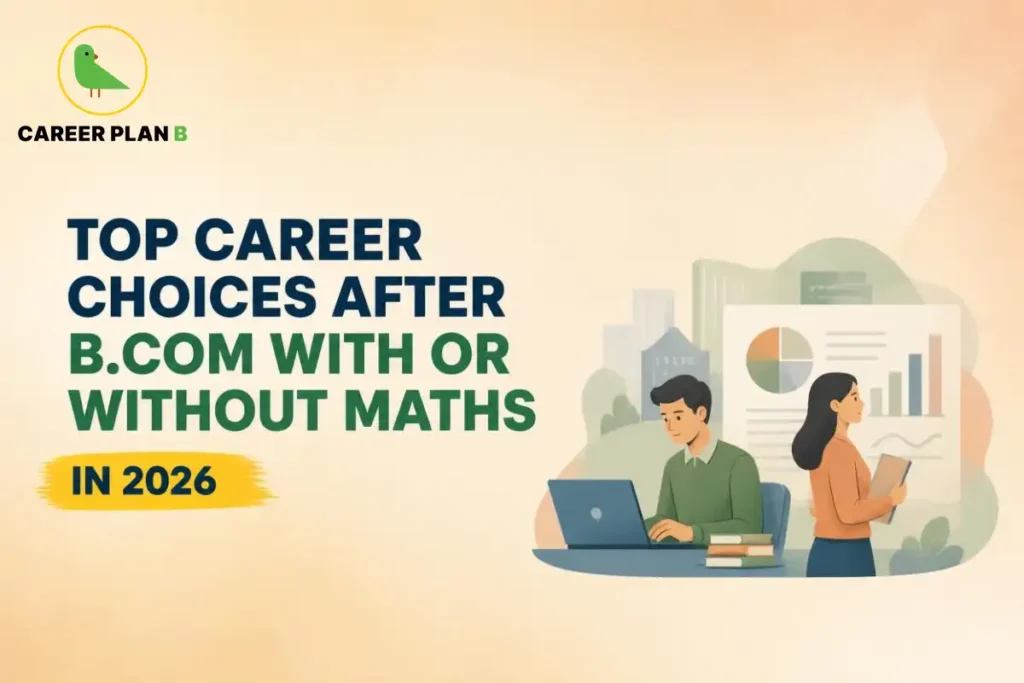
Introduction
Whether you had Mathematics in Class 12 genuinely shapes which B.Com career paths open up more easily, but it doesn’t lock you into a narrow track the way many students assume. Top Career Choices After B.Com With or Without Maths span a genuinely wide range, some naturally suited to strong quantitative skills, others built around communication, compliance, and business judgment instead.
This guide breaks down honest, realistic paths for both backgrounds, so your planning reflects your actual strengths rather than an assumption that Maths alone determines your entire career trajectory.
Why Maths Matters, But Doesn’t Gate Everything
B.Com itself doesn’t strictly require Mathematics in Class 12 at most institutions, since commerce degrees generally admit students from the Commerce stream regardless of whether they took the Maths or Applied Maths elective. That said, once you’re in the degree, certain specializations and career paths genuinely lean more heavily on quantitative comfort than others, which is exactly why understanding this distinction early helps you choose electives and specializations that align with your actual strengths.
Career Options After B.Com: The Quantitative-Heavy Track
Career Options After B.Com for students genuinely comfortable with Mathematics include chartered accountancy, which demands strong quantitative rigor throughout its examination structure, actuarial science, among the most mathematically intensive commerce-adjacent careers, financial analysis and investment banking roles, which rely heavily on quantitative modeling, and increasingly, data analytics and business intelligence roles that apply statistical methods directly to commerce contexts. These paths reward and often require the kind of comfort with numbers and formal quantitative reasoning that a Maths background in Class 12 and beyond typically builds.
Read more:- 10 High-Demand Careers in 2026 Across All Streams
Jobs After B.Com Without Maths: Genuinely Strong Alternatives
Jobs After B.Com Without Maths are far more plentiful than students without a Maths background often assume. Human resources and organizational behavior roles value interpersonal and communication skills over quantitative depth. Marketing and brand management careers reward creative and strategic thinking, with quantitative work typically limited to interpreting existing reports rather than building complex models. Company secretary and compliance roles focus heavily on legal and regulatory knowledge rather than advanced mathematics. Business journalism and financial content roles combine commerce knowledge with strong writing skills, an entirely different strength profile than quantitative analysis.
Best Careers After B.Com: A Grounded, Honest Comparison
Rather than ranking Best Careers After B.Com by an arbitrary “best” label, it’s more useful to match career direction to your actual strength profile. If you’re genuinely strong with numbers and enjoy structured, rules-based analytical work, CA, actuarial science, and financial analysis offer strong, well-established paths. If you’re stronger with people, communication, and strategic thinking, HR, marketing, and compliance roles offer equally legitimate, well-paying career tracks that simply don’t lean on the same quantitative skill set.
Have Any Doubts?
B.Com Career Opportunities: Building the Right Skill Bridge
B.Com Career Opportunities in either direction benefit from deliberately building bridge skills beyond your core coursework. For quantitative-track students, pursuing CA, CMA, or CFA certifications alongside your degree substantially strengthens your profile. For non-quantitative-track students, building genuine expertise in areas like digital marketing certifications, HR analytics fundamentals, or company secretary qualifications adds real, demonstrable depth beyond a general B.Com degree alone. Neither track is inherently “easier” or “harder”; each simply rewards a different combination of skills built deliberately over your degree.
Career After B.Com 2026: Practical Planning Steps
For Career After B.Com 2026 planning, start by honestly assessing your own strengths, quantitative comfort versus communication and strategic thinking, rather than choosing a path based on assumed prestige. Research the specific certification or specialization pathway relevant to your chosen direction early in your degree, since certifications like CA or CS typically require a multi-year commitment that benefits from starting during your undergraduate years rather than after graduation. Build relevant internship experience aligned with your chosen direction, since practical exposure genuinely differentiates candidates within both the quantitative and non-quantitative career tracks.
How Career Plan B Helps
Choosing the right B.Com career direction based on your genuine strengths, rather than an assumption about what “Maths people” versus “non-Maths people” should do, takes real, personalized guidance.
- Personalized Career Counselling: Helps you evaluate which B.Com career direction genuinely fits your strengths, regardless of your Maths background.
- Psychometric & Career Assessment Tests: Identifies whether quantitative analysis, communication-focused, or strategic roles suit you best.
- Career Roadmapping: Builds a realistic plan connecting your chosen direction to the right certifications and bridge skills.
- Admission & Academic Profile Guidance: Supports you in selecting the right B.Com specialization and electives aligned with your target career.
Get In Touch With Us
Frequently Asked Questions
1. Do I need Mathematics in Class 12 to pursue B.Com at all?
No. Most institutions admit B.Com students from the Commerce stream regardless of whether they took Maths, though a few specialized programmes may prefer or require it.
2. What are the strongest Jobs After B.Com Without Maths specifically?
HR, marketing, company secretary, compliance, and business journalism roles all offer strong, legitimate career paths that don’t lean heavily on quantitative skills.
3. Is chartered accountancy realistic without a strong Maths background?
It’s genuinely demanding regardless of background, but students without Class 12 Maths can still pursue CA successfully if they’re willing to build quantitative comfort through the qualification’s own structured curriculum.
4. How do I know which B.Com Career Opportunities genuinely fit me?
Honestly assess whether you’re more energized by structured, numbers-based problem-solving or by communication, strategy, and people-focused work, and let that guide your direction.
5. Should I decide my Career After B.Com 2026 path immediately, or can I explore during my degree?
You can genuinely explore during your degree, but starting relevant certification pathways or building bridge skills early gives you a meaningful head start regardless of which direction you eventually choose.
Conclusion
Top Career Choices After B.Com With or Without Maths genuinely span both quantitative and non-quantitative directions, each offering strong, legitimate career paths when matched honestly to your actual strengths rather than an assumption about which background is “better.” Building the right certifications and bridge skills deliberately, in either direction, matters more than which stream you came from originally.
Assess your genuine strengths honestly, and start building relevant skills or certifications early in your degree. If you’d like help figuring out which B.Com career direction genuinely fits you, Career Plan B’s counsellors are ready to guide you through it.