Deepti · August 12, 2026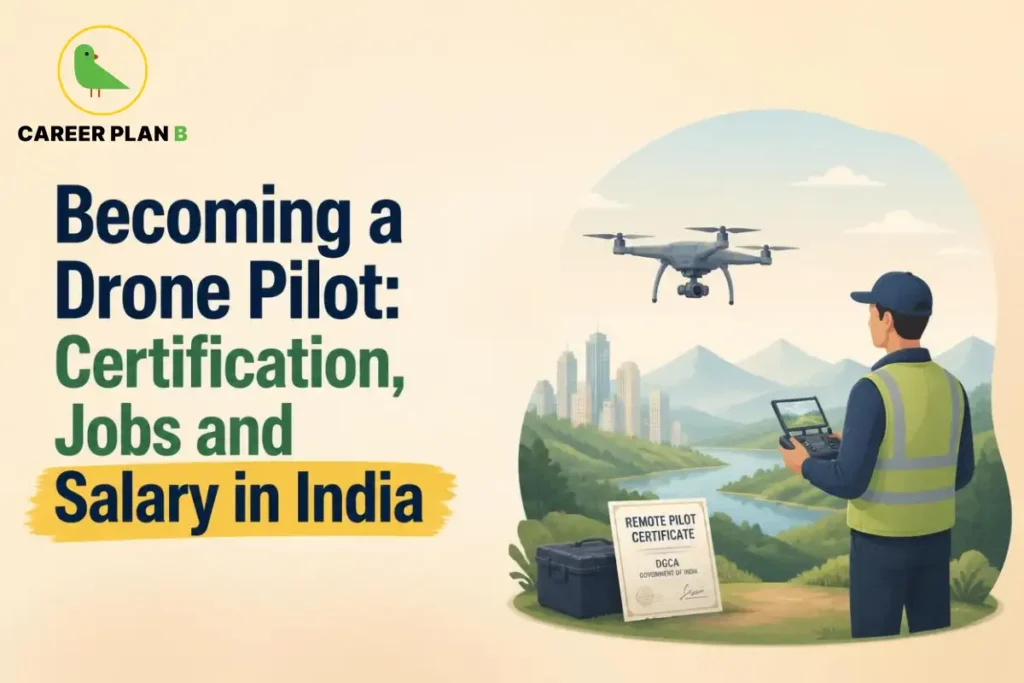
Introduction
Drone pilot certification India has become a genuinely structured, accessible process over the past few years, and it’s one of the more interesting emerging careers for students who enjoy technology but don’t necessarily want a conventional engineering degree. Drones are now used across agriculture, infrastructure inspection, mapping, filmmaking, disaster management, and logistics — and every legal commercial operation requires a certified pilot. This guide walks through exactly how certification works, what jobs actually exist, and realistic salary expectations.
Understanding India’s Drone Regulatory Framework First
All drone operations in India are governed by the Directorate General of Civil Aviation (DGCA) under the Drone Rules, 2021, through the Digital Sky platform. Drones are classified by weight — Nano (under 250g), Micro (250g–2kg), Small (2–25kg), Medium (25–150kg), and Large (above 150kg) — and your certification requirement depends on this category and whether your use is commercial. Nano drones generally need no certification; commercial operation of Micro drones and above requires a DGCA Remote Pilot Certificate (RPC).
What Is the DGCA Remote Pilot Certificate?
The RPC is, in practical terms, the equivalent of a driving licence for drone pilots — it’s the credential that makes you legally eligible to fly commercially. To obtain it, you must be at least 18 years old (some sources note a lower age threshold for certain certificate types, so always confirm current DGCA norms), have passed Class 10, hold a valid medical certificate from a DGCA-authorised examiner, and complete both ground and practical training through an authorised training organisation.
The RPTO Training Process
RPTO training — training through a DGCA-authorised Remote Pilot Training Organisation — is a mandatory step before certification. The training typically runs 5 to 8 days and covers:
- Basic radio telephony and communication procedures
- Flight planning and air traffic control procedures
- Regulations specific to your area of operation
- Airspace structure, restrictions, and no-fly zones
- Basic aviation meteorology
- Practical flight training, either live or simulated, demonstrating control throughout a flight
After completing training, you appear for the DGCA examination (conducted through the Digital Sky/NTA system), and upon passing, your Remote Pilot Certificate is issued digitally, generally valid for around 10 years.
Drone Pilot Career After 12th: Do You Need an Engineering Degree?
A common misconception is that a drone pilot career after 12th requires an aviation or engineering background — it doesn’t. There is no requirement for a private pilot license or prior aviation experience to obtain an RPC; the RPTO training itself covers everything needed. This makes drone piloting a genuinely accessible career entry point straight after Class 12, provided you complete certified training rather than relying on informal or unlicensed flying experience.
For Personalized Guidance
Where Drone Pilot Jobs Actually Exist in India
Real drone pilot jobs India currently offers span a surprisingly wide set of sectors:
| Sector | Typical Use | Example Employers |
|---|---|---|
| Agriculture | Crop spraying, health monitoring | Agri-tech startups, Kisan Drone-linked initiatives |
| Infrastructure | Inspection of towers, pipelines, solar farms | Power Grid Corporation, NHAI-linked contractors |
| Mapping and surveying | Land records, mining surveys | State survey departments, private survey firms |
| Filmmaking and media | Aerial photography and video | Production houses, wedding/event photographers |
| Disaster management and logistics | Emergency response, delivery pilots (BVLOS corridors) | State disaster management authorities, logistics companies |
(Source: DGCA Drone Rules 2021 framework, digitalsky.dgca.gov.in)
Drone Pilot Salary: What Realistic Expectations Look Like
Reported drone pilot salary figures vary considerably depending on sector, employer, and whether you’re salaried or freelance — entry-level roles have been reported in a modest monthly range, rising meaningfully with specialisation (e.g., agricultural drone operations, industrial inspection, or BVLOS-certified commercial roles) and experience. Because pay structures differ so much between government-linked agricultural schemes, private industrial contracts, and freelance photography/filming work, it’s best to treat any single number you see online as indicative rather than a guarantee, and to verify current figures with training institutes or employers directly before making a financial decision based on it.
Costs and Practical Considerations
Training costs at RPTOs typically run into a moderate range depending on the institute and drone category, and the RPC application fee itself is minimal (around ₹100 as per current DGCA norms). Third-party liability insurance is mandatory for commercial operations and a sensible precaution even for serious hobbyists, since drone pilots are personally liable for any damage or injury caused.
How Career Plan B Helps
Deciding whether drone piloting fits you as a serious career or a specialised add-on skill alongside another degree is a genuine decision worth thinking through carefully. Career Plan B’s Psycheintel and Career Assessment Tests can help clarify whether the technical, outdoors-oriented nature of this work suits your strengths. Our Admission and Academic Profile Guidance team can help you evaluate RPTO options and combine this certification meaningfully with a broader academic plan. And our Career Roadmapping service helps map how a drone pilot certification could fit into agriculture, media, infrastructure, or logistics career tracks over the long run.
Get In Touch With Us
FAQs
Q1. Do I need an engineering degree to become a drone pilot in India?
No, there’s no requirement for a private pilot license or aviation background — RPTO training alone qualifies you for the Remote Pilot Certificate.
Q2. How long does DGCA drone pilot certification take?
RPTO training typically takes 5 to 8 days, followed by a DGCA examination; certification is usually issued digitally within about two weeks of passing.
Q3. Can I start drone pilot training right after Class 12?
Yes, provided you meet the minimum age and Class 10 pass requirements — no further academic qualification is mandatory.
Q4. Is drone piloting a stable full-time career?
It can be, particularly if you specialise in a high-demand sector like agriculture or industrial inspection, though many pilots combine it with other skills (photography, GIS mapping, or a core degree) rather than treating it as a stand-alone career from day one.
Q5. Do I need to register my drone even for personal use?
Yes, if it weighs above 250 grams — registration and a UIN are required through the Digital Sky platform regardless of commercial or personal use.
Conclusion
Drone pilot certification in India offers an accessible and well-regulated career pathway that does not require an engineering background. The training typically takes about a week and prepares candidates for opportunities in agriculture, infrastructure, media, and logistics. However, treat advertised salary figures as reference points rather than guarantees, and choose a DGCA-authorised RPTO carefully. If you want to understand how this career fits your long-term goals, Career Plan B’s counsellors can help you plan the right path.