Team Career Plan B · September 28, 2026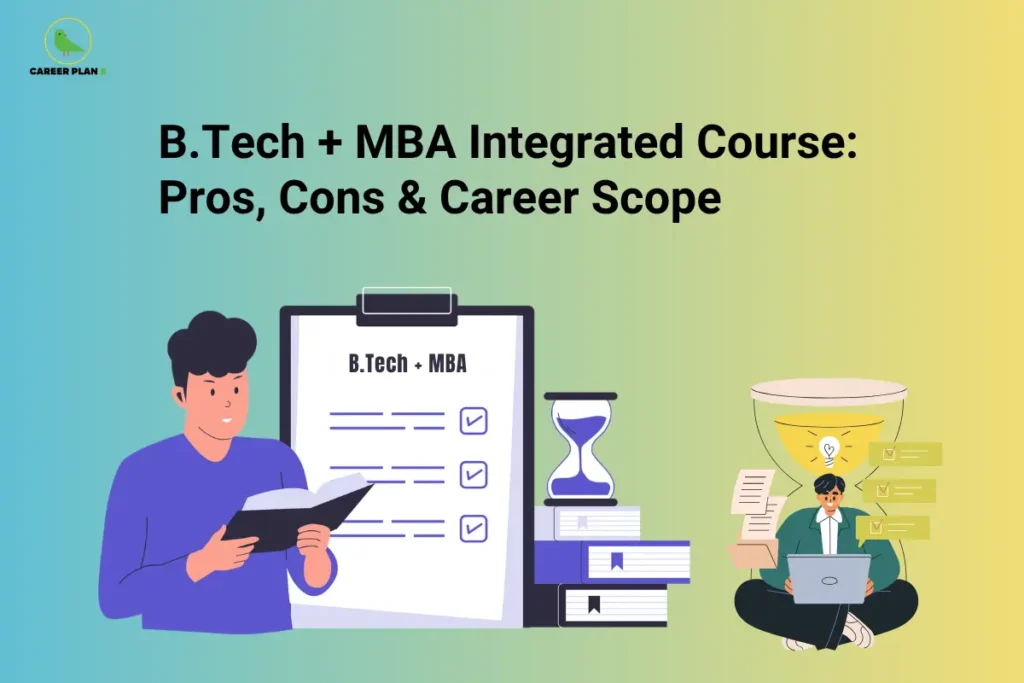
Introduction
For years, Indian students were taught to think about engineering and management as two completely separate journeys. First came the B.Tech degree. Then, after placements, work experience, or confusion about career direction, came the MBA. But that structure is changing rapidly now. In 2026, many universities and institutions are introducing integrated engineering-management programmes designed to combine technical knowledge with business leadership from the beginning.
That is why interest in the B.Tech MBA integrated course is growing steadily among students who want both technical expertise and management exposure without spending six separate years in higher education.
The appeal sounds obvious at first glance. One programme. One admission process. A combined pathway towards technology and business leadership. For many students, it feels like a smarter and faster route towards future corporate roles.
But this course is also one of the most misunderstood career pathways right now.
Some students choose it because they genuinely enjoy both technology and management. Others choose it simply because the combination “sounds powerful” without fully understanding what the course or future work environment actually demands.
And honestly, that difference matters far more than most students realise during Class 12.
What Is a B.Tech + MBA Integrated Programme?
A B.Tech + MBA integrated programme is usually a five-year dual-degree course that combines engineering education with management studies. Instead of completing a four-year B.Tech followed by a separate two-year MBA later, students complete both qualifications together through one structured programme.
These programmes are becoming increasingly visible in India as institutions move towards multidisciplinary education models aligned with NEP 2020 and industry demands for techno-managerial professionals. Official AICTE and NEP frameworks increasingly encourage interdisciplinary learning structures across engineering and management education. (AICTE)
Several universities now offer integrated pathways combining engineering specialisations with management training in finance, operations, analytics, entrepreneurship, technology management, and leadership. (Institute of Management)
But students should understand something clearly. This course is not simply “engineering plus business”. It is a highly demanding academic environment where students are expected to develop technical understanding alongside communication, analytical thinking, leadership ability, and business decision-making skills. That combination suits some students extremely well. For others, it becomes exhausting very quickly.
Why Students Are Considering Integrated Engineering and MBA Pathways
The biggest reason these programmes are becoming popular is uncertainty. Many engineering students complete graduation and later realise they are more interested in management, consulting, operations, business strategy, entrepreneurship, or product leadership than in core technical jobs. That often leads them towards MBA preparation after engineering anyway.
Integrated programmes try to solve this gap early by combining both domains. Students also see practical advantages. One admission cycle instead of two. Reduced academic duration compared to separate degrees. Early exposure to management subjects. Better understanding of how technology and business interact in real industries.
And honestly, the corporate world itself is changing rapidly. Companies increasingly value professionals who can understand both technical systems and business strategy together. According to AICTE curriculum updates, interdisciplinary learning and integration of management, AI, and emerging technologies are becoming increasingly important across engineering education in India. This is especially relevant in industries connected to AI, fintech, product management, energy systems, consulting, technology operations, and entrepreneurship.
The Biggest Advantages of a B.Tech + MBA Integrated Course
One major advantage of integrated programmes is academic continuity. Students do not need to pause after engineering graduation and prepare separately for CAT or other MBA entrances later. The transition into management education happens naturally within the same academic ecosystem.
Another benefit is earlier exposure to business thinking. Most engineering students only encounter finance, operations, marketing, leadership, or organisational management much later during MBA preparation. Integrated programmes introduce these concepts gradually alongside technical education.
Students also gain interdisciplinary understanding much earlier. A student studying computer science alongside management begins understanding not only software systems but also product strategy, business operations, customer behaviour, and organisational decision-making.
That combination can become extremely valuable in modern industries. And honestly, many students today are naturally interested in both technology and business. They enjoy solving technical problems but are equally curious about startups, leadership, strategy, or innovation ecosystems. For such students, integrated programmes can feel intellectually exciting instead of restrictive.
The Challenges Students Often Ignore
But this pathway also comes with real disadvantages that students rarely think about properly before admission.
The biggest issue is early commitment.
At 17 or 18 years old, students are expected to commit simultaneously to both engineering and management without fully experiencing either field independently first.
And that becomes risky sometimes.
A student may enjoy PCM subjects in school but later realise they dislike engineering-style technical work completely. Another student may initially feel attracted towards management because of corporate glamour online, but later discover they actually prefer research, coding, design, or specialised technical roles instead. Integrated programmes reduce flexibility once students enter them. That is why students should never choose these courses simply because they “sound premium”.
Another challenge is academic pressure. Engineering itself is already demanding. Combining technical coursework with management learning, projects, presentations, internships, communication training, and analytical subjects creates an intense academic environment. Students who struggle with time management or emotional balance may feel overwhelmed. And honestly, many students underestimate this completely during admissions.
Career Scope After B.Tech + MBA
The strongest advantage of this programme is versatility.
Graduates can move into technical management, consulting, analytics, operations, fintech, product management, business development, technology leadership, entrepreneurship, and emerging interdisciplinary sectors.
| Career Area | Common Roles |
|---|---|
| Product Management | Product Analyst, Product Manager |
| Technology Consulting | Business and Technology Consultant |
| Operations & Analytics | Operations Analyst, Strategy Associate |
| Fintech & Digital Business | Business Analyst, Fintech Associate |
| Entrepreneurship | Startup Founder, Innovation Roles |
| Technology Management | Tech Operations and Leadership |
Industry demand for techno-managerial professionals is increasing as businesses integrate AI, analytics, automation, and digital systems into operations. But students should understand something honestly.
The degree itself does not automatically create leadership careers. Communication ability, internships, adaptability, emotional intelligence, and continuous learning still matter enormously. A student with strong interpersonal and strategic thinking skills may thrive in these environments. Another student may discover they actually prefer technical depth over management exposure. And both outcomes are completely valid.
Who Should Actually Choose This Course?
This programme works best for students who genuinely enjoy both analytical problem-solving and business-oriented thinking.
A student interested in technology startups, product systems, innovation, management strategy, entrepreneurship, or leadership roles may find this combination highly meaningful.
It also suits students who dislike the idea of preparing separately for MBA entrances later while simultaneously wanting broader career flexibility beyond core engineering roles.
But this programme is probably not ideal for students who:
- Are still completely unsure about engineering itself
- Prefer pure technical specialisation or research careers
- Strongly dislike presentations, teamwork, or communication-heavy environments
- Are you choosing management only because it “sounds prestigious”
And honestly, this is where many students become confused internally.
Some students choose engineering because family expectations push them there, while secretly feeling more connected to business, creativity, or communication. Others choose integrated programmes simply because they fear missing opportunities later.
But career planning cannot happen properly through fear alone. Students need to understand themselves before choosing hybrid career pathways like this.
For Personalized Guidance
Admission Process for B.Tech + MBA Integrated Courses
Admissions usually depend on Class 12 PCM eligibility, along with engineering entrance exams such as JEE Main or institution-specific admission processes. Some universities also include interviews or aptitude evaluations during selection.
| Admission Component | Common Requirement |
|---|---|
| Class 12 Eligibility | PCM with minimum aggregate marks |
| Entrance Exams | JEE Main or university-level tests |
| Additional Evaluation | Interviews or aptitude rounds |
| Programme Duration | Usually 5 years |
Students should also verify AICTE recognition and institutional approvals carefully before joining any integrated programme because approval structures for dual-degree pathways can sometimes vary. That verification matters more than many students realise.
How Career Plan B Helps
Many students interested in integrated B.Tech + MBA programmes are not actually confused about colleges first.
They are confused about themselves.
At Career Plan B, the counselling process focuses on helping students understand whether engineering, management, entrepreneurship, or interdisciplinary careers genuinely align with their aptitude, personality, interests, and long-term goals.
Through career counselling, academic counselling, and the PsycheIntel assessment, students receive structured guidance related to career alignment, entrance planning, course selection, and long-term professional direction. Instead of choosing programmes purely based on trends or social pressure, students are guided towards pathways that realistically fit both their abilities and future aspirations.
Students exploring engineering-management pathways often benefit from structured support through career counselling for students because hybrid careers require clarity, not just ambition.
Get In Touch With Us
Frequently Asked Questions
Q1. Is a B.Tech + MBA integrated course better than doing an MBA separately?
It depends on the student’s goals. Integrated programmes suit students already interested in combining technology and management early, while separate MBAs provide more flexibility later.
Q2. Can students get management jobs after integrated B.Tech MBA programmes?
Yes. Graduates often work in consulting, operations, analytics, product management, business strategy, and technology leadership roles.
Q3. Is CAT required after completing an integrated B.Tech MBA course?
Usually, no, because students already complete MBA education within the integrated programme itself.
Q4. Are integrated B.Tech MBA programmes recognised in India?
Yes, but students should verify AICTE approvals and institutional recognition carefully before admission.
Conclusion
A B.Tech + MBA integrated course can become an extremely powerful pathway for the right student. But only when the student genuinely understands why they are choosing it. Because this course is not simply about combining two degrees together. It is about balancing technology, business thinking, leadership, communication, and long-term adaptability inside one demanding academic journey.
And sometimes the biggest mistake students make is choosing the wrong course. It is choosing a future they never fully stopped to understand before entering it.