Team Career Plan B · September 28, 2026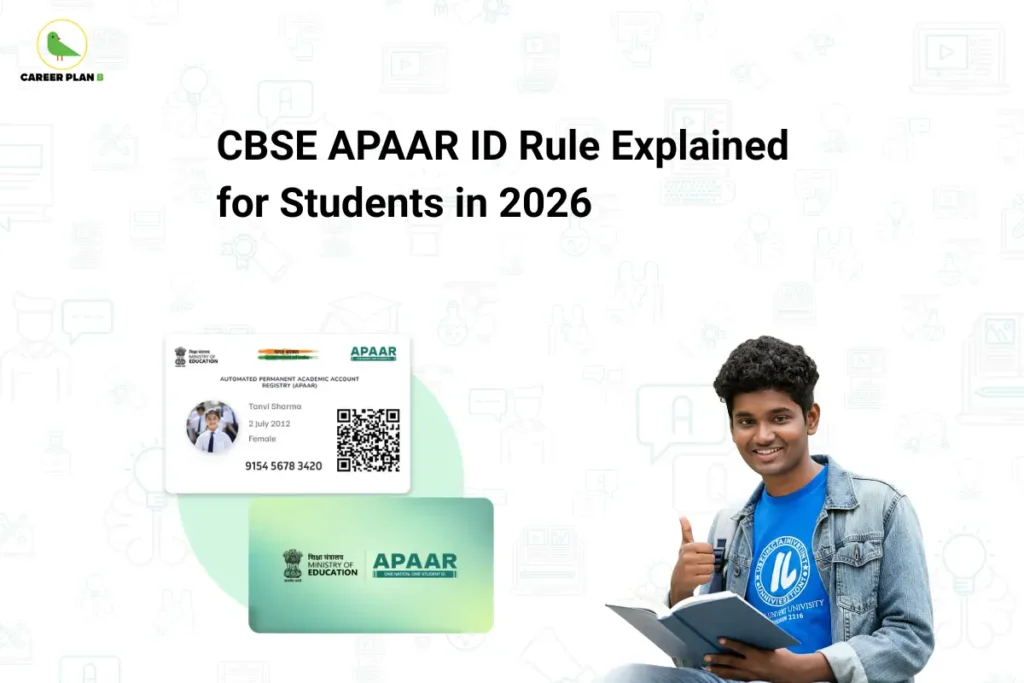
Introduction
Over the last few months, many CBSE students and parents have suddenly started hearing one unfamiliar term repeatedly – APAAR ID. Schools are sending notices. DigiLocker notifications are appearing. Students are being asked to verify records. Parents are hearing terms like “One Nation, One Student ID” without fully understanding what it actually means.
That confusion is exactly why the topic of CBSE APAAR ID has become one of the most discussed educational changes in 2026.
The Central Board of Secondary Education has gradually started implementing APAAR ID as a major digital academic identifier for students across classes, especially for Classes 9 to 12. According to official CBSE circulars, schools have been instructed to prioritise APAAR ID creation and integration with student records as part of the broader National Education Policy digital framework. Official source: CBSE APAAR ID Circular
But despite all the notifications, many students still do not understand what APAAR ID actually does, whether it is compulsory, how it affects board exams, or why schools are suddenly treating it so seriously.
And honestly, the anxiety around it is understandable.
Whenever education systems become more digital, students and parents naturally worry about privacy, documentation problems, Aadhaar mismatches, and whether one technical issue could affect something as important as board exams.
What Is APAAR ID?
APAAR stands for Automated Permanent Academic Account Registry. It is part of the government’s “One Nation, One Student ID” initiative under the National Education Policy framework.
The idea behind APAAR ID is to create one lifelong academic identity for every student in India. This ID is linked to academic records and helps digitally store information such as marksheets, certificates, achievements, credits, and educational progression throughout a student’s learning journey.
According to official CBSE and DigiLocker-related updates, the APAAR system is designed to integrate academic records into one digital ecosystem that students can access more efficiently over time. (CBSE)
Students are also seeing APAAR integration increasingly connected with DigiLocker systems because digital marksheets and academic records are gradually moving towards centralised digital storage frameworks.
But what sounds simple in theory often feels complicated in practice for families.
Especially when parents suddenly receive notices involving Aadhaar verification, document mismatches, consent forms, and technical procedures they were never prepared for earlier.
Why CBSE Is Implementing APAAR ID
The main objective behind APAAR ID is educational digitisation and centralised academic tracking. CBSE and government authorities want to reduce fragmented record systems and create a long-term digital academic profile for students.
This system is expected to help with:
- Easier access to academic records
- Reduction in fake or duplicate certificates
- Simplified transfer of academic information
- Better integration with DigiLocker and future education systems
- Lifelong academic record management
According to official CBSE examination circulars, APAAR ID implementation is being integrated into registration and student verification systems for future academic sessions. (CBSE)
And from an administrative perspective, the logic makes sense.
India’s education system handles enormous student populations across schools, boards, universities, and institutions. A unified digital identity can theoretically reduce paperwork and improve record management significantly.
But theory and real-life implementation are rarely equally smooth.
Is the APAAR ID Mandatory for CBSE Students?
This is where most confusion exists right now.
Several CBSE-related notices and school communications strongly pushed APAAR ID integration for board registrations and student records, especially for Classes 9 and 11 registrations linked to future board examinations. However, there have also been official clarifications and relaxations later because many schools and parents faced practical difficulties related to Aadhaar mismatches, consent issues, and data verification problems. NCERT also clarified publicly that students cannot be denied school admission solely because they do not possess an APAAR ID.
Similarly, several updates regarding CBSE board results clarified that students can still access results using roll number credentials even without APAAR integration. And honestly, this mixed communication is one reason many parents feel stressed.
On one side, schools treat APAAR integration urgently. On the other side, public clarifications say certain services cannot legally be denied without it. That inconsistency naturally creates confusion.
The Real Challenges Students and Parents Are Facing
The biggest issue many families are facing is document mismatch.
A student’s name may appear slightly differently on Aadhaar compared to school records. Parent names may have spelling variations. Birth dates may not align exactly across systems. These problems sound minor, but digital verification systems often treat them as major issues.
Several schools across India reported difficulties during student registration processes because records could not be submitted smoothly due to Aadhaar-related mismatches. CBSE later introduced relaxation mechanisms and “unverified” options in some cases to reduce these problems.
But for students preparing for board exams, even small technical issues feel emotionally huge.A Class 10 or 12 student already dealing with exam pressure suddenly hears terms like “mandatory linking”, “verification pending”, or “APAAR not generated”.
And immediately the mind goes towards fear:
“Will this affect my exams?”
“Will my results get delayed?”
“Did we miss some important process?”
That emotional stress is very real for students and parents alike.
APAAR ID and DigiLocker Integration
One major reason APAAR ID is becoming more visible is because of DigiLocker integration.
CBSE marksheets, certificates, migration documents, and academic records are increasingly being connected with DigiLocker systems for easier digital access. APAAR helps create one connected educational identity within these systems. Students with APAAR-linked records may experience smoother digital document access in future academic systems.
But importantly, multiple official updates also clarified that students without an APAAR ID can still access CBSE results through standard credentials and DigiLocker registration processes. That clarification is important because social media misinformation has created unnecessary panic among many families.
What Students and Parents Should Actually Do Right Now
Instead of panicking, students and parents should focus calmly on documentation accuracy.
| Important Step | Why It Matters |
|---|---|
| Verify Aadhaar Details | Prevents mismatch issues |
| Check School Records Carefully | Ensures correct name and DOB alignment |
| Keep DigiLocker Access Ready | Helpful for future document access |
| Submit Parent Consent Properly | Required in several schools |
| Follow Official CBSE Notices Only | Avoids misinformation panic |
Most importantly, students should avoid relying on rumours circulating through WhatsApp groups or social media forwards.
Because honestly, much of the confusion around APAAR is being amplified through incomplete or misleading information online.
For Personalized Guidance
The Bigger Shift Happening in Indian Education
APAAR ID is not just one isolated technical update.
It represents a much larger shift happening in Indian education towards digital academic ecosystems, lifelong academic records, and integrated student databases.
According to NEP-related education reforms, digitisation, multidisciplinary academic tracking, and technology-enabled educational governance are expected to become increasingly important over the coming years. (CBSE)
And while this may improve efficiency long-term, it also means students and parents will need better awareness around digital systems, educational records, and documentation processes.
This is especially important because many families are already overwhelmed by entrance exams, board pressure, admissions, counselling confusion, and career decisions.
Adding new digital compliance systems without a proper understanding naturally increases anxiety.
How Career Plan B Helps
Educational changes today are happening faster than many students and parents can comfortably process. Between board reforms, digital systems, entrance exams, career uncertainty, and admission pressure, families often feel confused not because they lack capability — but because the education landscape itself is changing rapidly.
At Career Plan B, students and parents receive structured guidance not only for career planning but also for understanding academic systems, future pathways, entrance planning, and long-term educational clarity.
Through Career Counselling, Academic Counselling, and structured student guidance, families receive support in understanding educational decisions calmly instead of reacting through fear or confusion created by sudden policy changes.
Students navigating board years often benefit from Career Counselling for Students because clarity becomes extremely important during periods where both education systems and career expectations are changing simultaneously.
Get In Touch With Us
Frequently Asked Questions
Q1. What is APAAR ID in CBSE?
APAAR ID is a unique digital academic identifier introduced under the “One Nation, One Student ID” initiative to help maintain lifelong academic records digitally.
Q2. Is APAAR ID compulsory for CBSE board exams?
CBSE has increasingly integrated APAAR into registration systems, but official relaxations and clarifications have also stated that students should not face denial of essential academic services solely because of APAAR-related issues. (CBSE)
Q3. Can students check CBSE results without an APAAR ID?
Yes. Official updates clarified that students can still access CBSE results using roll number credentials and DigiLocker systems even without APAAR linkage. (The Indian Express)
Q4. Why are schools asking for Aadhaar verification?
APAAR ID systems are linked with Aadhaar-based verification processes to ensure record accuracy and avoid duplicate academic identities.
Conclusion
The introduction of APAAR ID shows how rapidly India’s education system is moving towards a digital academic infrastructure and long-term student record integration.
But for students and parents, the bigger challenge is not technology itself.
It is learning how to navigate an education system that keeps changing faster every year — while still trying to make the right academic and career decisions in the middle of all that uncertainty.