Careerplanb · September 19, 2026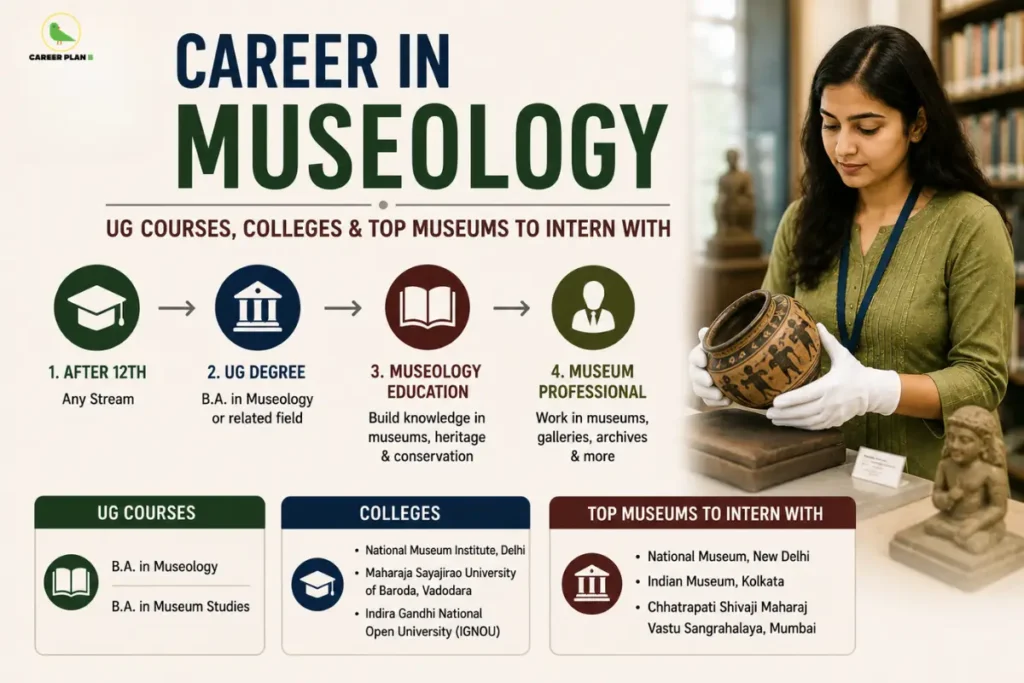
Introduction
Think about the last time you walked through a museum. The carefully labelled artefacts, the well-lit galleries, the stories told through centuries-old objects — none of that happens by accident. Behind every exhibit is a trained professional who studied, preserved, and curated that piece of history. That professional is a museologist.
India has a vast cultural heritage spanning thousands of years, with museums managed by the Ministry of Culture, the Archaeological Survey of India (ASI), state governments, and private bodies. The Ministry of Culture’s mandate includes the preservation, promotion, and dissemination of India’s tangible and intangible heritage through its network of museums, archives, and cultural institutions.
Yet museology remains one of the most underexplored career options for students after 12th. If you love history, art, culture, or science, this career path might be your calling.
What Is Museology?
Museology is the study of museums — their history, their role in society, and the professional activities they undertake, including curating, preservation, public programming, and education. It involves the study of historical and cultural material evidence such as manuscripts, art pieces, tools, earthenware, pottery, and architectural structures.
In simple words, museology teaches you how museums work — from acquiring artefacts to designing exhibitions that the public can meaningfully engage with. It sits at the crossroads of history, art, science, and communication.
Have Any Doubts?
UG Options After 12th: What Can You Study?
BA in Archaeology and Museology
At the undergraduate level, students can pursue a Bachelor of Arts in Archaeology and Museology — a 3-year degree available at select universities across India. The course covers Indian art history, museum collection and documentation, conservation and preservation, exhibition design, and museum education.
Eligibility: Candidates must have passed 10+2 from the Arts stream from a recognised board, with History as one of the compulsory subjects.
What About Science Students?
Science students can pursue museology at the postgraduate level after completing a bachelor’s degree in a relevant subject. Postgraduate programmes in museology accept graduates in Science, History, Humanities, Fine Arts, or Archaeology.
What Comes After UG?
Beyond the BA, students can pursue an MA in Museology, MA in Conservation, MA in History of Arts, or a PG Diploma in Museology. Research opportunities at the PhD level are available at several institutions. The National Museum Institute, New Delhi — a deemed university under the Ministry of Culture — offers PG and doctoral programmes specifically in Museology, History of Art, and Conservation.
Top Colleges Offering Museology in India:
| Institution | Location | Programme |
|---|---|---|
| National Museum Institute (NMI) | New Delhi | M.A. and Ph.D. in Museology, History of Art, and Conservation |
| University of Calcutta | Kolkata, West Bengal | M.A. / M.Sc. in Museology |
| The Maharaja Sayajirao University of Baroda (MSU) | Vadodara, Gujarat | Postgraduate Diploma and Ph.D. in Museology |
| Banaras Hindu University (BHU) | Varanasi, Uttar Pradesh | M.A. in Museology |
| University of Jammu | Jammu, Jammu & Kashmir | Postgraduate Diploma in Museology and Conservation |
The Department of Museology at Calcutta University is one of India’s pioneer departments in the field. It offers two-year full-time MA and MSc degrees, as well as doctoral and post-doctoral research programmes. Internship is a mandatory component — students must complete 90 days of fieldwork in museums, heritage institutes, or conservation laboratories.
Top Museums in India to Intern With
National Museum, New Delhi Internship
Internships play a vital role in museology because they provide practical experience in curation, conservation, documentation, and public engagement.
One of the best opportunities is the National Museum Internship Programme in New Delhi. The programme allows students to work with experts from the art and culture sector while gaining hands-on museum experience.
According to the National Museum’s official internship guidelines:
- Duration: 6 to 12 weeks
- Internship Batches: Summer (May–July) and Winter (December–February)
- Eligible Disciplines: History, Art History, Science, Architecture, Design, Engineering, Photography, Library Science, and Languages
- Stipend: No. The internship is unpaid, and the museum does not reimburse travel or accommodation expenses.
- Certificate: Students receive a certificate after successfully completing the internship. In addition, they must submit a final report and deliver a presentation.
- Application Requirement: Applicants must submit a form countersigned and officially stamped by the head of their institution.
Why This Internship Matters
Most importantly, the internship helps students understand how museums preserve, research, and present collections. As a result, they develop practical skills that strengthen their academic knowledge and improve their employability in the heritage sector.
Source: nationalmuseumindia.gov.in
2. National Gallery of Modern Art (NGMA)
NGMA offers on-the-job internships for students studying art and museum-related subjects, providing professional training and career opportunities. Interns work with NGMA’s vast collection and gain exposure to key museological concepts. NGMA’s experienced staff mentors and trains the next generation of museum professionals. NGMA operates branches in New Delhi, Mumbai, and Bengaluru.
Source: ngmaindia.gov.in
3. Indian Museum, Kolkata
Established in 1814, the Indian Museum is India’s oldest and largest museum, housing over 35 galleries covering archaeology, anthropology, art, economic botany, zoology, and geology. An internship here offers unmatched exposure to India’s most diverse collection.
4. Government Museum, Chennai
The second oldest museum in India, the Government Museum in Chennai is spread over 16.25 acres and is a landmark institution for students interested in natural history, archaeology, and numismatics.
5. Chhatrapati Shivaji Maharaj Vastu Sangrahalaya (CSMVS), Mumbai
One of India’s most progressive museums, CSMVS regularly runs internship and volunteer programmes for students interested in art history, conservation, and public engagement.
💡 Pro Tip: The National Museum’s internship programme requires a Statement of Purpose and institutional countersignature. Applications must be submitted through the official online portal — do not approach individual curators directly. (Source: nationalmuseumindia.gov.in )
Job Roles in Museology
A degree in museology opens doors to roles such as Curator, Conservation Specialist, Exhibit Designer, Archivist, Museum Educator, and Museum Administrator — in central government museums, state government institutions, private heritage organisations, and international cultural bodies.
The Ministry of Culture runs several museums and cultural institutions directly, including the National Museum, NGMA, and the Indian Museum, all of which are regular employers of trained museology professionals.
How Career Plan B Helps
Choosing museology requires aligning your interests, strengths, and goals. Career Plan B offers Personalised Career Counselling to assess whether heritage studies match your aptitude. Through Psycheintel and Career Assessment Tests, you can discover your fit for research-based, creative, and detail-oriented work. Their Admission and Academic Profile Guidance helps you identify the right UG institution and entrance requirements, while Career Roadmapping builds a structured plan from your 12th stream choice all the way to your first museum internship.
Get In Touch With Us
Frequently Asked Questions
Q1. Can I pursue museology after a Science background in 12th?
The BA route primarily requires Arts with History at 12th level. However, science students can pursue museology at the postgraduate level after completing a bachelor’s degree in a relevant subject such as conservation science or natural history.
Q2. Are museology internships paid in India?
As confirmed by the National Museum’s official internship programme page, these are unpaid internships. Interns may not claim any remuneration, including travel costs or accommodation. However, certificates are awarded on successful completion. (Source: nationalmuseumindia.gov.in )
Q3. Is museology a good career option in India?
Yes. As the Ministry of Culture continues to expand its network of museums and heritage sites, the demand for qualified museology professionals is steadily increasing.In addition, the National Mission on Cultural Mapping is actively documenting India’s cultural landscape. At the same time, this initiative is creating valuable opportunities for research, documentation, and heritage management. As a result, career opportunities are expanding across both the government and private heritage sectors. Consequently, trained museology graduates are becoming increasingly valuable to museums, cultural institutions, and heritage organisations.
Q4. What is the NMI and how do I apply?
The National Museum Institute (NMI), New Delhi is a deemed university under the Ministry of Culture offering MA and PhD programmes in Museology, History of Art, and Conservation. Admission is through a written entrance examination conducted by NMI. Visit nmi.gov.in for details.
Q5. What is the difference between museology and archaeology?
Archaeology focuses on excavating and studying ancient material culture. Museology focuses on how those objects are collected, preserved, displayed, and communicated to the public. Many UG programmes combine both disciplines.
Have Any Doubts?
Conclusion
The Past Needs People Who Care About It
Ultimately, every meaningful museum experience is possible because a museologist has preserved and interpreted the stories behind each artefact. Therefore, if you find beauty in historical objects, meaning in forgotten stories, and purpose in preservation, museology could become one of the most fulfilling careers to pursue after Class 12. In turn, you can help preserve India’s cultural heritage for future generations.
Start by finding the right UG course, building your academic profile, and targeting an internship at one of India’s great museums. Your journey into India’s cultural heritage begins now.
Ready to find your ideal career path? Take a Career Assessment Test with Career Plan B today.