Careerplanb · July 30, 2026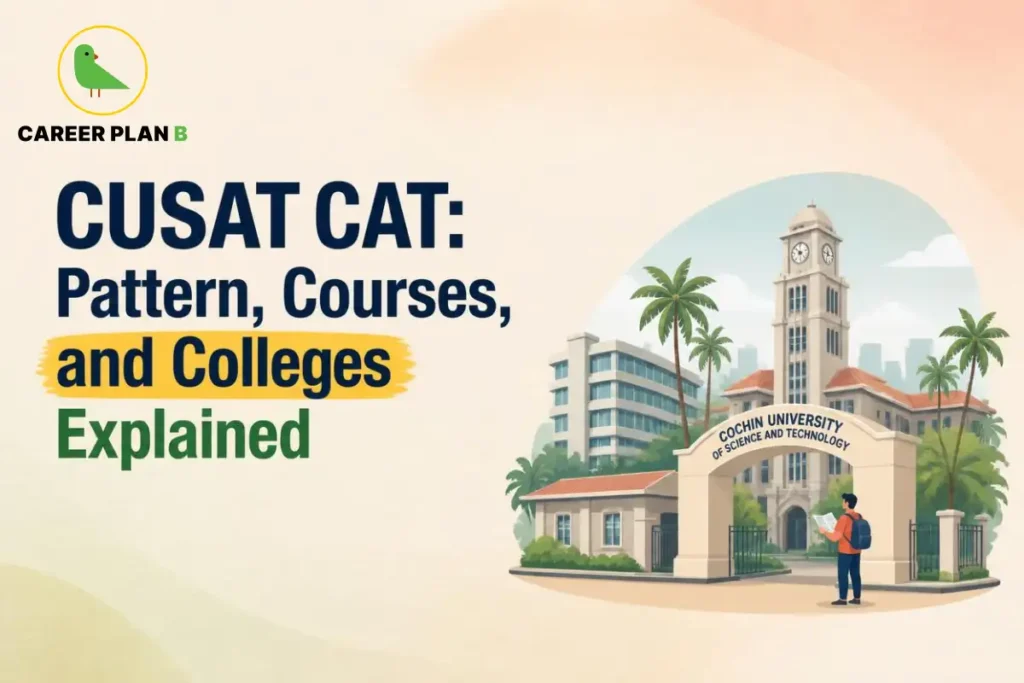
Introduction
Most students outside Kerala have barely heard of CUSAT CAT. That is their loss.
Cochin University of Science and Technology is a premier government university in Kochi, re-accredited with NAAC Grade A+. It ranks among the top 100 universities globally in the Times Higher Education Interdisciplinary Science Rankings 2026. The Common Admission Test it conducts, CUSAT CAT, is the gateway to B.Tech, LLB, BBA LLB, MCA, MBA, M.Tech, and over 130 programmes across CUSAT’s main campus and 29 participating colleges in Kerala.
Government university fees. Strong placement record. Unique specialisations in Naval Architecture, Safety and Fire Engineering, and Marine Engineering that no other institution in South India offers at the same depth.
This guide covers everything: the CUSAT CAT exam pattern for 2026, the complete course list with fees, the colleges that accept the score, and the selection process after the exam.
What Is CUSAT CAT? Quick Context
CUSAT CAT stands for Cochin University of Science and Technology Common Admission Test. It is conducted annually by CUSAT for admission to UG and PG programmes. The exam is held in online Computer-Based Test mode across exam centres in all 14 district headquarters of Kerala, plus select cities across India.
The 2026 CUSAT CAT was held on May 9, 10, and 11, 2026. Registration opened on January 27, 2026, and the last date for UG and PG courses was March 25, 2026. The final answer key was released after objection verification, and results are expected shortly after.
For aspirants targeting the 2027 cycle, registration is expected to open in late January 2027.
Have Any Doubts?
CUSAT CAT Exam Pattern 2026: Course-Wise Breakdown
CUSAT CAT does not have a single uniform pattern. The exam structure varies based on the programme you are applying for. This is one of the most important features of CUSAT CAT that aspirants must understand before applying.
B.Tech Pattern
This is the most common pattern and the one most CUSAT CAT aspirants prepare for.
| Section | Questions | Marks |
|---|---|---|
| Mathematics | 90 | 270 |
| Physics | 75 | 225 |
| Chemistry | 60 | 180 |
| Total | 225 | 675 |
- Duration: 3 hours
- Mode: Computer-Based Test
- Marking scheme: +3 for correct, -1 for incorrect, 0 for unattempted
- Question type: MCQs only
- Syllabus: Kerala Plus Two level for Physics, Chemistry, and Mathematics
The B.Tech pattern is syllabus-based. It tests Class 11 and 12 content directly, making NCERT books the primary preparation resource. Candidates from Kerala boards have a slight advantage given the syllabus alignment with the Kerala Plus Two curriculum.
LLB and BBA LLB Pattern
For law programmes, the pattern shifts to an aptitude-based format. The exam covers Legal Aptitude, General Knowledge, English Language, Logical Reasoning, and Numerical Aptitude. Duration is 2 hours. The marking scheme of +3 for correct and -1 for incorrect applies here as well.
MCA Pattern
The MCA exam has 150 questions over 2 hours. It covers Computer Science and Applications (100 questions) and Logical Reasoning (50 questions). Marking is +3 for correct and -1 for incorrect.
B.Voc Pattern
The B.Voc exam is 150 questions over 2 hours. It covers Numerical Reasoning Ability (60 questions), English Language Proficiency (45 questions), and Comprehension and Logical Reasoning (45 questions).
PG Programme Patterns
For M.Tech, M.Sc, and MBA, the CUSAT CAT pattern is programme-specific and tests UG-level subject knowledge relevant to the field. MBA admission at CUSAT, however, is not through CUSAT CAT. It uses CAT (IIM), CMAT, KMAT Kerala, or CUET PG scores, followed by GD and PI rounds conducted by the School of Management Studies.
Eligibility: What You Need Before Applying
Eligibility criteria differ by programme. Here are the key requirements:
B.Tech: Pass Higher Secondary examination from a recognised board with minimum 50 percent marks overall. Physics, Chemistry, and Mathematics are mandatory subjects. A minimum of 50 percent in the PCM combination is required. Candidates from outside Kerala should note that certain specialised courses like Naval Architecture, Ship Technology, and Safety and Fire Engineering may have restrictions for non-Kerala applicants.
LLB (5-year integrated): Pass Class 12 from a recognised board with minimum 50 percent marks. No specific stream restriction.
BBA LLB (Hons.): Same as LLB. Class 12 passed with 50 percent minimum.
MCA: Bachelor’s degree in any subject with Mathematics as a compulsory paper and minimum 50 percent aggregate.
MBA: Bachelor’s degree in any subject with minimum 50 percent marks. SC and ST candidates from Kerala require only pass marks in the qualifying degree.
Application fee: Varies by category and number of test codes selected. The fee covers a maximum of two test codes. Candidates applying for multiple programmes must select the appropriate test code for each.
Courses Offered at CUSAT: The Full Picture
CUSAT offers 138 programmes at UG, PG, and doctoral levels. The fee structure at (admissions.cusat.ac.in) is government-level, making it one of the most affordable research and science universities in India.
B.Tech Specialisations (16 tracks)
The most popular programmes at CUSAT are B.Tech programmes. Computer Science and Engineering is the highest-demand track. The full list includes:
- Computer Science and Engineering
- Electronics and Communication Engineering
- Electrical and Electronics Engineering
- Mechanical Engineering
- Civil Engineering
- Chemical Engineering
- Information Technology
- Naval Architecture and Ship Building
- Safety and Fire Engineering
- Marine Engineering
- Polymer Science and Engineering
- Industrial Engineering
- Ship Technology
- Instrumentation Technology
- Photonics
- Aerospace Engineering
B.Tech fee: Rs 75,600 to Rs 1.35 lakh per year depending on specialisation, making the total four-year cost between Rs 3 lakh and Rs 5.4 lakh. Naval Architecture and Marine Engineering are unique nationally significant programmes not widely available elsewhere in South India. Safety and Fire Engineering is similarly distinctive and feeds directly into industrial safety careers.
Law Programmes
CUSAT offers LLB (5-year), BBA LLB (Hons.), B.Com LLB (Hons.), and B.Sc LLB (Hons. in Computer Science), and LLM at the postgraduate level. These programmes are accessible through CUSAT CAT and produce graduates who enter corporate law, maritime law, and government legal practice.
Management Programmes
The School of Management Studies (SMS) at CUSAT is one of the most reputed B-schools in South India. The MBA programme runs for two years. An Evening MBA is also available for three years. The current average CTC from SMS CUSAT stands at Rs 9.14 LPA, with the highest package at Rs 23 LPA. Over 35 companies participate in placements annually, including SunTec, Wipro, IBM, and Infosys.
MBA fees: Rs 70,070 per year, totalling approximately Rs 1.4 lakh for the two-year programme. This is among the lowest MBA fees for a NAAC A+ accredited university in India.
MCA and M.Tech
MCA fees at CUSAT are Rs 18,510 per year, with total course fees of Rs 55,530 for the three-year programme. M.Tech fees are comparable. Both programmes are accessible through CUSAT CAT for computer science and engineering disciplines.
M.Sc Programmes (21 specialisations)
CUSAT offers integrated B.Sc plus M.Sc programmes in Mathematics, Statistics, Computer Science (Artificial Intelligence and Data Science), and other science disciplines. These integrated programmes are growing in popularity among students who want a research-intensive pathway without the engineering track.
Colleges Accepting CUSAT CAT Score: The 29 Participating Institutes
CUSAT CAT scores are accepted by 29 participating institutes across Kerala for B.Tech admissions. These provide a combined total of over 3,000 engineering seats across various specialisations. The participating institutes include both government and private engineering colleges affiliated with CUSAT.
The three primary institutions under the CUSAT umbrella are:
- Cochin University of Science and Technology, Thrikkakara, Kochi (Main Campus): The flagship institution with the strongest placement record. Computer Science, Electronics, and specialised engineering programmes like Naval Architecture and Safety and Fire Engineering attract the highest demand.
- Cochin University College of Engineering, Kuttanad: The second CUSAT-run campus, located in Kuttanad, Alappuzha district. It offers B.Tech programmes with comparable fee structures.
- Cochin University College of Engineering, Thrikkaripur: The third CUSAT-run campus in North Kerala, accessible to students from the Kasaragod and Kannur districts.
Beyond these three, the 29 participating institutes include:
- Model Engineering College, Kochi
- MG College of Engineering, Thiruvallam, Thiruvananthapuram
- College of Engineering, Pallipuram, Cherthala, Alappuzha
- TKM Institute of Technology, Kollam
- Co-operative Institute of Technology, Vadakara, Kozhikode
- College of Engineering, Thrikkaripur, Kasaragod
- Sarabhai Institute of Science and Technology, Thiruvananthapuram
- Central Institute of Fisheries, Nautical and Engineering Training (CIFNET), Kochi
- Institutions under Southern Naval Command Headquarters, Kochi
- Over 20 additional government and private engineering colleges spread across all 14 Kerala districts
The final seat allotment across all 29 participating institutes is based on rank and programme choice during the centralised counselling process conducted by CUSAT after results.
The Post-Exam Process: Counselling and Seat Allotment
Qualifying CUSAT CAT produces a rank card. The rank card mentions the candidate’s name, roll number, marks attained, rank, and application number. It is the basis for the counselling process.
CUSAT conducts centralised counselling after results. Candidates log in to the official admissions portal, enter their programme and institute preferences in order of priority, and seats are allotted based on rank and availability. Multiple counselling rounds are conducted including a general round, supplementary round, and spot admission round for remaining seats.
All seat allotment notifications, reporting dates, and fee payment deadlines are published here. Candidates who miss a reporting deadline forfeit their allotted seat.
Merit seats are available for high rankers at significantly reduced fees. Scholarship and financial aid are available for SC, ST, and OBC students, with free education provisions for certain categories under government norms.
How Career Plan B Helps
Preparing for CUSAT CAT, selecting the right programme and institute from 29 options, and planning a post-graduation career path from CUSAT requires structured guidance.
Career Plan B’s Personalised Career Counselling helps you identify which CUSAT programme aligns with your long-term goals.
Psycheintel Career Assessment Tests identify whether your aptitudes align with engineering, law, management, or science tracks.
Admission Guidance covers CUSAT CAT preparation strategy and counselling navigation, while Career Roadmapping builds a structured plan from entrance exam to your first career role.
Get In Touch With Us
Frequently Asked Questions
Q1. What is the CUSAT CAT 2026 exam pattern for B.Tech?
The exam has 225 MCQs across Mathematics (90), Physics (75), and Chemistry (60), with +3 for correct and -1 for incorrect answers, in a 3-hour CBT format.
Q2. How many colleges accept CUSAT CAT scores?
CUSAT CAT 2026 is accepted by 29 participating institutes across Kerala for B.Tech admissions, offering a combined total of over 3,000 seats.
Q3. Does CUSAT CAT apply to MBA admissions?
No. MBA admission at CUSAT’s School of Management Studies is through CAT (IIM), CMAT, KMAT Kerala, or CUET PG scores, not through CUSAT CAT.
Q4. What are the unique engineering programmes at CUSAT not widely available elsewhere?
Naval Architecture and Ship Building, Safety and Fire Engineering, and Marine Engineering are nationally significant programmes at CUSAT with limited availability at other South Indian institutions.
Q5. What is the application deadline for CUSAT CAT 2027?
Based on 2026 patterns, registration opens in late January 2027 and closes around late March 2027.
Have Any Doubts?
Conclusion
CUSAT CAT is not a well-publicised exam outside Kerala. That oversight consistently leaves opportunities on the table for students who would benefit most from what CUSAT offers.
Government-level fees ranging from Rs 75,600 per year for B.Tech to Rs 70,070 per year for MBA. NAAC A+ accreditation. A 29-college network across all 14 Kerala districts. And genuinely unique programmes in Naval Architecture, Marine Engineering, and Safety and Fire Engineering that no other South Indian institution offers with the same institutional depth.
For students targeting Kerala-based engineering, law, or management careers, CUSAT CAT delivers one of the strongest fee-to-outcome ratios available through any state-level entrance exam in India. The counselling process is centralised and rank-based, removing the uncertainty of independent college applications.
Appear early. Prepare from the Kerala Plus Two syllabus for B.Tech. And use the counselling process to secure the right programme, not just the most familiar name on the list.