Team5 · July 31, 2026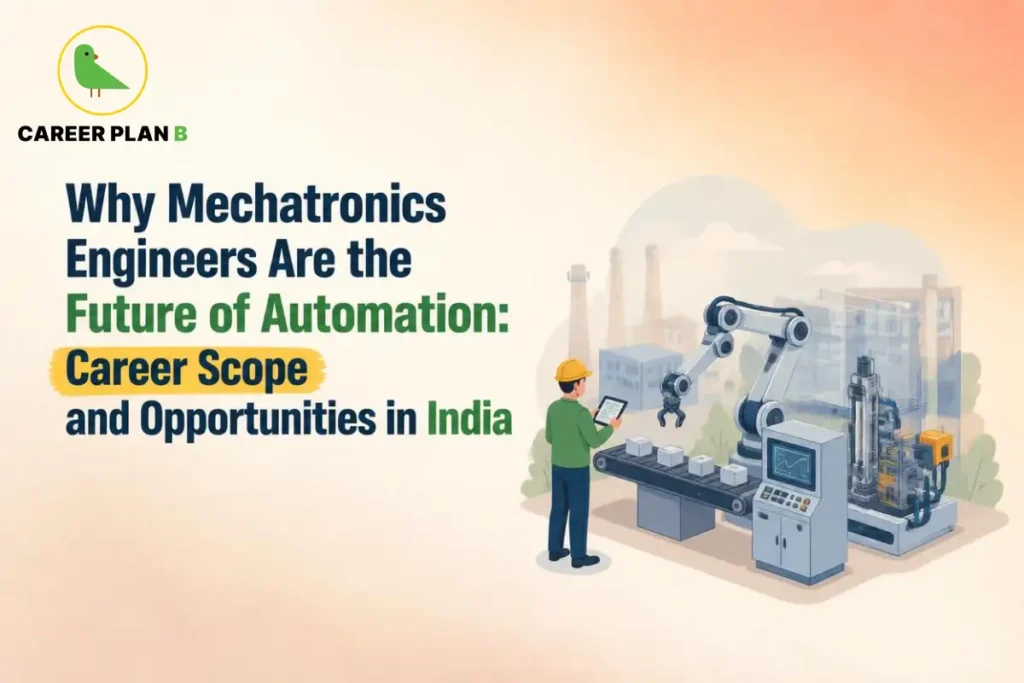
Introduction
Every robotic arm that welds a car body, every automated conveyor that sorts thousands of packages per hour, every drone that delivers medicine to a remote village, and every smart sensor that monitors a factory floor in real time has one thing in common a mechatronics engineer made it work. Not a mechanical engineer alone. Also Not an electrical engineer alone. Not a software engineer alone. A professional who understands all three and knows how to integrate them into a single, intelligent, functioning system.
This is precisely why mechatronics engineers are the future of automation. As India accelerates its transition toward Industry 4.0, smart manufacturing, and robotics-driven production, the demand for engineers who can bridge the gap between physical machines, electronic systems, and intelligent software has never been higher. Mechatronics is no longer a niche specialisation it is becoming the most essential engineering discipline of the automation era.
In this blog, we cover what mechatronics engineering actually involves, why it sits at the centre of India’s automation push, which job roles are available and what they pay, what skills you need to build, and why the mechatronics engineering career scope in India is set to grow dramatically through the rest of this decade.
What Is Mechatronics Engineering?
Mechatronics engineering is the multidisciplinary branch of engineering that combines mechanical engineering, electrical engineering, electronics, and computer science into a single integrated discipline. The term itself a fusion of mechanics and electronics was coined in Japan in the 1960s, and it has since evolved into one of the most versatile and in-demand engineering specialisations in the world.
Where a mechanical engineer designs the physical structure of a system and an electrical engineer designs its power and control circuits, a mechatronics engineer designs the entire system ensuring that the mechanical components, electronic sensors, actuators, microcontrollers, and software all work together seamlessly to achieve a desired outcome.
This integrative capability is what makes mechatronics uniquely suited to the age of automation. Modern automated systems are not purely mechanical or purely electronic they are complex, interconnected, cyber-physical systems that require engineers who think across disciplines. Mechatronics engineers are trained to do exactly that, which is why they are increasingly the engineers of choice for companies building the next generation of automated machines, robotic systems, and smart manufacturing infrastructure.
Why Mechatronics Engineers Are at the Centre of India’s Automation Push
India’s manufacturing sector is undergoing the most significant technological transformation in its history. Driven by the Government of India’s push toward advanced manufacturing, global competitiveness, and self-reliance in critical industries, factories across the country are adopting automation, robotics, and digital systems at an accelerating pace.
The National Manufacturing Policy, supported by the Ministry of Commerce and Industry, aims to increase manufacturing’s share of India’s GDP to 25 percent and create 100 million jobs by 2025. Achieving this target requires not just more factories it requires smarter, more efficient, more automated factories. And smart manufacturing and mechatronics engineering are inseparable in this transformation.
The Make in India initiative is attracting global manufacturers across electronics, automotive, aerospace, defence, and pharmaceuticals all of which are heavily automation-dependent sectors. Production Linked Incentive schemes across 14 key sectors are further driving investment in automated production lines that require mechatronics-skilled engineers to design, install, commission, and maintain.
At the same time, India’s labour cost advantages are gradually being offset by the need for precision, consistency, and speed all of which automation delivers better than manual processes. This creates a structural, long-term demand for engineers who understand automation systems from the ground up. Mechatronics engineers, trained to work across mechanical, electronic, and software domains, are the natural answer to this demand.
The convergence of industrial automation jobs for engineers India with the broader Industry 4.0 transformation means that mechatronics engineers are not just filling existing roles they are creating entirely new ones that did not exist five years ago.
Key Job Roles for Mechatronics Engineers in Automation
Understanding the specific roles available in the automation ecosystem is essential for planning your career. Here is a detailed breakdown of the most in-demand positions for mechatronics engineers:
Robotics and Automation Engineer
This is the most directly associated role with mechatronics expertise. Robotics and automation engineers design, programme, install, and maintain robotic systems used in manufacturing, logistics, healthcare, and defence. They work with industrial robots from companies like FANUC, ABB, KUKA, and Universal Robots programming motion paths, integrating end-of-arm tooling, and ensuring that robotic cells operate safely and efficiently within larger production systems.
Automation and robotics engineering careers India are growing rapidly across the automotive, electronics, and FMCG sectors, where companies are replacing manual assembly operations with automated robotic cells to improve quality and throughput. This role requires strong skills in robot programming languages, mechanical systems integration, and safety standards.
PLC and SCADA Systems Engineer
Programmable Logic Controllers and Supervisory Control and Data Acquisition systems are the backbone of industrial automation. PLC and SCADA engineers design, programme, and maintain the control systems that run automated machinery on factory floors. They write ladder logic and function block programmes, configure HMI screens, set up communication networks between machines, and troubleshoot control system faults.
This role is one of the most consistently in-demand in India’s industrial automation jobs for engineers landscape, with opportunities across power plants, water treatment facilities, oil and gas installations, automotive plants, and food and beverage manufacturing. PLC programming is one of the most foundational skills required for mechatronics engineers entering the automation field.
Industrial IoT Engineer
The Industrial Internet of Things IIoT is the technology layer that connects machines, sensors, and systems across a factory or supply chain, enabling real-time data collection, remote monitoring, and predictive analytics. Industrial IoT engineers design and deploy sensor networks, configure data acquisition systems, manage edge computing devices, and integrate IIoT platforms with enterprise software systems like ERP and MES.
This role sits squarely at the intersection of mechatronics, data engineering, and connectivity and it is one of the fastest-growing positions in smart manufacturing and mechatronics engineering today. Companies across all manufacturing sectors are investing in IIoT infrastructure, and engineers who understand both the physical systems and the digital connectivity layer are in exceptional demand.
Control Systems Engineer
Control systems engineers design the algorithms and hardware that regulate the behaviour of automated systems ensuring that machines respond correctly to inputs, maintain desired operating conditions, and handle disturbances safely. This includes everything from PID controller design for temperature and speed regulation to advanced model predictive control for complex industrial processes.
This is one of the most technically demanding mechatronics roles, requiring strong foundations in control theory, mathematics, and signal processing. Control systems engineers work across process industries, aerospace, automotive, and robotics making it one of the most versatile specialisations within the broader mechatronics engineering career scope in India.
Smart Manufacturing and Industry 4.0 Engineer
This is an emerging and rapidly growing role that focuses on implementing and optimising the full suite of Industry 4.0 technologies robotics, IIoT, digital twins, AI-powered quality inspection, and cyber-physical systems within manufacturing environments. Smart manufacturing engineers work across the entire technology stack, from physical machine integration to data analytics and process optimisation.
Companies implementing smart factory initiatives across India are actively looking for engineers with this cross-disciplinary profile, making it one of the most exciting and well-compensated roles available to mechatronics graduates today.
Skills Required for Mechatronics Engineers
Building the right skill foundation is the single most important investment an aspiring mechatronics engineer can make. Here is a comprehensive breakdown of the skills required for mechatronics engineers across technical and professional dimensions:
Core Technical Knowledge
- PLC Programming: Ladder logic, function block diagrams, structured text Siemens TIA Portal, Allen-Bradley Studio 5000, Mitsubishi GX Works
- Robotics and Motion Control: Robot programming, kinematics, motion path design, end-of-arm tooling integration
- Embedded Systems and Microcontrollers: Arduino, Raspberry Pi, STM32, and ARM-based controllers for smart device development
- Sensor Technology and Instrumentation: Proximity sensors, encoders, vision systems, force-torque sensors, and their integration with control systems
- Electrical and Electronics Fundamentals: Circuit design, power electronics, motor drives, and variable frequency drives
- Pneumatics and Hydraulics: Understanding fluid power systems used extensively in industrial automation machinery
- Control Systems Theory: PID control, feedback loops, system modelling, and stability analysis
Software and Simulation Tools
- MATLAB and Simulink: For control system design, simulation, and model-based engineering
- LabVIEW: For data acquisition, instrument control, and test automation
- SolidWorks and AutoCAD: For mechanical design and system layout
- ROS Robot Operating System: For advanced robotics programming and autonomous systems development
- ANSYS and COMSOL: For simulation of mechatronic systems
- Digital Twin Platforms: Siemens Tecnomatix, NVIDIA Omniverse, and similar tools for virtual factory modelling
For structured academic credentials, AICTE-recognised engineering programmes in Mechatronics, Electronics, or Mechanical Engineering provide the foundational qualifications that employers require. NSDC-aligned certification programmes offer industry-recognised upskilling in automation, robotics, PLC programming, and IIoT technologies that complement degree-level education with practical, job-ready skills.
Emerging Skills for Future-Ready Mechatronics Engineers
- Industrial IoT and Edge Computing: Connecting physical machines to digital platforms for real-time monitoring and control
- AI and Machine Vision Integration: Deploying AI-powered quality inspection systems and autonomous guided vehicles
- Digital Twin Development: Creating virtual replicas of physical systems for simulation, optimisation, and predictive maintenance
- Cybersecurity for Industrial Systems: Protecting connected automation systems from cyber threats an increasingly critical competency
Soft Skills That Matter
- Systems thinking: The ability to understand how mechanical, electronic, and software components interact and affect each other
- Cross-disciplinary collaboration: Working effectively with mechanical, electrical, and software engineering teams simultaneously
- Problem-solving under time pressure: Automation systems downtime is extremely costly fast, accurate troubleshooting is highly valued
- Adaptability: The automation technology landscape evolves rapidly continuous learning is non-negotiable
Mechatronics Engineering Career Scope in India
The mechatronics engineering career scope in India is broad, growing, and increasingly central to every sector of the economy that depends on manufacturing, production, or automated systems. Here is a sector-by-sector breakdown:
Top Sectors Hiring Mechatronics Engineers
- Automotive and EV Manufacturing: Robotic assembly lines, automated welding, EV battery assembly automation
- Aerospace and Defence: Unmanned systems, missile guidance, aircraft manufacturing automation
- Electronics and Semiconductor Manufacturing: Precision pick-and-place robots, automated optical inspection systems
- FMCG and Food Processing: Packaging automation, filling and sealing lines, quality inspection systems
- Logistics and Warehousing: Automated guided vehicles, conveyor systems, warehouse robotics
- Pharmaceuticals: Sterile manufacturing automation, packaging lines, laboratory automation
- Smart Cities and Infrastructure: Building automation systems, traffic management, energy management
Top Government Employers
- DRDO Defence Research and Development Organisation: Unmanned systems, robotics for defence applications, smart weapon systems, and automated manufacturing for defence equipment
- ISRO Indian Space Research Organisation: Robotic systems, spacecraft assembly automation, rover design, and launch vehicle systems integration
- HAL Hindustan Aeronautics Limited: Aircraft manufacturing automation, robotic assembly systems, and avionics integration
- BHEL Bharat Heavy Electricals Limited: Automated manufacturing systems for power plant equipment and industrial machinery
- BEL Bharat Electronics Limited: Defence electronics manufacturing automation and robotic assembly systems
Government Job Pathways for Mechatronics Engineers
- GATE Examination: The primary route into PSU jobs at BHEL, DRDO, ISRO, and BEL for electronics and mechanical engineering graduates
- UPSC Engineering Services Examination: For Group A and Group B Central Government engineering posts in electronics and mechanical streams
- PSU Direct Recruitment: Several PSUs conduct their own written tests for specific automation and electronics engineering roles
Top Private Sector Employers
- Siemens India: Factory automation, digital industries, and smart infrastructure divisions
- ABB India: Robotics, motion control, and industrial automation systems
- Bosch India: Automotive automation, Industry 4.0 solutions, and connected manufacturing
- FANUC India: Industrial robots, CNC systems, and factory automation
- Honeywell India: Process automation, building management systems, and industrial IoT
- Rockwell Automation India: PLC and SCADA systems, smart manufacturing solutions
- Schneider Electric India: Industrial automation, energy management, and smart factory systems
Mechatronics Engineer Job Roles and Salary
Understanding realistic mechatronics engineer job roles and salary expectations helps you plan your career progression with clear benchmarks.
Salary Range for Mechatronics Engineers in India
| Experience Level | Salary Range | Typical Roles |
|---|---|---|
| Fresher (0–2 years) | ₹3.5 LPA – ₹7 LPA | Graduate Engineer Trainee, Automation Technician |
| Mid-Level (3–6 years) | ₹8 LPA – ₹16 LPA | Automation Engineer, PLC/SCADA Engineer, Robotics Engineer |
| Senior / Specialist (7+ years) | ₹18 LPA – ₹35 LPA+ | Lead Automation Engineer, Systems Architect, R&D Manager |
Engineers working in multinational automation companies like Siemens, ABB, Bosch, and Honeywell tend to command salaries at the upper end of these ranges, with additional benefits including international training programmes, performance bonuses, and global project exposure.
Private vs Government Pay Scale
In the private sector, mechatronics engineers at multinational automation companies can earn ₹20 LPA to ₹35 LPA in senior roles. Performance and continuous upskilling often lead to faster salary growth. Government roles at PSUs such as BHEL, DRDO, and ISRO follow structured IDA pay scales. They also offer benefits such as housing, medical coverage, pensions, and strong job security. These advantages significantly increase total compensation, especially at the mid and senior levels.
Global Salary Comparison
For mechatronics engineers working abroad, the earning potential is considerably higher:
- United States: $85,000 – $1,30,000 per year (automation, robotics, aerospace sectors)
- Germany: €60,000 – €90,000 per year (automotive automation, industrial machinery)
- Japan: ¥6,000,000 – ¥10,000,000 per year (robotics, precision manufacturing)
- UAE: AED 1,20,000 – AED 2,00,000 per year (oil and gas automation, smart infrastructure)
- Canada: CAD 75,000 – CAD 1,10,000 per year (manufacturing automation, energy sector)
This global earning potential makes mechatronics one of the strongest engineering branches for international career mobility particularly in automation-heavy economies like Germany, Japan, and the US.
Have Any Doubts?
Mechatronics vs Mechanical Engineering Which Is Better for Automation Careers?
The mechatronics vs mechanical engineering career question is common among students choosing an engineering branch. The answer depends on the type of work you want to do and the industry you want to join. A mechanical engineering degree is an excellent choice for careers in design, manufacturing, thermal systems, and structural engineering. These roles mainly focus on physical systems with limited electronic or software integration. Mechatronics engineering is a better fit for careers in automation, robotics, and smart manufacturing. It provides a stronger foundation for these industries because it combines mechanical, electronic, and software engineering. This multidisciplinary approach matches the requirements of modern automated systems.
Choose Mechatronics Engineering if you:
- Are specifically interested in automation, robotics, and smart manufacturing careers
- Want to work with integrated systems rather than purely mechanical or purely electronic systems
- Are drawn to cutting-edge technology roles at the intersection of hardware and software
- Want maximum career flexibility across automotive, aerospace, defence, logistics, and electronics sectors
Choose Mechanical Engineering if you:
- Are interested in design, thermal systems, manufacturing, or structural engineering roles
- Want the broadest possible range of core engineering career options
- Plan to specialise at the postgraduate level in mechatronics or automation after building a strong mechanical foundation
The most important insight for the current job market is this: hybrid skills win in Industry 4.0. Whether you hold a mechatronics degree or a mechanical engineering degree, the engineers who build cross-disciplinary expertise in both physical systems and automation technologies will consistently be in the strongest career positions across industrial automation jobs for engineers India and globally.
How Career Plan B Helps
Mechatronics engineering opens doors across some of the most exciting and well-paying career paths in India’s automation, robotics, and smart manufacturing ecosystem but knowing which door to walk through requires more than enthusiasm. Career Plan B offers personalised career counselling, PsycheIntel Career Assessment Tests, and structured Career Roadmapping to help mechatronics engineering students and graduates identify the right specialisation whether PLC and SCADA systems, robotics engineering, industrial IoT, or smart manufacturing and build a clear, actionable plan to enter and grow in India’s fast-expanding automation industry.
For Latest Information
Frequently Asked Questions
- What is the career scope of mechatronics engineering in India?
The mechatronics engineering career scope in India is strong and growing rapidly across automotive, aerospace, defence, electronics manufacturing, FMCG, logistics, and pharmaceuticals. India’s Industry 4.0 transition and Make in India initiative are driving significant investment in automated production systems creating sustained demand for mechatronics engineers who can design, commission, and maintain these systems across both government and private sector organisations.
- What are the top skills required for mechatronics engineers in the automation industry?
The most important skills required for mechatronics engineers include PLC programming, robotics and motion control, embedded systems, sensor integration, control systems theory, MATLAB and Simulink, and industrial IoT. Emerging skills in digital twins, AI-powered machine vision, and cybersecurity for industrial systems are increasingly valued by employers in smart manufacturing and automation roles.
- Is mechatronics engineering better than mechanical engineering for automation careers?
For roles specifically in automation, robotics, and smart manufacturing, mechatronics engineering provides a more directly relevant skill foundation than pure mechanical engineering because it integrates mechanical, electronic, and software expertise. However, mechanical engineers who build additional skills in PLC programming, robotics, and automation systems can also access strong automation careers.
- Which government organisations hire mechatronics engineers in India?
The leading government employers for mechatronics engineers in India include DRDO, ISRO, HAL, BHEL, and BEL. DRDO and ISRO hire for robotics, unmanned systems, and spacecraft automation roles. HAL recruits for aircraft manufacturing automation. BHEL hires for power plant equipment manufacturing automation. BEL recruits for defence electronics manufacturing systems.
Conclusion
The evidence is compelling and the direction is clear why mechatronics engineers are the future of automation is not a prediction, it is already a reality taking shape on factory floors, in warehouses, on defence testing grounds, and in space research laboratories across India and the world. The engineers who can seamlessly integrate mechanical systems, electronic controls, and intelligent software are not just filling roles they are defining what the next generation of industrial and automated systems looks like.
India’s manufacturing ambition, backed by Make in India, PLI schemes, and Industry 4.0 adoption, is creating a wave of opportunity for mechatronics engineers that will only grow stronger through the rest of this decade. The only question is whether you are building the skills, the knowledge, and the career strategy to be part of it.
If you are a mechatronics engineering student or graduate trying to navigate the automation landscape and find the right specialisation, Career Plan B is built to help you get there with personalised assessments, expert counselling, and a career roadmap tailored to your strengths and the real demands of India’s fast-moving automation industry.
The machines are getting smarter. The factories are getting faster. The engineers who understand both will lead the way.