Team6 · July 9, 2026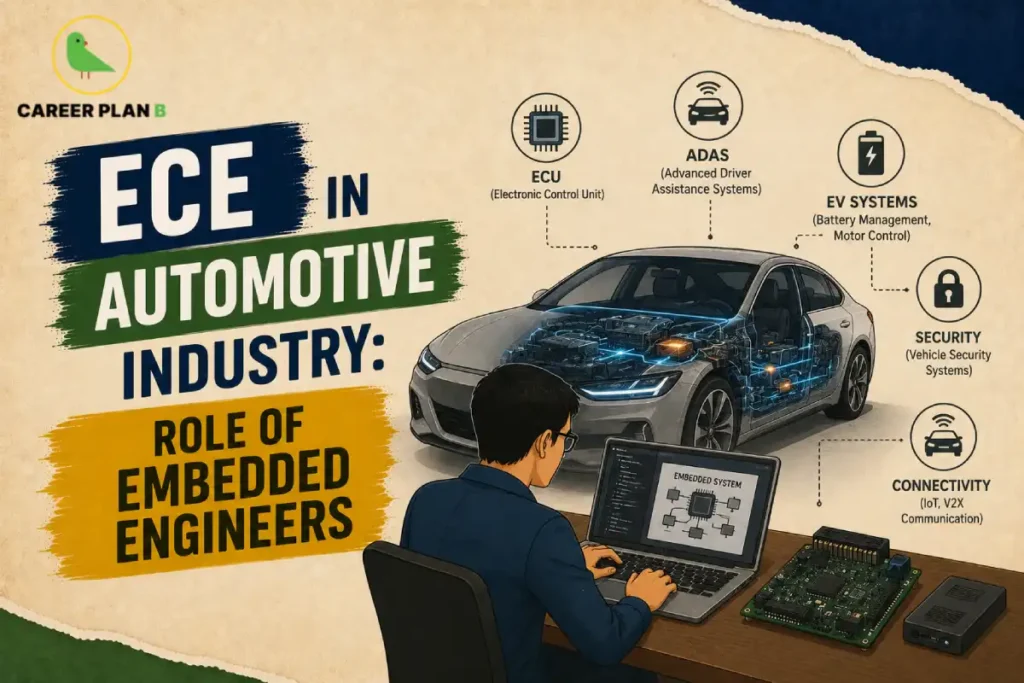
Introduction
Think about the last time you used a car’s parking sensor, lane assist, or touchscreen navigation. None of that is mechanical. All of it is electronics.
Today’s modern vehicles contain anywhere between 50 to 150 Electronic Control Units (ECUs), small embedded computers managing everything from engine performance to airbag deployment. In premium EVs like Tesla, that number goes even higher. The truth is simple: the automobile industry is no longer just a mechanical domain. It has become one of the largest consumers of electronics and embedded technology in the world.
This is exactly why ECE in the automotive industry has emerged as one of the most exciting and high-growth career paths for electronics engineers today. The demand for skilled embedded engineers in automotive is rising sharply both in India and globally as vehicles become smarter, safer, and increasingly software-defined.
If you are an ECE graduate wondering where your future lies, this blog unpacks the full picture from what embedded engineers actually do in the automotive sector to career scope, salary, and the skills you need to get there.
How ECE Became Central to the Automotive Industry
For most of the 20th century, the automobile was a triumph of mechanical engineering. But from the 1990s onwards, electronics quietly began taking over, and today, the role of ECE in the automobile sector is absolutely foundational.
Modern vehicles rely on a complex web of sensors, microcontrollers, communication protocols, and software to function. Features like anti-lock braking systems (ABS), electronic fuel injection, traction control, and adaptive cruise control are all made possible by automotive embedded systems.
According to industry estimates, electronics now account for nearly 40% of a car’s total manufacturing cost, a figure expected to reach 50% by 2030. With EVs and autonomous vehicles accelerating this shift, the automobile industry is fast becoming an electronics-first sector. And at the heart of it all is the embedded engineer.
What Does an Embedded Engineer Do in the Automotive Sector?
An embedded software engineer in automotive is responsible for developing, testing, and validating the software that runs inside a vehicle’s electronic control units. Unlike traditional software development, embedded engineering in automotive demands extreme precision because a bug in a car’s braking or steering system is not just a glitch; it is a safety risk.
Core responsibilities of an automotive embedded engineer include:
- Writing and optimising firmware in C and C++ for ECUs
- Developing and integrating software using the AUTOSAR framework (Automotive Open System Architecture)
- Working with communication protocols like CAN (Controller Area Network), LIN, and FlexRay
- Performing Hardware-in-the-Loop (HIL) and Software-in-the-Loop (SIL) testing
- Ensuring code quality using MISRA C coding standards
- Collaborating with hardware teams for sensor integration and validation
- Debugging real-time embedded software issues
The work requires a deep understanding of both hardware and software, making ECE graduates with strong fundamentals in microcontrollers, digital electronics, and programming naturally well-suited for this field.
Key Areas Where Embedded Engineers Work in Automotive
The scope of automotive embedded systems spans almost every system inside a modern vehicle. Here are the key domains where embedded engineers make their mark:
1. ADAS – Advanced Driver Assistance Systems
ADAS features like automatic emergency braking, blind spot detection, and lane-keeping assist rely heavily on embedded engineers who can integrate radar, LiDAR, and camera data into real-time decision-making systems.
2. Powertrain and Engine Control Units (ECU)
The ECU is essentially the brain of a vehicle’s engine. Embedded engineers develop the algorithms that control fuel injection, emission levels, torque distribution, and gear shifts critical for both performance and compliance.
3. EV Battery Management Systems (BMS)
In electric vehicles, the battery management system monitors cell voltage, temperature, and charge cycles to ensure safety and efficiency. This is one of the fastest-growing specialisations in ECE job opportunities in the automobile industry.
4. Infotainment and Connectivity Systems
From Android Auto integration to over-the-air (OTA) software updates, embedded engineers build the connected car experience that modern consumers expect.
5. Vehicle Communication Networks
Every ECU in a car talks to others through communication buses. Embedded engineers design and maintain these networks using protocols like CAN, LIN, and the emerging Automotive Ethernet standard.
Career Scope for ECE Graduates in the Automotive Industry
The career scope for ECE in automotive is expanding rapidly, and India is right in the middle of this transformation.
India is the world’s third-largest automobile market. The government’s push for electric mobility under the FAME India Scheme (Faster Adoption and Manufacturing of Hybrid and Electric Vehicles) is creating thousands of new roles in EV electronics, embedded systems, and automotive software. You can explore official updates on this initiative through the Ministry of Heavy Industries, Government of India.
Key organisations and companies hiring embedded engineers in India:
- DRDO (Defence Research and Development Organisation) for defence vehicle electronics and embedded systems
- NATRiP (National Automotive Testing and R&D Infrastructure Project) India’s premier automotive testing and R&D body under the Ministry of Heavy Industries
- TATA Motors, Mahindra, and Maruti Suzuki all aggressively building in-house embedded teams for EVs
- Bosch India, Continental, and Aptiv global Tier-1 automotive suppliers with large embedded engineering centres in India
- Global OEMs like BMW, Ford, and Volkswagen with India-based engineering and R&D centres
For students targeting academic and research pathways, AICTE and IIT automotive research centres offer structured programmes aligned with industry needs.
Globally, countries like Germany, Japan, South Korea, and the United States have massive demand for automotive embedded engineers, making this one of the strongest branches for international career opportunities.
Have Any Doubts?
ECE Job Opportunities in Automobile Industry – Roles and Salary
Here is a practical look at ECE job opportunities in the automobile industry for Indian graduates:
| Job Role | Fresher Salary | Experienced (3-5 yrs) |
|---|---|---|
| Embedded Software Engineer | ₹4 – ₹7 LPA | ₹10 – ₹20 LPA |
| ECU Developer | ₹4 – ₹6 LPA | ₹9 – ₹18 LPA |
| ADAS Engineer | ₹5 – ₹8 LPA | ₹12 – ₹25 LPA |
| BMS Engineer (EV) | ₹4.5 – ₹7 LPA | ₹10 – ₹20 LPA |
| Automotive Testing Engineer | ₹3.5 – ₹6 LPA | ₹8 – ₹15 LPA |
Top Recruiters: Bosch, Continental, Tata Elxsi, KPIT Technologies, Aptiv, Mahindra, Maruti Suzuki, L&T Technology Services, and Wipro’s automotive division.
ADAS and EV-related roles command the highest salaries due to the niche skill set involved, and demand in these areas is projected to grow significantly through 2030.
Skills Every ECE Graduate Needs for Automotive Embedded Roles
Breaking into electronics in modern vehicles as a career requires a focused skill-building plan alongside your core ECE degree.
Technical skills to develop:
- Programming in C and C++, the backbone of all embedded automotive software
- Understanding of AUTOSAR architecture (Classic and Adaptive)
- Knowledge of CAN, LIN, and FlexRay communication protocols
- Experience with Real-Time Operating Systems (RTOS)
- Familiarity with MISRA C coding standards for safety-critical systems
- Hands-on exposure to microcontrollers (ARM Cortex, STM32)
Certifications that add value:
- ISO 26262 Functional Safety (automotive safety standard)
- AUTOSAR Associate Certification
- Embedded Systems courses from platforms like NPTEL (offered by IITs and IISc NPTEL Official)
Practical tips:
- Work on real ECU or Arduino-based projects during college
- Contribute to open-source automotive simulation projects
- Participate in SAE India competitions and automotive hackathons via SAE India
How Career Plan B Helps
Breaking into the automotive embedded domain requires more than a degree; it requires the right roadmap. Career Plan B helps ECE students identify their strengths through psychometric and career assessment tests and then builds a personalised plan through career roadmapping and expert counselling sessions. Whether you are targeting ADAS roles, EV companies, or global automotive firms, Career Plan B guides you step by step from skill-building to placement preparation.
For Latest Information
Frequently Asked Questions (FAQs)
Q1. Is the automotive industry a good career option for ECE graduates?
Absolutely. With vehicles becoming increasingly software-defined and electric, the automotive industry is one of the fastest-growing sectors for ECE graduates especially in embedded systems, ADAS, and EV battery management.
Q2. Do I need to know mechanical engineering to work in the automotive embedded field?
Not deeply, but a basic understanding of vehicle systems helps. Your core strength as an ECE graduate in coding, microcontrollers, and communication protocols is what automotive companies primarily look for.
Q3. What programming language is most important for automotive embedded roles?
C is the most critical language for automotive embedded development, followed by C++. Knowledge of Python is increasingly useful for testing and automation.
Q4. Are there government opportunities for ECE graduates in the automobile sector?
Yes. Organisations like DRDO and NATRiP hire ECE graduates for vehicle electronics and R&D roles. The GATE exam also opens doors to PSU roles connected to automotive and defence electronics.
Q5. What is AUTOSAR, and why is it important for automotive embedded engineers?
(Automotive Open System Architecture) is the global standard software framework used in automotive ECU development. Most automotive companies worldwide build their embedded software on this platform, making it an essential skill for anyone entering this field.
Conclusion
The modern car is essentially a software product wrapped in metal, and that is not an exaggeration. From the moment you start the ignition to the second the parking sensor beeps, ECE in the automotive industry is working silently behind the scenes.
For ECE graduates, this represents one of the most exciting career frontiers available today. The role of embedded engineers in automotive is no longer niche; it is central. And with India’s EV revolution accelerating, the opportunity has never been more accessible or more rewarding.
But knowing the opportunity is not enough. You need the right skills, the right guidance, and a plan that is tailored to where you want to go.
Start building that plan today. Visit Career Plan B and take the first step toward an automotive career that is truly engineered for your future.