Team5 · July 10, 2026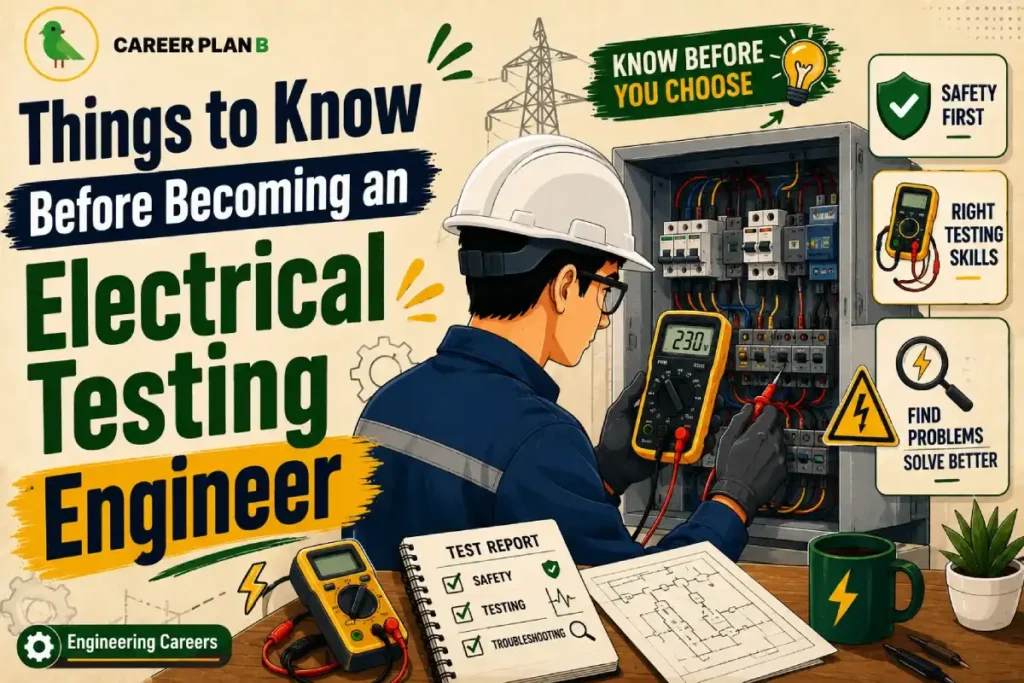
Introduction
Every time you switch on a light, start a machine in a factory, or charge your electric vehicle, you are trusting that the electrical system powering that action has been thoroughly tested and certified safe. But who ensures that trust is justified?
That is the electrical testing engineer, the professional who stands between an electrical installation and the moment it goes live. They test, verify, and validate every component of an electrical system from a single transformer at a substation to the entire protection relay network of a power plant before a single unit of electricity flows through it.
India’s power sector is undergoing one of its most ambitious expansions in history. The government’s target of 500 GW of renewable energy by 2030, the rapid rollout of EV charging infrastructure, and the massive upgrade of India’s transmission and distribution network under the Revamped Distribution Sector Scheme (RDSS) are all creating unprecedented demand for skilled electrical testing engineers across the country.
Yet despite this growing demand, most electrical engineering students know surprisingly little about this career before stepping into it, and that knowledge gap often leads to poor preparation and missed opportunities.
This blog covers everything you need to know before becoming an electrical testing engineer, from what the role actually involves and what qualifications you need to career scope, top recruiters, salary expectations, and the skills that define success in this field.
Who Is an Electrical Testing Engineer?
An electrical testing engineer is a specialist responsible for testing, commissioning, and validating electrical equipment, systems, and installations, ensuring they meet safety standards, performance specifications, and regulatory requirements before and during operation.
It is important to distinguish this role from a design engineer. While a design engineer creates the blueprint for an electrical system, a testing engineer is the professional who verifies that the built system actually works as designed safely, reliably, and in compliance with applicable standards.
Industries where electrical testing engineers work:
- Power generation, transmission, and distribution utilities
- Heavy electrical equipment manufacturing
- Infrastructure and construction projects
- Oil, gas, and petrochemical plants
- Renewable energy solar, wind, and hydro installations
- Electric vehicle manufacturing and charging infrastructure
- Defence and aerospace electrical systems
The role is fundamentally hands-on, combining deep theoretical knowledge of electrical systems with practical field experience and a rigorous commitment to safety.
What Does an Electrical Testing Engineer Actually Do?
Understanding electrical testing engineer responsibilities in detail is essential before you commit to this career because it is quite different from what most engineering curricula prepare you for.
Core responsibilities include:
- Conducting commissioning tests on new electrical installations: transformers, switchgear, circuit breakers, protection relays, and cables
- Performing routine and preventive maintenance testing on existing electrical infrastructure
- Carrying out high voltage (HV) and extra high voltage (EHV) tests on equipment to verify insulation integrity and dielectric strength
- Testing and calibrating protection and relay systems to ensure correct fault detection and isolation
- Conducting power quality analysis measuring harmonics, voltage fluctuations, and power factor at industrial and commercial installations
- Preparing detailed test reports and commissioning certificates critical documentation for regulatory compliance
- Coordinating with project engineers, site managers, and client representatives during commissioning activities
Key instruments and tools used:
- A megger (insulation resistance tester) tests insulation health of cables and equipment
- Power and energy analysers measure power quality parameters at site
- Relay test kits for testing protection relay performance and coordination
- Oscilloscopes and multimeters for circuit-level diagnostics
- HV test sets and partial discharge detectors for high-voltage equipment testing
- CT and PT test equipment for current and potential transformer testing
Key Things to Know Before Entering This Field
Before you pursue a power systems testing career, there are some important realities about this profession that you need to understand clearly because they shape everything from your daily work life to your long-term career trajectory.
1. It Is a Field-Heavy, Hands-On Role
Unlike software or design roles where you primarily work at a desk, electrical testing engineering takes you to substations, power plants, construction sites, and industrial facilities. If you prefer office-based work, this career will challenge you. But if you enjoy working with real equipment and seeing the direct results of your work, you will thrive here.
2. Safety Is Absolutely Non-Negotiable
You will regularly work near high-voltage equipment, sometimes at 11 kV, 33 kV, 132 kV, or even higher voltage levels. Electrical safety standards, proper PPE (personal protective equipment), lockout-tagout (LOTO) procedures, and compliance with Central Electricity Authority (CEA) safety regulations are not optional extras; they are core competencies. The CEA (Measures Relating to Safety and Electric Supply) Regulations govern electrical safety standards across India and are available at the CEA official portal.
3. Documentation Skills Matter as Much as Technical Skills
Every test you conduct must be meticulously documented. Test reports, commissioning certificates, and inspection records form the legal and technical basis for equipment handover and regulatory approval. Engineers who are careless with documentation create serious compliance risks for their organisations.
4. Standards and Regulations Are Constantly Evolving
India’s electrical standards are governed by the Bureau of Indian Standards (BIS) and aligned with international IEC standards. Staying current with evolving standards, particularly as new technologies like EVs, solar inverters, and smart grid equipment enter the testing domain, is a career-long commitment. Official standards are accessible at BIS India.
5. Continuous Learning Is Built Into the Role
New equipment types, new testing methodologies, and new safety regulations emerge regularly. The most successful electrical testing engineers are those who approach their career as a continuous learning journey, not a static technical skill acquired once and applied forever.
Educational Qualifications and Certifications Required
Understanding how to become an electrical testing engineer starts with getting the educational foundation right.
Core academic qualification:
- B.Tech in Electrical Engineering or EEE (Electrical and Electronics Engineering) is the standard entry point. A strong academic record in subjects like power systems, electrical machines, protection systems, and high voltage engineering gives you the theoretical base needed for this role.
Key certifications that strengthen your profile:
- CPRI (Central Power Research Institute): CPRI is India’s premier electrical testing and research organisation. Training programmes and testing certifications from CPRI are highly valued by PSUs and private companies hiring testing engineers. CPRI also conducts type testing and certification of electrical equipment, making it a direct employer of testing engineers.
- ERDA (Electrical Research and Development Association): ERDA offers specialised training in electrical testing, calibration, and energy auditing widely recognised in the electrical industry. Located in Vadodara, ERDA is one of India’s most important electrical testing institutions.
- BIS (Bureau of Indian Standards): Familiarity with BIS standards for electrical equipment available at BIS India is essential for testing engineers who work on equipment certification and compliance.
- GATE: Clearing GATE opens doors to PSU roles at PGCIL, NTPC, BHEL, and CPRI, all major employers of electrical testing engineers.
- Safety certifications: Awareness of NEBOSH (National Examination Board in Occupational Safety and Health) and OHSAS 18001 standards significantly improves your employability, especially for roles in international or multinational organisations.
- Energy Auditor Certification from Bureau of Energy Efficiency (BEE) under the Ministry of Power adds value for testing engineers working in energy management and power quality roles.
Career Scope for Electrical Testing Engineers in India
The electrical testing engineer career scope in India is expanding on multiple fronts simultaneously, creating a sustained long-term demand for skilled professionals in this field.
Power Sector Expansion: India’s electricity generation capacity is growing rapidly under the Ministry of Power, Government of India. Every new power plant, substation, and transmission line requires extensive commissioning and testing before it becomes operational, directly driving demand for testing engineers at every project stage.
The Revamped Distribution Sector Scheme (RDSS): With an outlay of over ₹3 lakh crore, RDSS is India’s most ambitious distribution infrastructure upgrade programme. Smart metering, underground cabling, and distribution automation projects across the country all require electrical testing and commissioning support. Official details at Ministry of Power – RDSS.
Renewable Energy Testing Demand: India’s solar and wind energy expansion coordinated by MNRE (Ministry of New and Renewable Energy) requires specialised testing of solar inverters, wind turbine electrical systems, and grid interconnection equipment. This is a rapidly growing niche for testing engineers with renewable energy expertise.
EV Infrastructure Testing: As India’s electric vehicle ecosystem expands under the FAME India Scheme managed by the Ministry of Heavy Industries, EV charging stations, battery management systems, and EV power electronics all require rigorous electrical testing and certification, creating a new frontier for electrical engineer testing jobs in India.
Industrial and Infrastructure Growth: New manufacturing facilities, data centres, airports, metro rail projects, and smart cities all require electrical testing engineers for commissioning and maintenance, ensuring a steady pipeline of opportunities beyond the pure power sector.
Top Recruiters for Electrical Testing Engineers
The electrical engineer testing jobs in India are available across prestigious government organisations, large private companies, and specialised testing and certification laboratories.
Government and Public Sector Recruiters
- Power Grid Corporation of India Limited (PGCIL) India’s central transmission utility, recruits electrical testing engineers for substation commissioning, protection relay testing, and EHV equipment testing across its national transmission network.
- NTPC Limited India’s largest power generator, hires testing engineers for electrical commissioning of generating units, transformers, switchgear, and auxiliary systems at its thermal, solar, and hydro plants.
- BHEL (Bharat Heavy Electricals Limited) A Navratna PSU and India’s largest electrical equipment manufacturer. BHEL recruits testing engineers for factory acceptance testing, site commissioning, and performance testing of transformers, generators, and switchgear.
- CPRI (Central Power Research Institute) India’s apex electrical testing and research institution, directly employing electrical testing engineers for equipment type testing, certification, and applied research in power systems.
- CEA (Central Electricity Authority) The technical arm of the Ministry of Power is responsible for setting electrical standards and overseeing power system performance, offering specialised roles for senior electrical testing professionals.
Private Sector Recruiters
- Siemens India Works on substation automation, protection systems, and high-voltage equipment testing. One of the top private employers for power systems testing career aspirants.
- ABB India recruits testing engineers for transformer testing, switchgear commissioning, and power quality analysis across industrial and utility projects.
- Schneider Electric India Offers roles in electrical system commissioning, relay testing, and energy management system validation.
- L&T Power and L&T Construction Major infrastructure and power project contractor with large teams of commissioning and testing engineers deployed across India.
- Tata Power recruits testing engineers for generation, transmission, and distribution assets across its project portfolio.
- Sterlite Power and Adani Transmission: private transmission companies building large-scale EHV networks requiring extensive testing and commissioning support.
Testing and Certification Laboratories
- NABL-Accredited Electrical Testing Labs The National Accreditation Board for Testing and Calibration Laboratories (NABL) accredits electrical testing laboratories across India. NABL-accredited labs are major employers of testing engineers for product certification and calibration work.
- ERDA (Electrical Research and Development Association) conducts specialised electrical testing and offers both employment and training opportunities for testing engineers.
Electrical Testing Engineer: Salary and Job Roles
Here is a realistic snapshot of electrical testing engineer salaries and roles for Indian graduates:
| Job Role | Fresher Salary | Experienced (3–5 Years) |
|---|---|---|
| Commissioning Engineer | ₹4 – ₹7 LPA | ₹10 – ₹20 LPA |
| HV Testing Engineer | ₹4.5 – ₹7.5 LPA | ₹10 – ₹22 LPA |
| Protection & Relay Engineer | ₹5 – ₹8 LPA | ₹12 – ₹25 LPA |
| Power Quality Analyst | ₹4 – ₹6.5 LPA | ₹9 – ₹18 LPA |
| Electrical Safety Auditor | ₹4.5 – ₹7 LPA | ₹10 – ₹18 LPA |
| PSU Testing Engineer (via GATE) | ₹50,000 – ₹70,000 per month | ₹80,000 – ₹1.2 lakh per month |
Protection and relay engineers command the highest salaries in the private sector due to the highly specialised nature of the work and the critical safety implications of protection system failures. PSU roles through GATE offer exceptional job security and exposure to India’s most complex electrical infrastructure projects.
Have Any Doubts?
Skills Every Electrical Testing Engineer Must Have
Building the right skills required for electrical testing engineer roles requires a focused and deliberate approach because the field demands a rare combination of theoretical depth, practical ability, and safety discipline.
Technical skills that are essential:
- Circuit Analysis and Power Systems Fundamentals: deep understanding of AC circuits, load flow, fault analysis, and power system protection
- Relay Protection and Coordination knowledge of overcurrent, differential, distance, and earth fault protection schemes; ability to test and set protection relays using standard test kits
- High Voltage Testing Techniques: insulation resistance testing, dielectric withstand testing, partial discharge measurement, and transformer oil testing
- Power Quality Analysis: measuring and interpreting harmonics, voltage sags, flicker, and power factor using power analysers
- SCADA and Protection Panel Understanding familiarity with substation automation and control systems increasingly used in modern power infrastructure
- Relevant Standards IEC 60076 (transformers), IEC 62271 (switchgear), IS standards from BIS, and CEA regulations
Safety knowledge that is non-negotiable:
- Electrical safety regulations under CEA Safety Regulations
- Lockout-tagout (LOTO) procedures and permit-to-work systems
- Proper use of personal protective equipment (PPE) for HV environments
- Emergency response procedures for electrical accidents
Soft skills that define career growth:
- Attention to Detail: A missed test step or incorrect relay setting can have catastrophic consequences; meticulousness is not optional
- Documentation and Report Writing: Clear, accurate test reports are the professional output of every testing engineer
- Problem-Solving Under Pressure: Commissioning environments are often time-critical; the ability to diagnose faults quickly and calmly is invaluable
- Communication: Coordinating with site engineers, project managers, and clients requires clear, professional communication
Learning resources:
- NPTEL courses on Power Systems, Electrical Machines, and High Voltage Engineering from IITs’ NPTEL
- IEEE resources on power system protection and testing via IEEE Power and Energy Society
- Training programmes at CPRI and ERDA for hands-on testing skills
How Career Plan B Helps
The path to becoming a skilled electrical testing engineer requires much more than a B.Tech degree; it requires the right specialisation, the right certifications, and a career plan built around where the power sector is heading. Career Plan B helps electrical and EEE engineering students identify their strengths through psychometric and career assessment tests, map the right career direction through career roadmapping sessions, and prepare for top recruiters with personalised career counselling from industry experts. Whether you are targeting PGCIL, BHEL, Siemens, or a specialised testing laboratory, Career Plan B ensures your journey into the power systems testing career is structured, purposeful, and built for long-term success.
For Latest Information
Frequently Asked Questions (FAQs)
Q1. Is electrical testing engineering a good career choice in India?
Absolutely. With India’s massive power sector expansion, renewable energy push, EV infrastructure rollout, and industrial growth, the demand for skilled electrical testing engineers is strong and growing consistently. It is a career that offers both excellent job stability and strong salary progression, especially in PSUs and large infrastructure companies.
Q2. What is the difference between a commissioning engineer and an electrical testing engineer?
The terms are often used interchangeably, but there is a subtle distinction. A commissioning engineer focuses on the process of bringing a new system or installation into operational service which includes testing as a key component. An electrical testing engineer may work on both new commissioning and ongoing maintenance testing of existing systems. In practice, most professionals in this field perform both roles.
Q3. Is GATE necessary to become an electrical testing engineer?
GATE is not mandatory for all electrical testing engineerroles;s many private sector companies hire directly from campus or through experience. However, clearing GATE significantly improves your access to PSU roles at PGCIL, NTPC, BHEL, and CPRI which are among the most prestigious and well-paying employers for electrical testing engineers in India.
Q4. What safety regulations govern electrical testing work in India?
Electrical testing work in India is governed primarily by the CEA (Measures Relating to Safety and Electric Supply) Regulations and the Electricity Act 2003. These regulations specify safety requirements for working near live electrical equipment, testing procedures, and qualification requirements for electrical supervisors and engineers. Full details are available at CEA Official Portal.
Q5. Are there specialised training programmes for electrical testing engineers in India?
Yes. CPRI (Central Power Research Institute) and ERDA (Electrical Research and Development Association) both offer specialised training programmes in electrical testing, high-voltage testing, and power quality analysis recognised and valued by employers across India’s power and electrical industry. Details are available at CPRI and ERDA.
Conclusion
The electrical systems that power India from its cities and factories to its hospitals and data centres do not go live without being tested first. And the electrical testing engineer is the professional whose expertise, precision, and commitment to safety make that possible.
It is a career that demands technical depth, hands-on confidence, and an uncompromising attitude toward safety and documentation. But for those who embrace these demands, it offers something rare in engineering: the direct satisfaction of knowing that the systems you have tested are safe, reliable, and ready to power the world around you.
India’s power sector is growing faster than at any point in its history. The electrical testing engineer career scope has never been broader, spanning renewables, EVs, smart grids, industrial infrastructure, and defence. The opportunities are real, the demand is sustained, and the rewards, financial and professional, are significant.
But getting there requires the right preparation, the right certifications, and a career plan that is as precise as the work you will one day do. Visit Career Plan B today and take the first step toward an electrical testing engineering career that is built on the strongest possible foundation.