Team5 · July 10, 2026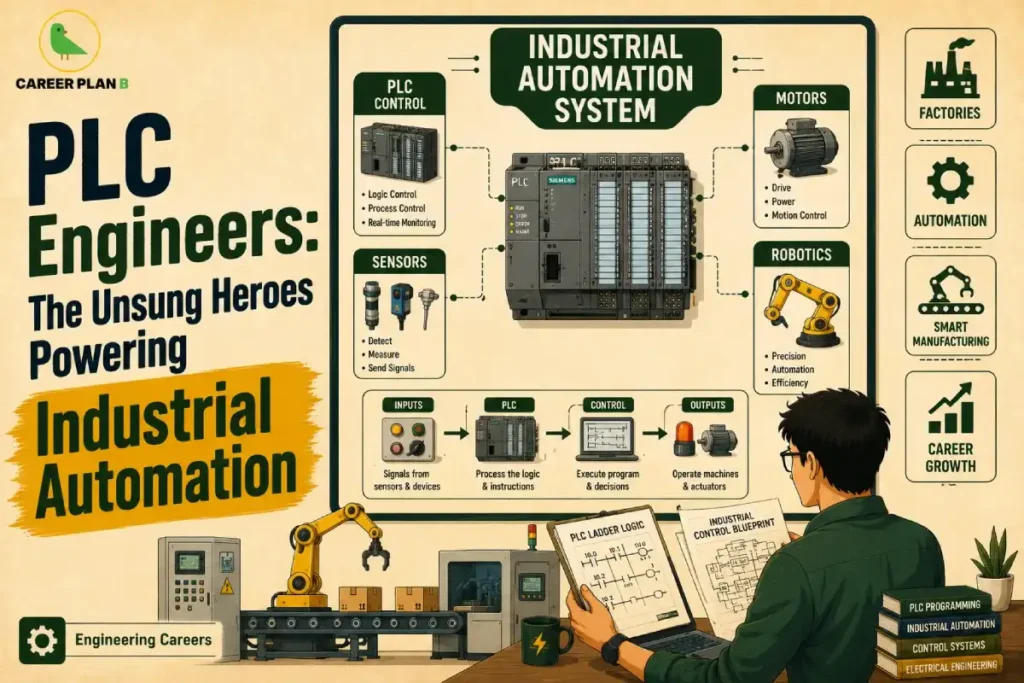
Introduction
Imagine a car manufacturing plant producing hundreds of vehicles every single day with barely any human hands on the assembly line. Or a water treatment facility that automatically monitors and adjusts chemical levels around the clock. Who makes this possible?
The answer is ‘PLC engineers’.
PLC engineers, professionals who design, program, and maintain programmable logic controllers, are the driving force behind modern industrial automation. As factories around the world shift toward smarter, faster, and more efficient systems, the demand for skilled PLC engineers has never been higher.
According to the International Federation of Robotics, global industrial robot installations reached a record 553,052 units in 2022, reflecting the explosive growth of automation across sectors. Behind every one of those automated systems is a control engineer making sure things run without a glitch.
In this blog, we’ll break down exactly why PLC engineers are so critical, what they do, which industries rely on them, and why this could be one of the smartest career paths you pursue in 2026 and beyond.
What Does a PLC Engineer Actually Do?
Before diving into why they’re so important, let’s understand the role itself.
A PLC engineer (programmable logic controller engineer) is a specialized professional responsible for designing, programming, testing, and maintaining automated control systems used in industrial environments.
Their day-to-day responsibilities typically include:
- Writing and debugging PLC programming code (commonly using Ladder Logic, Structured Text, or Function Block Diagrams)
- Designing control panels and electrical schematics
- Integrating systems with SCADA Systems (Supervisory Control and Data Acquisition) and HMI (Human-Machine Interface) panels
- Troubleshooting faults and reducing machine downtime
- Collaborating with mechanical and process engineers on automation projects
- Commissioning new machinery and upgrading legacy systems
In short, a PLC engineer sits at the intersection of electrical engineering, software development, and industrial operations, a combination that makes them incredibly versatile and valuable.
The Backbone of Modern Manufacturing Automation
To truly appreciate PLC engineers, you need to understand what the world looked like before them.
Decades ago, factories used hard-wired relay systems to control machines. Every time a process needed to change, engineers had to physically rewire the entire system, a time-consuming, error-prone, and expensive process.
The invention of the programmable logic controller changed everything. First developed in the late 1960s for the automotive industry, PLCs allowed engineers to reprogramme machine behaviour through software instead of rewiring hardware. This single innovation became the foundation of modern manufacturing automation.
Today, control systems engineering powered by PLCs drives some of the world’s most critical industries. The Make in India initiative and the National Policy for Advanced Manufacturing both highlight automation and smart manufacturing as pillars of India’s industrial growth, creating an enormous domestic demand for trained PLC engineers.
Globally, the industrial automation market is projected to reach USD 395 billion by 2029, according to market research. India’s own automation sector is expanding rapidly, supported by government programmes like the Production Linked Incentive (PLI) Scheme, which is accelerating manufacturing across 14 key sectors.
Why Are PLC Engineers So Hard to Replace?
Here’s the honest truth: not everyone can do what a PLC engineer does.
Their skill set is a rare blend:
- Electrical knowledge: understanding circuits, sensors, actuators, and control panels
- Software skills proficiency in PLC programming environments like Siemens TIA Portal, Allen-Bradley Studio 5000, and Mitsubishi GX Works
- Systems thinking: the ability to see how an entire automated process connects and behaves
- SCADA systems expertise: monitoring and controlling industrial processes remotely
- Problem-solving under pressure because when a production line stops, every minute costs money
This combination is not something you can learn overnight. It takes years of hands-on training and field experience to become a competent automation engineer. And that’s exactly why the skill gap in this field is growing.
According to the National Skill Development Corporation (NSDC), sectors like electronics, engineering, and advanced manufacturing face a significant shortage of technically skilled professionals, and PLC engineers fall right in that gap.
Key Industries That Rely on PLC Engineers
Industrial automation is not limited to one sector. PLC engineers are needed across a wide range of industries:
- Automotive: Assembly lines, robotic welding, paint shops
- Pharmaceuticals: Automated mixing, filling, packaging, and quality control
- Food & Beverage: Conveyor systems, temperature control, bottling lines
- Oil & Gas: Pipeline monitoring, valve control, safety systems
- Water & Wastewater Treatment: Pump automation, chemical dosing, remote monitoring
- Energy & Power: Grid automation, substation control systems
- Cement & Mining: Kiln automation, crusher controls, material handling
Each of these industries depends on control systems engineering to maintain efficiency, safety, and compliance. Without PLC engineers, these systems would either fail or require massive manual workforces to operate.
For Personalized Guidance
Career Scope for PLC Engineers in 2026 and Beyond
If you’re considering a career as a PLC engineer or an automation engineer, the timing couldn’t be better.
In India:
- Entry-level PLC Engineers earn between ₹3–5 LPA
- Mid-level professionals with 3–6 years of experience earn ₹6–12 LPA
- Senior engineers and automation consultants can earn ₹15–25 LPA or more
Globally:
- In the US, according to the Bureau of Labor Statistics, electrical and electronics engineers a closely related field earn a median annual salary of over USD 101,780
- Employment in this sector is projected to grow steadily with the rise of Industry 4.0
Industry 4.0, the fourth industrial revolution, brings together IoT (Internet of Things), AI, cloud computing, and manufacturing automation. PLC engineers who upskill in these areas are transitioning into roles like the following:
- Industrial IoT Engineer
- Automation Systems Architect
- Digital Twin Specialist
- Smart Factory Consultant
The Ministry of Skill Development and Entrepreneurship, Government of India, actively supports skilling initiatives for advanced manufacturing roles, making this an excellent time to invest in this career path.
How Career Plan B Helps
Choosing the right career path in engineering can be overwhelming, especially when niche fields like PLC programming and control systems engineering aren’t widely covered in school or college counselling.
Career Plan B bridges exactly that gap. Whether you’re a student exploring engineering specializations, a fresher unsure about your strengths, or a working professional looking to transition into industrial automation, Career Plan B offers the following:
- Personalised career counselling to help you understand if a technical, hands-on field like automation engineering aligns with your personality and goals
- PsycheIntel and Career Assessment Tests that evaluate your aptitude for logical thinking, technical problem-solving, and engineering mindset key traits for any successful Automation Engineer
- Career Roadmapping that lays out a clear step-by-step plan from the right engineering branch and certifications (like Siemens SITRAIN or Rockwell Automation training) to job roles and growth milestones in the Industrial Automation sector
Don’t leave your career to chance. Career Plan B helps you make informed, confident decisions backed by data and expert guidance.
For Latest Information
Frequently Asked Questions (FAQs)
Q1. What qualifications do I need to become a PLC engineer?
Most PLC engineers hold a degree or diploma in electrical engineering, electronics engineering, instrumentation, or mechatronics. Hands-on training in PLC programming software (like Siemens or Allen-Bradley) and certifications from recognized bodies add significant value.
Q2. Is PLC programming hard to learn?
PLC programming has a learning curve, but it’s very learnable, especially for those with an electrical or electronics background. Ladder Logic, the most common PLC language, is designed to resemble electrical relay diagrams, making it intuitive for engineers. Many free and paid resources, as well as manufacturer training portals, can help you get started.
Q3. What is the difference between a PLC engineer and an automation engineer?
A PLC engineer specifically focuses on programmable logic controllers, while an automation engineer has a broader role that may include robotics, SCADA systems, motion control, and overall system integration. In many companies, the roles overlap significantly.
Q4. Which industries offer the most jobs for PLC engineers in India?
Automotive, pharmaceuticals, food processing, oil & gas, and water treatment are among the top employers of PLC engineers in India. With the government’s push through PLI schemes and Make in India, manufacturing-heavy sectors are growing rapidly.
Q5. How important is SCADA knowledge for a PLC engineer?
Very important. Most industrial environments use SCADA systems alongside PLCs for real-time monitoring and control. Proficiency in SCADA software like Wonderware, Ignition, or WinCC makes a PLC engineer far more employable and versatile.
Conclusion
The world is automating, and it’s not slowing down. From the cars we drive to the medicines we take and the water we drink, PLC engineers silently ensure that the machines behind these products run safely, efficiently, and without interruption.
They are not just technical professionals. They are the architects of modern industrial automation, combining electrical expertise, software precision, and systems-level thinking in a way few roles require.
If you’re drawn to engineering, problem-solving, and a career that’s both hands-on and future-proof, a path in control systems engineering and PLC programming deserves serious consideration.
And if you’re not sure where to start? That’s exactly what Career Plan B is here for. Take a career assessment, speak with an expert counsellor, and map out your future in the world of smart manufacturing one informed decision at a time.
Because in a world run by machines, the engineers who program them will always be in demand.