Team Career Plan B · July 17, 2026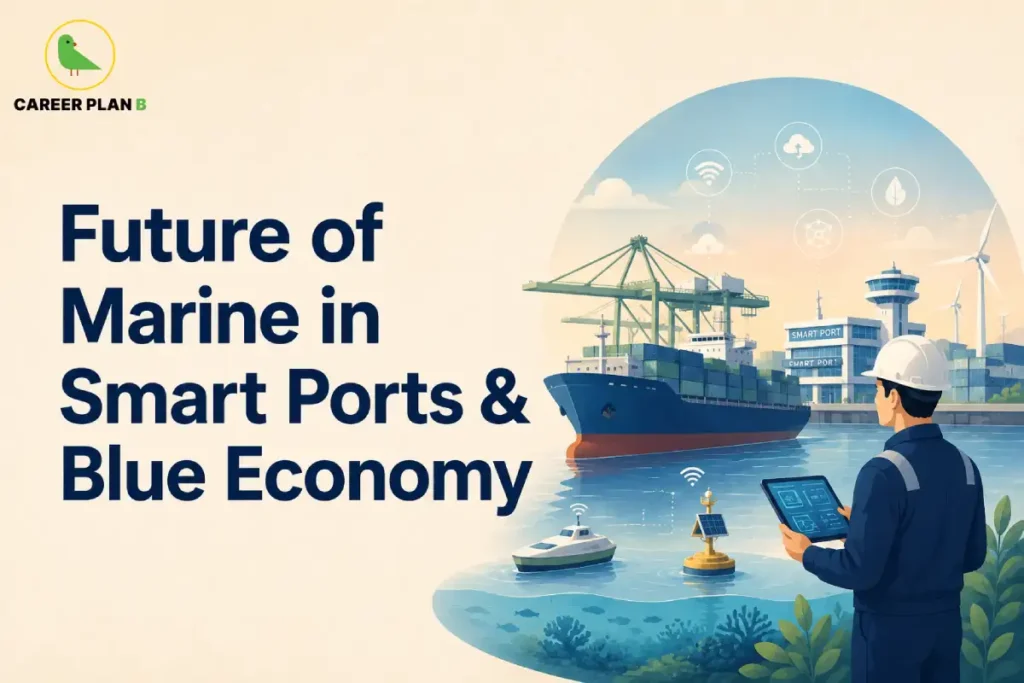
Introduction
For decades, ports relied on manual processes. Dockworkers coordinated cargo movement, paper-based systems tracked shipments, and machinery operated with limited automation. Today, that picture is changing rapidly. Ports around the world, including in India, are becoming digitised and automated hubs known as smart ports. These ports use sensors, data systems, and automation to move cargo faster and more efficiently. This transformation is reshaping the future of marine engineering in smart ports and the blue economy. As ports modernise and the blue economy expands, marine engineers are gaining access to new career opportunities. This blog explains what smart ports are, how they support the blue economy, and the role marine engineers play in this evolving industry.
What Are Smart Ports, and Why Are They Emerging Now?
A smart port uses technologies such as automation, Internet of Things (IoT) sensors, real-time data tracking, and digital monitoring systems. These technologies improve cargo handling, equipment maintenance, and overall port operations. Instead of relying only on manual labour and periodic inspections, smart ports use continuous data to detect problems early. They also optimise schedules and reduce operational delays.
Two major factors are driving this transformation. First, global trade continues to grow, and ports must handle more cargo without increasing costs or congestion. Second, ports face growing pressure to operate more sustainably by reducing emissions, energy waste, and inefficiencies. As a result, smart port technology has moved beyond the experimental stage. It is now becoming a key priority for major maritime nations, including India.
How Smart Ports Connect to the Blue Economy
Smart ports aren’t a standalone trend; they’re deeply connected to the broader blue economy, which focuses on the sustainable use of ocean and coastal resources for economic growth. Efficient, modernized ports directly support blue economy goals by reducing logistics costs, minimizing environmental impact, and strengthening coastal economic development.
In India, this connection is reflected clearly in government policy. The Ministry of Ports, Shipping and Waterways has been implementing the Sagarmala Programme, a flagship initiative focused on port modernization, port-led industrialization, and coastal community development, with hundreds of projects already completed or underway across the country (Source: sagarmala.gov.in). This kind of large-scale investment in port infrastructure is a core pillar of India’s blue economy initiatives, since efficient ports are essential to unlocking the broader economic potential of the country’s coastline.
Key Ways Marine Engineers Are Contributing to Smart Ports
Marine engineers are playing a hands-on role in bringing these smart port systems to life in several specific ways.
Automated Cargo Handling Systems
Modern ports increasingly rely on automated cranes, conveyor systems, and robotic equipment to load and unload cargo faster and more safely. Marine engineers help design, install, and maintain these systems, ensuring they integrate smoothly with existing port infrastructure and vessel operations.
Predictive Maintenance for Port Equipment
Rather than waiting for equipment to fail, smart ports use sensor data to predict when machinery needs maintenance before a breakdown occurs. Marine engineers with knowledge of both mechanical systems and basic data monitoring are well-positioned to lead this shift toward predictive, rather than reactive, maintenance.
Energy-Efficient and Green Port Technologies
As sustainability becomes a greater priority, ports are adopting cleaner energy sources and more efficient equipment. These changes help reduce their environmental footprint. Marine engineers support this transition by developing energy-efficient systems and contributing to sustainable ocean economy careers across the maritime sector.
Integration of IoT and Sensor-Based Monitoring
Smart ports rely on networks of sensors to monitor equipment performance and environmental conditions. Marine engineers should understand how these systems work, even if they do not develop the software. Interpreting and using sensor data is becoming an essential part of daily port operations.
Skills Marine Engineers Need for Smart Port and Blue Economy Careers
To stay relevant in this evolving field, marine engineers should look beyond traditional mechanical training. They should also develop technology-driven skills. Start by learning the basics of automation systems and how they integrate with mechanical equipment. Build confidence in using data monitoring and sensor-based systems, even without advanced programming knowledge. Develop a strong understanding of sustainability practices related to green shipping and smart port operations. Adaptability is equally important. Smart port technologies continue to evolve rapidly, and engineers who keep learning new digital tools will have a clear advantage over those who rely only on traditional training.
How India Is Supporting Smart Ports and the Blue Economy
India’s commitment to this space is reflected in several concrete initiatives. Beyond the broader Sagarmala Programme, the Ministry of Ports, Shipping and Waterways has specifically launched innovation-focused efforts like the Sagarmala Startup Innovation Initiative, aimed at encouraging maritime innovation in areas including green shipping, smart ports and logistics technology (Source: sagarmala.gov.in). NITI Aayog has also contributed to this space through its work on India’s broader blue economy strategy, emphasizing sustainable, technology-driven growth across ocean-based sectors. Together, these efforts show a clear, coordinated push toward modernizing India’s maritime infrastructure in ways that directly benefit engineers entering this field.
Have Any Doubts?
Career Scope for Marine Engineers in This Space
As smart ports and blue economy initiatives expand, the marine engineering career scope is growing beyond traditional onboard roles. Engineers can now pursue opportunities in port automation, maintenance systems, sustainable shipping technologies, and blue economy infrastructure projects. This wider range of marine engineering job opportunities offers more career options than ever before. Today’s engineers can combine traditional mechanical expertise with emerging technologies and sustainability-focused skills.
How Career Plan B Helps
Curious about how to position yourself for this evolving intersection of marine engineering, technology, and sustainability? Career Plan B can help you navigate it with clarity and confidence. Through personalised career counselling, we help you discover how your interests align with emerging fields such as marine engineering in smart ports and green maritime technology. Our PsycheIntel and Career Assessment Tests help you determine whether this technology-driven branch of marine engineering matches your strengths. We also provide Admission and Academic Profile Guidance to help you choose the right course and institute for building relevant skills early. In addition, our career roadmapping process keeps you informed about the latest developments in port automation and digitalisation throughout your academic journey.
For Latest Information
Frequently Asked Questions
- What is a smart port in simple terms?
A smart port uses technologies such as automation, sensors, and real-time data tracking. These technologies make cargo handling, maintenance, and daily operations faster, safer, and more efficient than traditional manual systems..
- Do I need coding skills to work in smart ports?
Not necessarily deep coding expertise, but a basic understanding of how automation and sensor-based systems work is increasingly valuable for marine engineers in this space.
- Is this different from traditional marine engineering roles?
It builds on traditional marine engineering knowledge. It also introduces skills in automation, data monitoring, and sustainability. As a result, it represents a natural evolution of the field rather than a completely separate discipline.
- Are smart port careers only available in major cities or ports?
Not exclusively. As modernization projects expand across various ports under initiatives like Sagarmala, opportunities are gradually growing across multiple coastal regions, not just major metropolitan hubs.
- Is the blue economy only relevant to marine engineers or other branches too?
It’s relevant to multiple engineering branches, including electrical, mechanical, and environmental engineering, though marine engineers play a particularly central role given their direct expertise in ship and port systems.
- Is this a stable long-term career path?
Given continued government investment in port modernization and blue economy initiatives, this space is expected to offer strong, stable long-term career opportunities for engineers willing to build relevant, updated skills.
Conclusion
The future of marine in smart ports & blue economy reflects a genuinely exciting shift, one where traditional mechanical expertise is increasingly combined with automation, data systems, and sustainability-focused thinking. As India continues investing heavily in port modernization and broader blue economy growth, marine engineers who build skills in these emerging areas will find themselves well-positioned for a wide range of meaningful, future-ready career opportunities. If you’d like guidance on how to prepare for this evolving space, Career Plan B is here to help you plan your next step with confidence.