Careerplanb · July 15, 2026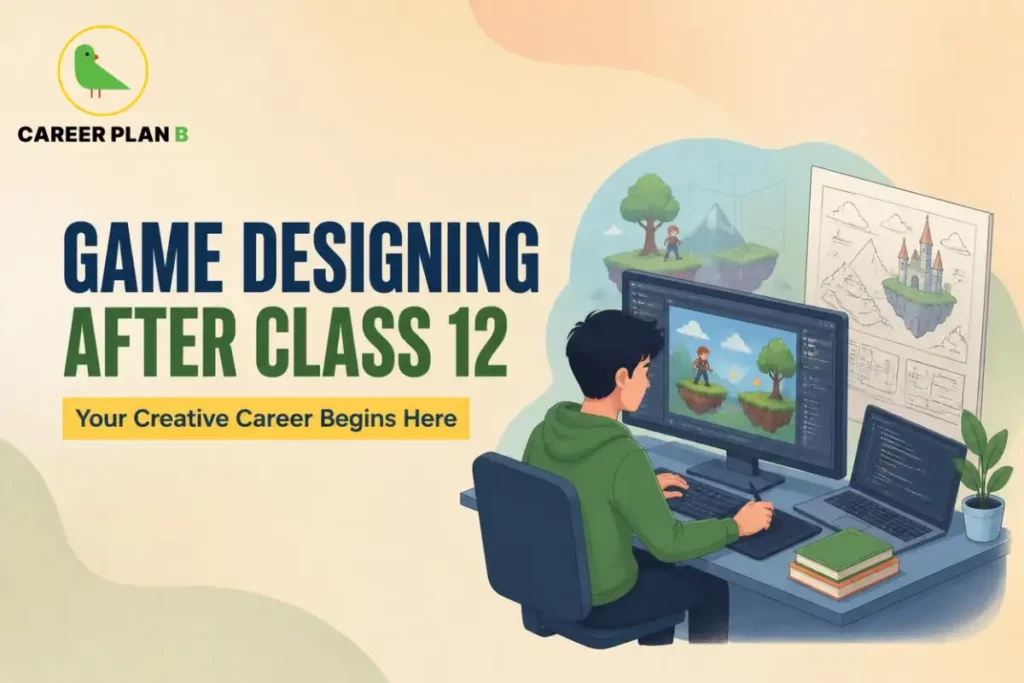
Introduction
If you have spent hours playing BGMI, designing levels in Roblox, or wondering how the mechanics of your favourite game were built — you are not wasting time. You may be discovering your career. India’s gaming industry is one of the world’s fastest-growing, and the government has made it a national economic priority.
The Union Budget 2026–27 allocated ₹250 crore for AVGC (Animation, Visual Effects, Gaming, and Comics) Content Creator Labs in 15,000 secondary schools and 500 colleges across India. The AVGC Promotion Task Force, constituted by the Government of India in April 2022, projected that India’s AVGC-XR sector may require around 2 million skilled professionals by 2030. The Indian Institute of Creative Technologies (IICT), Mumbai has been designated as the nodal government agency for AVGC education.
Source: Press Information Bureau ; http://indiabudget.gov.in
What Is Game Design?
Game design is the process of creating the rules, systems, mechanics, levels, characters, and narratives that make a game engaging and playable. It is different from game development (which focuses on coding and programming) and game art (which focuses on visual assets).
A game designer:
- Creates game concepts, stories, and world-building
- Designs game mechanics — how the player interacts with the game
- Plans levels, maps, and progression systems
- Defines rules, difficulty curves, and player psychology
- Works in teams with programmers, artists, and audio engineers
Have Any Doubts?
Who Can Study Game Design After 12th?
Students from any stream — Science, Commerce, or Arts — can pursue game design courses after 12th. Most undergraduate game design programmes require 12th pass with a minimum of 45–50% aggregate. No stream restriction applies at most design institutions.
UG Course Options After 12th
1. B.Des. at NID — Animation Film Design (Gateway to Game Design)
The National Institute of Design (NID), under DPIIT, Ministry of Commerce and Industry, and declared an Institution of National Importance, offers B.Des. in Animation Film Design — the most closely related NID programme to game design, combining animation, storytelling, character design, and interactive narrative. Admission is through NID DAT (Design Aptitude Test). No stream restriction.
Source: NID ; admissions.nid.edu
2. B.Des. at IITs via UCEED
UCEED (conducted by IIT Bombay) is the gateway to B.Des. at IIT Bombay, IIT Delhi, IIT Hyderabad, IIT Indore, IIT Guwahati, IIT Roorkee, and IIITDM Jabalpur. IIT B.Des. programmes include interaction design, game design elements, and human-computer interaction. Commerce and Arts students can apply to IIT Bombay, IIT Delhi, IIT Hyderabad, and IIT Indore.
UCEED 2026 was held on 18 January 2026.
Source: uceed.iitb.ac.in
3. IICT Mumbai — Government AVGC Institution
The Indian Institute of Creative Technologies (IICT), Mumbai — the government’s designated nodal AVGC agency under the Union Budget 2026–27 — offers 18 courses including those in animation, VFX, XR, and integrated media. As of 2026, 136 students are enrolled.
Source: Press Information Bureau
4. BSc in Game Development / Game Design
Several AICTE-approved and UGC-recognised universities offer BSc in Gaming, BSc in Game Design and Development, or BSc (Hons.) in Game Design as 3-year undergraduate degrees.
Eligibility: 12th pass in any stream with minimum 50–55% marks from a recognised board
Admission: Merit-based or portfolio review, some institutions use UCEED or NID DAT; others conduct their own entrance tests
Key Skills Every Game Designer Must Build
Game design is a discipline that demands both creative and technical skills. Industry practitioners consistently emphasise that a strong portfolio of playable games matters more than marks or grades.
Design Skills:
- Game mechanics and systems design
- Level design and world-building
- Character and narrative design
- Player psychology and user experience (UX) for games
- Storyboarding and concept documentation
Technical Skills:
- Game engines: Unity (used in most mobile and indie games) and Unreal Engine 5 (used in AAA games)
- 3D modelling tools: Blender, Maya, 3ds Max
- Programming basics: C# (for Unity), C++ (for Unreal), Python
- 2D art: Adobe Photoshop and Illustrator
- Version control: Git for collaborative game development
Soft Skills:
- Collaborative teamwork — games are built by teams of 5–100+ professionals
- Written communication — game design documents must be clear and detailed
- Problem-solving — debugging design issues, balancing game difficulty
- Iterative thinking — games go through multiple playtest and revision cycles
Job Roles in the Gaming Industry
The AVGC Promotion Task Force report identified multiple professional roles across the gaming sector. Key roles game design graduates pursue:
- Game Designer — creates and documents game rules, mechanics, and progression systems
- Level Designer — builds individual stages, maps, and environments within a game
- Narrative Designer — writes story, dialogue, and lore for games
- Game Artist / Character Artist — creates visual assets, characters, and environments
- Game Programmer / Unity Developer — codes game logic, physics, and systems
- UI/UX Designer for Games — designs player interface and experience flows
- Quality Assurance (QA) Tester — tests games for bugs, balance issues, and design problems
- Game Producer — manages development timeline, team, and budget
- Esports Event Manager — organises and manages professional gaming tournaments
- Gaming Content Creator — builds gaming audiences on YouTube, Twitch, and Instagram
The AVGC sector is expected to add nearly 160,000 jobs every year and reach close to 20 lakh jobs by 2030.
Source: PIB
Entrance Exams for Game Design Courses
| Exam | For | Conducting Body |
|---|---|---|
| NID DAT | Admission to B.Des. programmes at NID campuses, including Animation Film Design. | National Institute of Design (DPIIT) |
| UCEED | Admission to B.Des. programmes at IITs and IIITDM Jabalpur. | IIT Bombay |
| CEED | Admission to M.Des. programmes at IITs and IISc. | IIT Bombay |
| Institution-Specific Tests | Admission to B.Des. or B.Sc. programmes at other design institutions. | Respective institutions |
Source: admissions.nid.edu ; uceed.iitb.ac.in ; ceed.iitb.ac.in
How Career Plan B Helps
Game design attracts students who love games — but succeeding as a professional requires strategic career planning, not just passion. Career Plan B’s Psycheintel and career assessment tests identify whether your strengths lie in creative design, technical development, narrative writing, or business aspects of the gaming industry. Personalised Career Counselling helps you choose between NID DAT, UCEED, and BSc game development pathways. Admission and Academic Profile Guidance prepares you for competitive design entrance exams. And Career Roadmapping maps your journey from 12th to a professional role in India’s rapidly growing gaming sector.
Get In Touch With Us
Frequently Asked Questions
Q1. How large is India’s gaming sector in 2026?
The AVGC Promotion Task Force, constituted by the Government of India, projected that India’s AVGC-XR sector may require around 2 million skilled professionals by 2030. The Union Budget 2026–27 allocated ₹250 crore for AVGC Content Creator Labs in 15,000 schools and 500 colleges. (Source: PIB — pib.gov.in)
Q2. Can Commerce or Arts students study game design?
Yes. Most game design programmes — including NID DAT and UCEED — have no stream restriction. Students from all streams are eligible, subject to minimum percentage requirements. (Source: admissions.nid.edu ; uceed.iitb.ac.in)
Q3. Which is more important for game design — coding or creativity?
Both are valuable but for different roles. Game designers (who create concepts, mechanics, and levels) need strong creativity and communication skills. Game developers (who code the game) need programming proficiency. Most successful game design programmes build both.
Q4. What is IICT Mumbai and what does it offer?
The Indian Institute of Creative Technologies (IICT), Mumbai, designated as the government’s nodal AVGC agency under the Union Budget 2026–27, currently offers 18 advanced courses in animation, VFX, XR, and integrated media with 136 students enrolled. (Source: PIB — pib.gov.in)
Q5. What game engines should I learn after 12th?
Unity (C# language) is the most widely used engine for mobile and indie game development in India. Unreal Engine 5 (C++ language) is used for AAA-quality games. Both offer free learning platforms — Unity Learn and Unreal Online Learning — for beginners.
Have Any Doubts?
Conclusion
The Best Time to Start Building Games Is Right After 12th
India’s gaming industry is growing at a pace that the education system is still catching up with. The students who build playable portfolio projects while in college — not just studying theory — will have the strongest careers. Start learning Unity or Unreal Engine, complete a structured B.Des. or BSc programme, and build games from Day 1.
Ready to explore a gaming career? Take Career Plan B’s assessment and find your direction today.