Careerplanb · July 15, 2026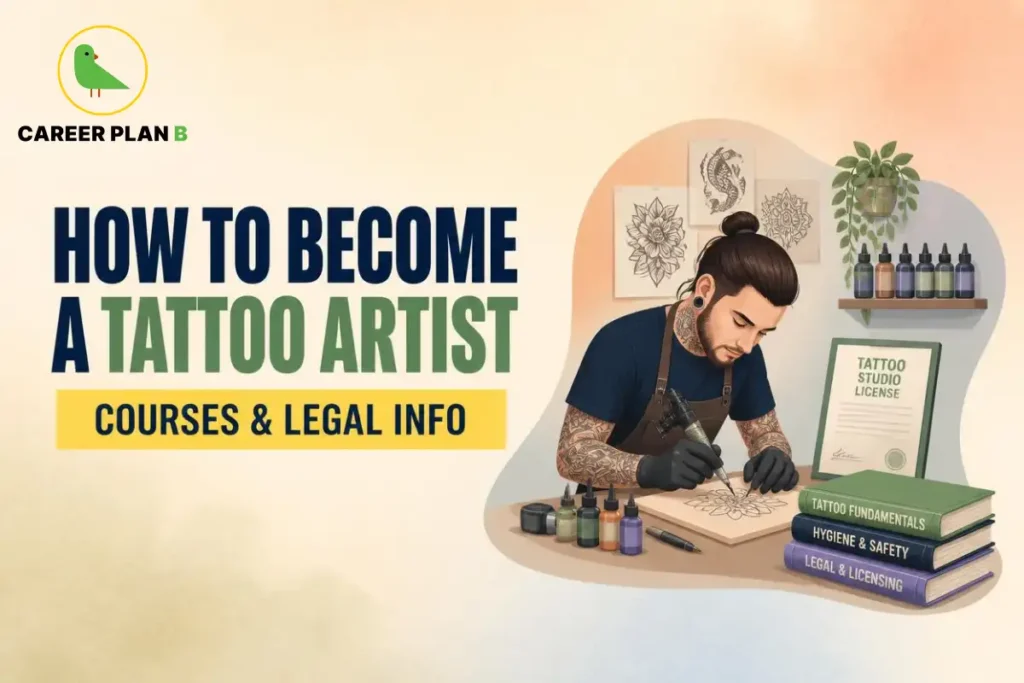
Introduction
Tattooing in India sits in a genuinely distinctive legal position — it is a booming, multi-million-dollar creative industry employing thousands of artists, and it has deep cultural roots stretching back to traditional body art forms like Godna and Pachakutharathu practised across Indian tribal and regional communities for centuries. Yet, unlike countries with dedicated tattoo licensing laws, India currently has no single national law governing body art.
This creates a genuinely important reality for anyone considering this career: understanding what regulation does apply, how to build genuine skill, and how to operate legally and safely, requires piecing together health regulations, municipal business licensing, and general legal principles — rather than following one clear licensing pathway.
This blog covers exactly how the legal landscape works, what training options exist, and what it genuinely takes to become a professional tattoo artist in India today.
The Legal Reality: No Dedicated National Tattoo Law
According to legal analysis on this subject, “in the Indian context, there is no sui generis law, which governs body art. However, a gamut of existing laws regulates the body art business in India.” This is a genuinely important starting point: unlike some Western countries with specific state-level tattoo licensing boards, India regulates tattooing through a patchwork of general laws and municipal health/business regulations rather than a dedicated body art statute.
Source: Art Law India
Have Any Doubts?
What This Means Practically
The tattoo industry in India is, as one industry training resource puts it, “largely unregulated compared to Western countries.” However, this does not mean there is no regulation at all — certain states and municipalities have begun implementing their own regulations to ensure safety and hygiene standards, and these vary significantly by region.
A tattoo license in India, where required, typically involves meeting specific health and safety standards, which can vary by region — meaning your obligations as a tattoo artist depend substantially on which city or state you plan to operate in.
Source: Skinart Training — Do You Need a Tattoo License in India?
What Regulations Actually Apply: A Realistic Breakdown
Since there is no single tattoo-specific law, here is what genuinely governs the practice in most parts of India:
Health Trade License: In major cities such as Delhi, Mumbai, and Bangalore, operating a beauty studio, salon, or cosmetic/tattoo facility requires a health trade license from the local municipal corporation — this is the primary practical licensing requirement most tattoo studio operators encounter, even though it is not tattoo-specific legislation. This license ensures your premises comply with hygiene, sanitation, and structural safety standards.
Shop and Establishment Registration: A standard business registration, issued by the Labour Department of the State, mandatory for all commercial establishments operating in India — including tattoo studios as a category of commercial business.
GST Registration: If your tattoo business’s annual turnover exceeds the applicable threshold, GST registration and filing becomes mandatory, as with any service-based business in India.
General public decency and copyright law: Tattoo work is subject to broader legal principles — including public decency and morality standards under the Indian Penal Code (now BNS), and copyright law considerations, particularly relevant when replicating existing artwork or designs. Legal analysis notes that where an artist creates an original tattoo design, they are generally considered the first owner of that design under copyright principles, and unauthorised reproduction of another artist’s original design may violate their exclusive rights.
Source: Cosmetics Regulatory — License for Permanent Makeup ; Art Law India
Age Restriction: The One Widely Consistent Rule
Across most jurisdictions and industry practice, tattooing minors under the age of 18 is not permitted. Some regions allow minors to be tattooed with parental/guardian consent in specific supervisory circumstances, but this varies and should never be assumed without direct verification of your specific state/city’s actual rules. Reputable studios and artists universally require checking government-issued photo ID and recording it as part of their client intake and consent process, regardless of formal legal mandate, as standard professional practice.
The Path to Becoming a Tattoo Artist: Apprenticeship vs. Formal Courses
The Traditional Path: Apprenticeship
Globally, and increasingly recognised as best practice in India as well, the most widely respected entry route into tattooing is a formal apprenticeship under an experienced, practising artist — rather than purely classroom-based learning. A typical apprenticeship structure involves:
- Finding a sponsor artist — an established, skilled tattoo artist willing to take you on as an apprentice and directly train you
- Foundational practice on non-skin surfaces — most apprentices spend a substantial initial period practising on synthetic skin, fruit, or foam before ever working on a real client, building muscle memory and technical control
- Progressive supervised client work — moving to actual tattooing only under direct supervision, gradually building toward independent practice
This apprenticeship-centred model reflects tattooing’s nature as a genuinely hands-on craft where technical mastery — needle depth control, line consistency, understanding skin behaviour across different body areas — is built through sustained, supervised practice, not solely through course completion.
Formal Training Courses
Alongside or as preparation before an apprenticeship, structured tattoo training courses — offered by established training academies — typically cover:
- Health, safety, and hygiene protocols — equipment sterilisation, cross-contamination prevention, safe disposal of sharps as regulated biohazardous waste
- Client consultation and health screening — identifying contraindications such as skin conditions, bleeding disorders, or medications that could affect healing
- Technical tattooing skills — machine handling, needle configuration, line work, shading, and colour theory
- Basic and advanced artistry techniques — progressing from foundational line work to more advanced styles (realism, watercolour, geometric, traditional)
Reputable training providers in this space often have decades of combined industry experience and structure their courses to prepare students realistically for professional practice, though it is worth noting formal course completion in India does not confer a government-recognised professional license, given the absence of a dedicated regulatory framework.
Source: Skinart India — Course Offerings — https://skinarttraining.com/in/articles/tattoo/do-you-need-a-tattoo-license-in-india/
Practical Steps to Start Legally and Safely in India
Based on the actual regulatory landscape described above, here is a realistic roadmap:
Step 1 — Research your specific state/city regulations. Since requirements vary meaningfully by region, contact your local municipal corporation or health department directly to understand exactly what applies where you plan to work.
Step 2 — Build genuine technical skill through apprenticeship and/or formal training. Given the absence of a licensing exam gatekeeping entry, your actual skill level — not a credential — is what determines whether clients trust you and whether your work is safe.
Step 3 — Strengthen your knowledge of health and safety. Complete relevant courses, even if your area does not legally require them. Bloodborne pathogen awareness and sterilisation protocols are professional and ethical essentials.
Step 4 — Prepare the documents needed for registration. Gather the paperwork required for your health trade licence and Shops and Establishments registration if you plan to open your own studio. This may include proof of training, premises compliance, and any additional documents specified by your local authority.
Step 5 — Create a strong, original portfolio. Showcase your best work, demonstrate your technical skills, and include a variety of tattoo styles to attract potential clients and employers.
Step 6 — Understand and use proper client consent and waiver documentation from day one — protecting both your clients and your own professional/legal standing, regardless of the absence of a mandatory national framework requiring this.
Step 7 — Decide between employment at an established studio versus independent practice. Working at a reputable studio initially offers built-in client base, established equipment/hygiene infrastructure, and the chance to continue learning alongside senior artists — often a wise choice before attempting independent studio ownership.
Source: 11Tattoos — Steps to Become a Certified Tattoo Artist in India — https://www.11tattoos.com/blog/become-a-certified-tattoo-artist-in-india/
Career Paths After Training
Employment at an established tattoo studio — offering a built-in client base, shared equipment/supplies, and the opportunity to work alongside and learn from senior artists.
Freelance artist — working independently while partnering with studios or salons on a per-project or guest-artist basis, offering flexibility without the overhead of full studio ownership.
Independent studio ownership — full creative and business control, requiring the complete regulatory compliance stack (health trade license, shop/establishment registration, GST if applicable) described above.
Specialisation tracks — many established tattoo artists build reputations around specific styles (realism, traditional, geometric, fine-line) or specific client segments (cover-up work, custom large-scale pieces), which can command premium pricing as skill and reputation grow.
How Career Plan B Helps
Understanding the genuinely complex, non-standardised legal landscape for tattoo artistry in India — and building the right combination of apprenticeship experience, formal training, and regulatory compliance — requires careful, honest guidance. Career Plan B offers Personalised Career Counselling to help you realistically evaluate this creative career path, Psycheintel Career Assessment Tests to confirm genuine aptitude and commitment to a skill-intensive craft, and Career Roadmapping to plan your training and studio/independent practice pathway.
Get In Touch With Us
Frequently Asked Questions
Becoming a tattoo artist in India requires an understanding of a unique legal framework. The country does not have a single national licensing system for tattoo artists. Instead, professionals must comply with municipal health trade licences, business registration requirements, and general laws covering consent, hygiene, and copyright. This makes proper training, safe practices, and ethical client care even more important.
The most respected career path combines formal training with a hands-on apprenticeship. Training helps you learn tattooing techniques, hygiene standards, and safety protocols. An apprenticeship lets you apply those skills under the guidance of an experienced artist. Together, they build the technical expertise and professional confidence needed for a successful tattooing career.