Team Career Plan B · July 9, 2026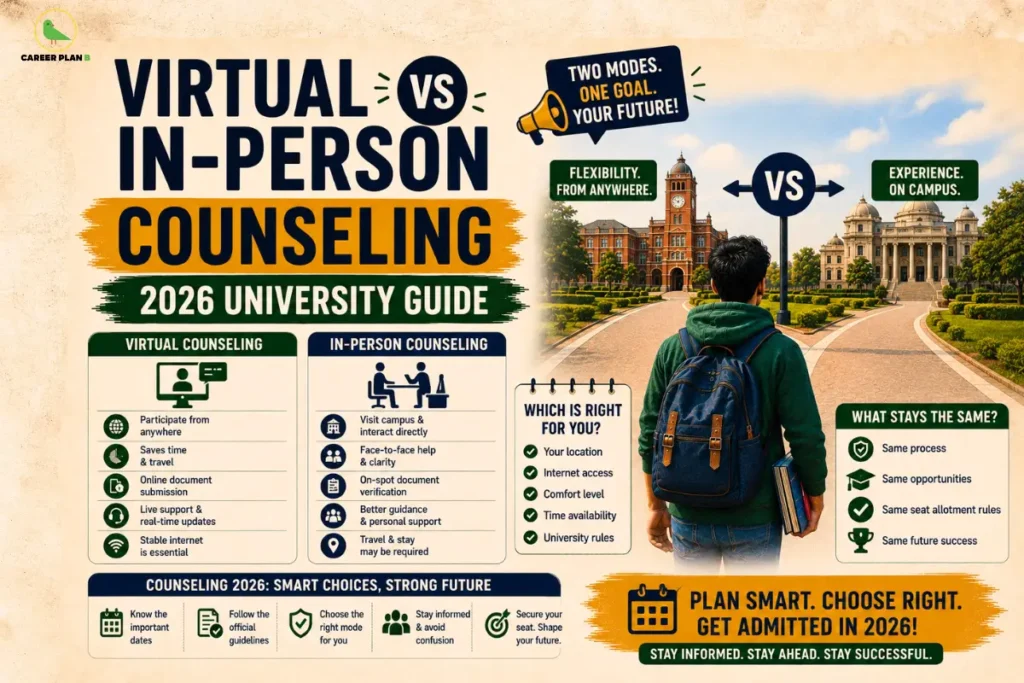
Introduction
Picture this. It is 11 PM on a Tuesday. Your assignment deadline is tomorrow, your inbox is overflowing, and somewhere in the middle of all that noise, you realise you are not okay. Not in a dramatic way. Just in that quiet, heavy way where you know you need to talk to someone. You open your phone and wonder — do I book an online session right now, or do I wait until I can walk into the campus counseling office?
That one small moment of confusion? Millions of university students face it every single year. Virtual vs in-person counseling has become one of the most talked-about questions in student mental health today, and in 2026, with more options available than ever before, the choice feels both easier and more complicated at the same time. This guide is here to help you cut through the noise and figure out what actually works for you.
The Rise of Counseling in University Life
Not too long ago, talking about mental health on a university campus was almost taboo. You dealt with stress quietly. Instead of giving up, you pushed through every challenge. In the end, you figured everything out on your own.
Universities around the world have started taking student mental health seriously in a way that was rare even a decade ago. A 2025 study in the Journal of American College Health found that low mental health literacy, which is especially common among first-generation students, predicts higher anxiety and delayed help-seeking. Counseling visits at college campuses have risen by nearly 30% in recent years. With increased pressure on college administrations, telehealth appointments offering faster and wider access to care have become more widely used within universities.
The demand is real. The need is real. And thankfully, so are the solutions both on your screen and right there on campus.
What Is Virtual Counseling and How Does It Work?
Think of virtual counseling as having a safe, private conversation with a trained professional except you are doing it from your dorm room, your bed, or a quiet corner of the library. No waiting rooms. No walking across campus in the rain.
Platforms and Formats Used
Most universities today have partnered with dedicated telehealth platforms to make this possible. Harvard students, for instance, have free access to virtual care services through TimelyCare, which includes scheduled counseling, psychiatry, health coaching, on-demand support available around the clock, self-care content, and a peer support community. Stanford University offers TimelyCare as a supplement to its existing in-person and virtual services through its Counseling and Psychological Services (CAPS) at Vaden Health Center. MIT Health offers its own drop-in service called Let’s Chat, where students can participate either in person or virtually through Zoom, connecting with a clinician on a first-come, first-served basis.
Sessions typically happen over video call, though some platforms also offer phone or chat-based support. You schedule at a time that suits you, often in the evenings or on weekends hours when campus offices are closed.
Who Is It Best Suited For?
Online university counseling works beautifully for students who are dealing with general stress, anxiety, academic pressure, or simply need a space to process their thoughts. It is also a lifeline for students studying abroad, those living off-campus, or anyone whose schedule makes it difficult to visit a physical office. University of Wisconsin campuses, through funding provided by the state legislature, offer Mantra Health services free of charge to students, with teletherapy and coaching available across extended evenings and weekends.
If flexibility and accessibility matter to you, virtual counseling delivers both.
What Does In-Person Counseling Actually Feel Like?
There is something different about walking into a counseling room. The soft lighting. The box of tissues on the table. The way a counselor leans forward slightly when you are talking. These are small things, but they carry a weight that a video call sometimes cannot fully replicate.
The Human Connection Element
In-person counseling offers what many students describe as a sense of being truly seen. Body language, eye contact, the physical presence of another human being these all play a role in how safe and understood you feel. Critics of virtual-only care point out that mental health services often require a more complex level of intervention than screen-to-screen services can provide, and that campus counselors are equipped to handle concerns including suicidal ideation, trauma, and other issues that demand intense, continuous, in-person support.
For students going through something deeper grief, trauma, relationship crises, or serious mental health challenges the grounded, physical environment of a campus counseling centre can make a significant difference.
Campus Resources and Walk-In Support
Most universities maintain dedicated counseling centres where you can book appointments, attend group therapy, or walk in during open hours. Howard University’s Counseling Services, for example, keeps all information shared during intake and future contacts completely confidential, with appointments available weekdays by calling their main line. Rowan University’s Counseling and Psychological Services offers support for a wide range of mental health concerns at no cost, focusing on helping students build skills, cope with challenges, and thrive both academically and personally.
These centres are staffed by trained professionals who understand the specific pressures of university life and that context matters more than students often realise.
Virtual vs In-Person Counseling — Head-to-Head Comparison
So how do they actually stack up against each other? Here is an honest, side-by-side look.
| Factor | Virtual Counseling | In-Person Counseling |
|---|---|---|
| Accessibility | Available 24/7 from virtually any location with internet access. | Limited by office hours and the counselor’s physical location. |
| Privacy | Private if you have access to a quiet, confidential space. | Provides a dedicated and confidential counseling environment. |
| Wait Times | Often shorter, with on-demand or flexible appointment options. | May involve longer waiting periods due to appointment availability. |
| Cost | Frequently free through university partnerships or student wellness services. | Usually free when provided through campus counseling centers. |
| Depth of Support | Best suited for mild to moderate concerns and ongoing support. | More suitable for complex, severe, or long-term mental health concerns. |
| Human Connection | Moderate — interaction takes place through a screen. | High — face-to-face communication enhances personal connection. |
| Flexibility | Very high — appointments can often be scheduled around your routine. | Lower — fixed appointment times and travel may be required. |
| Crisis Support | Limited — better suited for follow-up and ongoing care than immediate emergencies. | Strong — immediate, on-site assessment and intervention are available. |
Neither format is superior across the board. They serve different needs, different moments, and different students. The smarter question is not “which is better?” but “which is better for me, right now?”
What Do Students Actually Prefer in 2026?
The data tells an interesting story. According to a report on college campus counseling, 64 percent of clients received exclusively in-person counseling while 13 percent received video-only care. Teletherapy continues to be a popular offering, with 53 percent of four-year institutions employing a third-party vendor to provide virtual services.
So in-person still leads but virtual is growing fast, and the gap is closing. Hundreds of colleges are now using teletherapy vendors and renewing their contracts to ensure students feel supported both on-campus and online. What this tells us is that universities are not trying to replace one with the other. They are building a model where both exist together.
The students who benefit most are the ones who know how to use both treating them like tools in a toolbox rather than competing options.
For Personalized Guidance
How to Decide What Is Right for You
This is where it gets personal. And it should.
Questions to Ask Yourself
Before booking your next session, sit with these for a moment:
- How urgent is what I am going through? Is this a slow burn of stress, or something that feels heavy and serious?
- Do I have a private, quiet space where I can have a virtual session without interruptions?
- Am I comfortable opening up on a screen, or do I need to physically be in a room with someone to feel safe?
- Do I need flexibility, or would a fixed appointment actually help me commit?
- Have I been struggling with this for a while, or is it something that came up recently?
There are no wrong answers. Your answers just point you toward the right format.
Situations Where One Clearly Wins
Choose virtual counseling when:
- You are studying abroad or living far from campus
- You need support outside of regular office hours
- You are dealing with stress, anxiety, or general academic pressure
- You want to start small and ease into counseling
- Your schedule makes in-person appointments difficult
Choose in-person counseling when:
- You are going through something serious — trauma, grief, a mental health crisis
- You find it hard to open up through a screen
- You want a consistent, long-term therapeutic relationship
- You benefit from physical routine and the structure of showing up somewhere
- You are unsure what kind of support you need and want to be assessed properly
Interestingly, a 2025 study found that college students’ emotional self-disclosure was actually higher in mediated (virtual) sessions compared to in-person ones — suggesting that for some students, the slight distance of a screen makes it easier to open up. So if you have been avoiding counseling because you are worried you will freeze up or feel awkward, an online session might be a softer, more comfortable place to start.
How Career Plan B Helps
Career Plan B supports students through far more than academics—helping them navigate important decisions, personal growth, and future planning with confidence:
- Personalized Career Counselling: Helps students gain clarity on academic choices, career options, personal strengths, and long-term goals through one-on-one guidance.
- Psycheintel & Career Assessment Tests: Provides data-backed insights into aptitude, personality traits, interests, learning styles, and suitable career pathways.
- Admission & Academic Profile Guidance: Supports students in building strong academic profiles, understanding admission opportunities, and making informed application decisions.
- Career Roadmapping: Helps students create a structured plan that connects present academic choices with future educational and professional aspirations.
- Holistic Student Support: Assists students through periods of uncertainty, transition, and decision-making, helping them approach challenges with greater self-awareness and confidence.
- End-to-End Guidance: Works alongside students at every stage—from exploring possibilities and selecting courses to admissions and long-term career planning.
For Latest Information
Frequently Asked Questions
- Is virtual counseling as effective as in-person counseling for university students?
For mild to moderate concerns such as stress, anxiety, and academic pressure, virtual counseling has shown comparable outcomes to in-person sessions. However, for more complex mental health challenges, in-person support from a trained campus professional is generally recommended. Many universities now offer both, so you do not have to choose just one.
- Is virtual counseling free for university students?
At many universities, yes. Brown University, for example, offers enrolled students free access to teletherapy sessions through TimelyCare, including unlimited access to a library of wellness videos, available throughout the full academic year including summer months. Check your university’s student affairs or wellness portal to see what is available to you at no cost.
- What if I am not comfortable talking about my problems on video?
That is completely valid. Some students find it easier to talk in person, while others actually open up more easily through a screen. If video feels like too much at first, look for text-based or phone-based options — many platforms offer these. You can always try one session and switch formats if it does not feel right.
- Can I switch between virtual and in-person counseling?
Absolutely, and many students do exactly that. You might use virtual sessions for general check-ins and then transition to in-person appointments when you need deeper support. Most campus counseling services are designed to work in combination, not in isolation.
- How do I know if what I am feeling is serious enough to seek counseling?
If you are asking that question, it probably is. You do not need to be in crisis to reach out to a counselor. Counseling is not just for emergencies — it is for anyone who wants support, clarity, or just someone to talk to without judgment. A single session can be the beginning of something genuinely helpful.
Conclusion
Choosing between virtual vs in-person counseling is not a life-altering decision that needs months of deliberation. It is simply a matter of knowing yourself, understanding what you need right now, and taking one small step toward getting it. Both formats are valid, both are effective when used well, and both exist for the same reason to support you.
You do not have to have it all figured out before you reach out. The best thing you can do for your mental wellness as a student is to start somewhere. Whether that is opening an app at midnight or walking into a campus office on a Wednesday afternoon, reaching out is what matters most. The format is just the door. You are the one who has to walk through it.