Deepti · August 12, 2026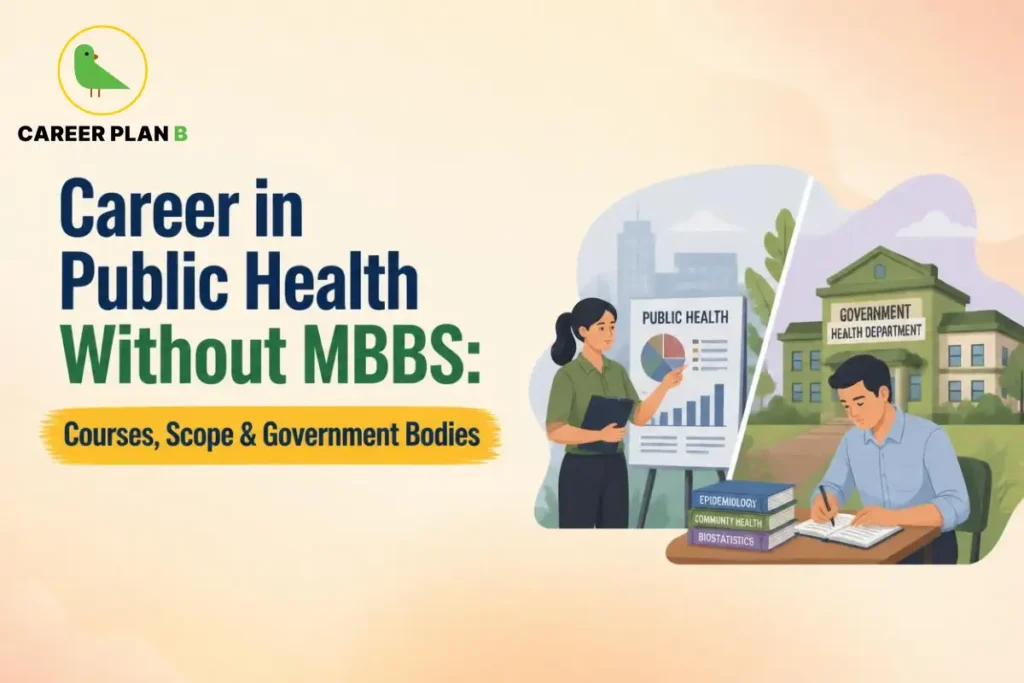
Introduction
Not every meaningful healthcare career runs through NEET and five and a half years of clinical training. If you’re drawn to health but not to treating patients one at a time, a career in public health without MBBS offers a genuine, government-supported alternative — one focused on population-level health, policy, and programme management rather than clinical practice.This field has grown substantially in India in recent years. It welcomes graduates from science, social science, and commerce backgrounds, not just health science students. This blog explains how to enter public health without a medical degree, which institutions matter, and where this career can lead.
What Is Public Health, and How Is It Different from Medicine?
Public health focuses on protecting and improving the health of communities and populations. It differs from diagnosing and treating individual patients.
For example, doctors treat individual illnesses, while public health professionals may design vaccination campaigns, analyse disease surveillance data, or develop nutrition policies that benefit millions.
This distinction also affects admissions. Public health is a population-focused discipline rather than a clinical medical course. Therefore, its degree programmes generally fall outside the NEET-based admission system used for MBBS and BDS.
Academic Pathways Without MBBS
Bachelor of Public Health (BPH) — A growing number of Indian institutions now offer a dedicated undergraduate BPH, open to Class 12 graduates from any stream (science, commerce, or arts), typically requiring a minimum aggregate rather than a specific PCB or NEET requirement. This is currently the most direct route into the field straight after Class 12.
Master of Public Health (MPH) — For graduates from a wide range of backgrounds — life sciences, biotechnology, statistics, sociology, psychology, economics, or even law and management — an MPH is a well-established postgraduate route into serious public health careers. At government-recognised institutions, admission is increasingly conducted through the Common University Entrance Test (CUET-PG), a national-level exam conducted by the National Testing Agency (NTA), rather than through NEET.
PG Diploma in Public Health Management — A shorter, more applied qualification aimed at working professionals already engaged in public health activities at community, hospital, or district levels, generally requiring a health science, nursing, or social science background.
For Personalized Guidance
Who Governs Public Health Education in India?
Public health training and qualifications in India are anchored by a specific set of government institutions, which is worth knowing before you pick a course:
- The National Institute of Health and Family Welfare (NIHFW), an autonomous institute directly under the Ministry of Health and Family Welfare (MoHFW), Government of India, holds UGC-recognised deemed university status and is designated a WHO Collaborating Centre for health workforce development — making its MPH and PG Diploma qualifications among the most credible in the country.
- The University Grants Commission (UGC) oversees recognition of public health degrees offered by universities nationwide.
- The National Institute of Public Health Training and Research (NIPHTR), under MoHFW, is another established public-sector institution offering public health training programmes.
Public Health Pathways: Quick Comparison
| Pathway | Typical Entry Point | NEET Required? | Best Suited For |
|---|---|---|---|
| Bachelor of Public Health (BPH) | After Class 12, any stream | No | Students who know early they want population health, not clinical practice |
| Master of Public Health (MPH) | After a bachelor’s degree in health science, life sciences, statistics, sociology, or related fields | No (uses CUET-PG at government institutes) | Graduates from varied academic backgrounds seeking serious public health careers |
| PG Diploma in Public Health Management | Health science/social science graduates, often in-service candidates | No | Working professionals in public health, hospital, or district health roles |
Career Scope After Public Health Training
Government health programmes — Roles within National Health Mission structures, state health departments, and district health offices, working on programme planning, monitoring, and implementation.
International organisations — Public health graduates, particularly those from WHO Collaborating Centres like NIHFW, are well-positioned for roles with global health bodies such as WHO, UNICEF, and other multilateral organisations.
NGOs and health-focused non-profits — A significant employment segment, especially for programme management, community health, and monitoring & evaluation roles.
Corporate wellness and health insurance — A newer but growing space, where population-health thinking is applied to workplace wellness programmes and insurance risk assessment.
Research and academia — Public health researchers contribute to epidemiology, health policy, and health systems research, often progressing through further postgraduate study or a PhD.
Health-tech — India’s expanding digital health sector increasingly needs professionals who understand public health data and population-level health trends, not just software engineers.
Skills That Matter in This Field
Beyond the degree itself, employers in public health consistently look for:
- Epidemiology and biostatistics fundamentals — understanding disease patterns and interpreting health data
- Health policy and programme management — translating research into actionable government or NGO programmes
- Communication across audiences — explaining complex health data to policymakers, communities, and the media alike
- Field experience — most serious public health programmes, including NIHFW’s MPH, build in structured field-based practical components alongside classroom coursework
How Career Plan B Helps
Public health is a field where the “right” entry point — BPH straight after Class 12, or an MPH after a different undergraduate degree — depends heavily on how early you’ve identified this as your direction. Career Plan B uses Psycheintel and Career Assessment Tests to help you understand whether your aptitude leans toward population-level, policy-driven work rather than clinical practice, well before you commit to a specific course. Our Personalised Career Counselling helps you evaluate BPH, MPH, and PG Diploma options realistically against your current academic stage, while Admission and Academic Profile Guidance supports your applications to government-recognised institutions and CUET-PG preparation where relevant. Career Roadmapping then lays out a clear multi-year path from your public health qualification to a genuine government, NGO, or international-organisation role.
Get In Touch With Us
FAQs
Q1. Do I need NEET to pursue a career in public health?
No, public health degrees, including the BPH and most MPH programmes, sit outside the NEET system, since NEET is specifically for clinical courses like MBBS and BDS.
Q2. Can commerce or arts students pursue public health after Class 12?
Yes, most BPH programmes accept students from any stream at the Class 12 level, since public health draws heavily on policy, economics, statistics, and social science alongside health science.
Q3. Is an MPH only for people with a prior health science degree?
Government-recognised MPH programmes accept graduates from diverse fields, including life sciences, statistics, sociology, psychology, economics, law, management, and health sciences.
Q4. Which government body is most recognised for public health qualifications in India?
NIHFW, under the Ministry of Health and Family Welfare, is among the most recognised, holding UGC deemed-university status and WHO Collaborating Centre designation.
Q5. Is public health a growing field in India?
Yes, The public health sector is growing rapidly, creating increasing demand for professionals across government organisations, non-profits, and health-tech companies.
Conclusion
A career in public health without MBBS offers a respected and government-supported pathway. Students can pursue dedicated degrees and explore diverse career opportunities.Whether you choose a BPH after Class 12 or an MPH after graduation, you can improve population health without pursuing a clinical career through NEET.