Team6 · November 2, 2026
Introduction
Every year, thousands of engineering students choose chemical or petroleum engineering with big ambitions. However, many enter the industry feeling underprepared. The reason is not a lack of knowledge but a lack of understanding of what the petrochemical industry expects beyond the classroom.
Becoming a petrochemical engineer involves far more than passing semester exams or securing a campus placement. It requires a practical understanding of refinery operations, process design, optimisation, safety, efficiency, and environmental compliance. These elements form the foundation of one of the world’s most complex and demanding industries.
India’s petrochemical sector is growing rapidly, creating strong demand for skilled engineers. At the same time, a gap still exists between what engineering colleges teach and what employers expect. Bridging this gap early can give you a significant advantage and help build a successful career.
This guide explains everything you need to know before becoming a petrochemical engineer. It covers essential subjects, technical tools, industry knowledge, certifications, and the professional mindset needed to succeed in the petrochemical industry.
What Does a Petrochemical Engineer Actually Do?
Before diving into what you need to learn, it helps to be crystal clear about what a petrochemical engineer actually does on the job because it is often very different from what students imagine.
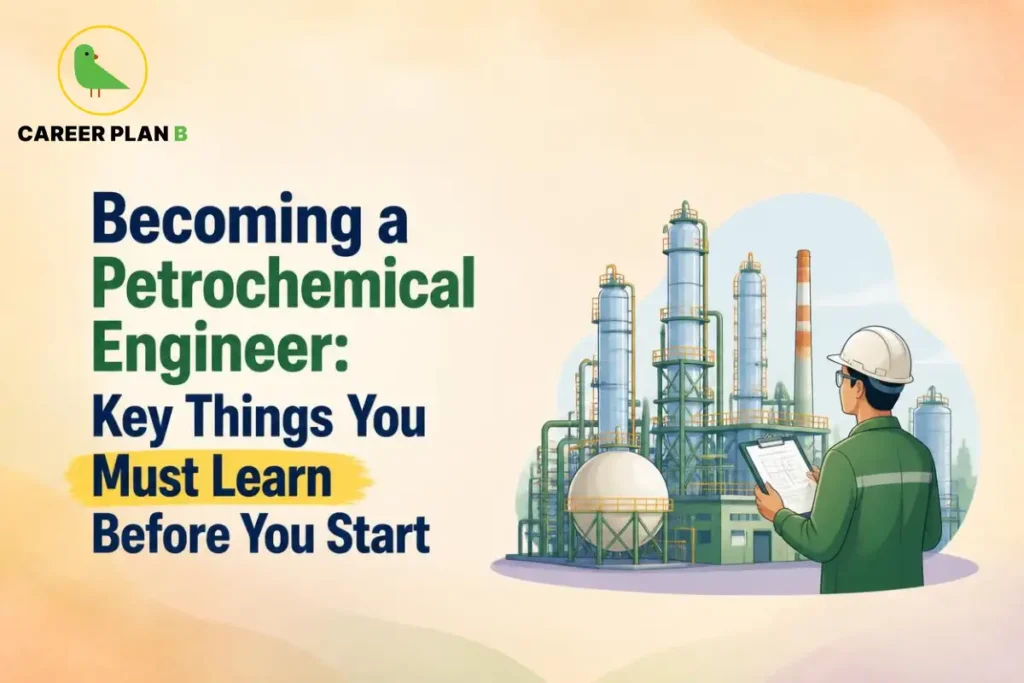
A petrochemical engineer designs, operates, and optimises the industrial processes that convert crude oil, natural gas, and other hydrocarbons into valuable products: fuels, plastics, fertilisers, solvents, synthetic fibres, and speciality chemicals. They work on large-scale, continuously operating plants where safety, efficiency, and environmental compliance are non-negotiable.
Day-to-Day Responsibilities Include:
- Monitoring and optimising refinery and petrochemical plant operations
- Designing process flow diagrams and equipment specifications
- Conducting HAZOP studies and safety audits
- Troubleshooting equipment failures and process deviations
- Collaborating with cross-functional teams: mechanical, instrumentation, and environmental engineers
- Ensuring regulatory compliance with environmental and safety standards
- Managing process scale-up from pilot to full industrial production
Understanding these responsibilities early helps you focus your learning on what actually matters in a petrochemical engineering career, not just what appears in your university syllabus.
Core Subjects You Must Master
The foundation of a successful petrochemical engineering career is built on a handful of core engineering subjects. Mastering these, not just passing them, is essential before entering the industry.
1. Thermodynamics
Thermodynamics is the backbone of every refinery and petrochemical process. Understanding how energy is transferred, how phase equilibria work, and how thermodynamic cycles govern industrial processes is non-negotiable. Focus particularly on equations of state, vapour-liquid equilibrium, and energy balance calculations; these appear in almost every real-world process engineering problem.
2. Fluid Mechanics
In a petrochemical plant, everything flows crude oil, gases, cooling water, and chemicals. Understanding fluid behaviour, pressure drop calculations, pump and compressor selection, and pipeline design is fundamental to things to learn for petrochemical engineering. Pay particular attention to multiphase flow, which is common in refinery operations.
3. Heat and Mass Transfer
Heat exchangers, distillation columns, absorption towers, and evaporators are the workhorses of petrochemical plants. A deep understanding of heat- and mass-transfer principles, both theoretical and applied, is essential for designing, sizing, and troubleshooting these critical pieces of equipment.
4. Chemical Reaction Engineering
Understanding how chemical reactions occur at an industrial scale, reaction kinetics, reactor design, catalysis, and yield optimisation are central to petrochemical process design. Catalytic cracking, reforming, and hydroprocessing reactions in refineries all depend on solid reaction engineering principles.
5. Petroleum Refining Processes
This is the most industry-specific subject on the list and one that many engineering programmes cover only superficially. Make the effort to deeply understand the key refinery processes: atmospheric and vacuum distillation, catalytic cracking, hydrocracking, reforming, isomerisation, and alkylation. Understanding how crude oil is transformed into multiple valuable products through these interconnected processes is the heart of petroleum engineering subjects.
6. Process Control and Instrumentation
Modern petrochemical plants are highly automated. Understanding control loops, PID controllers, distributed control systems (DCS), and process safety instrumented systems (SIS) is increasingly essential for engineers entering the industry today.
Essential Technical Skills to Develop
Beyond academic subjects, the petrochemical engineering skills that industry employers value most are built through deliberate practice and hands-on exposure, not just classroom learning.
1. Process Simulation Software
Proficiency in industry-standard simulation tools is one of the most valuable skills you can develop before entering the workforce.
- ASPEN HYSYS, the most widely used process simulator in oil, gas, and petrochemical industries
- ASPEN Plus commonly used in chemical and polymer processing
- MATLAB essential for process modelling, data analysis, and control system design
Many universities offer basic training in these tools, but self-directed learning through online tutorials and practice projects can significantly accelerate your proficiency.
2. Process Flow Diagrams and P&IDs
Being able to read, interpret, and create Process Flow Diagrams (PFDs) and Piping and Instrumentation Diagrams (P&IDs) is a fundamental workplace skill for any petrochemical engineer. These documents are the language of industrial plants, and fluency in them is expected from day one on the job.
3. HAZOP and Process Safety Fundamentals
Process safety is not optional in petrochemical engineering; it is a core professional responsibility. Understanding HAZOP (Hazard and Operability Study) methodology, risk assessment frameworks, and process safety management systems is essential knowledge for every aspiring petrochemical engineer.
The Centre for Chemical Process Safety (CCPS) under the American Institute of Chemical Engineers (AIChE) provides globally recognised process safety resources and guidelines on them.
4. Environmental Compliance Knowledge
Petrochemical plants operate under strict environmental regulations. Understanding effluent treatment, air emission controls, and environmental impact assessment frameworks governed in India by the Ministry of Environment, Forest and Climate Change (MoEFCC) is increasingly important for engineers at all levels.
5. Data Analysis and Digital Tools
The petrochemical industry is rapidly adopting digital technologies: real-time process monitoring, predictive maintenance, and AI-driven optimisation. Developing basic proficiency in data analysis tools like Python, Excel-based process calculations, and process data historian systems gives you a meaningful edge over peers who focus only on traditional engineering skills.
Industry Knowledge You Should Build Early
One of the most overlooked aspects of how to become a petrochemical engineer in India is building genuine industry awareness before you graduate. Students who understand the industry landscape, not just the engineering principles, transition far more smoothly from college to career.
Know India’s Petrochemical Sector
India is the world’s fourth-largest refiner, with refining capacity exceeding 250 million metric tonnes per annum (MMTPA). The Petroleum and Natural Gas Regulatory Board (PNGRB) regulates India’s midstream and downstream petroleum sector.
Know the Key Players
Familiarise yourself with India’s major petrochemical employers:
- ONGC
- Indian Oil Corporation Limited (IOCL)
- BPCL
- HPCL
- GAIL
Understanding what each company does, which processes they operate, and what skills they prioritise helps you tailor your learning and internship choices strategically.
Understand Government Policy and Industry Direction
India’s Petroleum, Chemicals and Petrochemicals Investment Region (PCPIR) initiative and the government’s push toward increasing domestic petrochemical value addition are shaping where the industry is heading. Staying informed about these policy directions through the Department for Promotion of Industry and Internal Trade (DPIIT) gives you valuable context for career planning.
Have Any Doubts?
Certifications and Courses That Give You an Edge
Beyond your engineering degree, strategic certifications can significantly strengthen your profile when becoming a petrochemical engineer.
GATE Preparation
For PSU recruitment and M.Tech admissions, GATE (Graduate Aptitude Test in Engineering) is essential. Chemical engineering is one of the GATE papers, and strong scores open doors to ONGC, IOCL, BPCL, HPCL, and GAIL recruitment as well as M.Tech admissions at IITs and NITs.
IChemE Membership and Certifications
The Institution of Chemical Engineers (IChemE) offers internationally recognised professional development resources, student membership, and eventually Chartered Chemical Engineer status. IChemE membership signals global professional credibility and is particularly valuable for engineers targeting international careers.
Process Safety Certifications
Certifications in process safety management, including HAZOP leader training and functional safety (IEC 61511), are highly valued by petrochemical employers. These can be pursued through recognised professional bodies after graduation.
Online Learning Platforms
Platforms offering chemical and petroleum engineering courses, including ASPEN HYSYS training, process safety fundamentals, and petroleum refining technology, provide excellent supplementary learning opportunities alongside your formal degree programme.
Common Mistakes Aspiring Petrochemical Engineers Make
Knowing what to avoid is just as important as knowing what to learn. Here are the most common mistakes students make on the path to becoming a petrochemical engineer:
- Treating Process Safety as an Optional Subject In the petrochemical industry, a safety failure can be catastrophic. Engineers who do not take process safety seriously are a liability, not an asset. Start building HAZOP awareness and safety culture from your very first year.
- Skipping Internships A single well-chosen internship at a refinery or petrochemical plant teaches you more about industrial reality than an entire semester of classroom learning. Prioritise internship applications at IOCL, HPCL, ONGC, and private sector companies every vacation.
- Ignoring Process Simulation Tools Many students graduate without ever seriously using HYSYS or ASPEN. Employers expect at least basic proficiency, and candidates who demonstrate simulation skills stand out immediately in campus placements and PSU interviews.
- Choosing a College Without Verifying AICTE Approval Always verify that your engineering institution is approved by the All India Council for Technical Education (AICTE). Graduating from a non-approved institution can create significant barriers to PSU recruitment and government job applications.
- Underestimating Soft Skills Petrochemical engineers work in large, multidisciplinary teams. Communication, documentation, and collaboration skills are valued as highly as technical knowledge by most employers and are often what distinguishes candidates at the final stage of recruitment.
- Not Starting GATE Preparation Early Many students decide to appear for GATE in their final year after spending three years without keeping their core engineering subjects sharp. Starting early, even with light revision from second year onwards, dramatically improves GATE performance and PSU recruitment prospects.
How Career Plan B Helps
The journey of becoming a petrochemical engineer involves dozens of decisions, from choosing the right college and specialisation to building the right skills, planning internships, and targeting PSU or private sector careers. Career Plan B offers personalised career counselling for engineering aspirants, PsycheIntel career assessment tests to evaluate whether your aptitude and interests align with a petrochemical engineering career, and structured career roadmapping that helps you build a clear, step-by-step plan from college admission to your first industry role. Their admission and academic profile guidance ensures you target the right institutions, while their career planning support helps you make the most of every year of your engineering degree.
For Latest Information
Frequently Asked Questions (FAQs)
1. What qualifications do I need to become a petrochemical engineer in India?
To pursue a petrochemical engineering career in India, you typically need a B.Tech or B.E. in chemical engineering, petroleum engineering, or petrochemical engineering from an AICTE-approved institution. Admission is through JEE Main, JEE Advanced (for IITs), or state-level engineering entrance exams. Seat allotment for centrally funded institutions is managed by the JoSAA.
2. Which is the best specialisation for becoming a petrochemical engineer?
Chemical Engineering with a focus on petroleum refining and petrochemical processes is the most widely available and industry-relevant path. Some institutions offer dedicated petroleum engineering or petrochemical engineering programmes; these provide more specialised preparation for the oil, gas, and petrochemical sectors.
3. Is GATE mandatory for a petrochemical engineering career?
GATE is essential for PSU recruitment (ONGC, IOCL, BPCL, HPCL, GAIL) and M.Tech admissions at IITs and NITs. For private sector roles, GATE scores are advantageous but not always mandatory; companies like Reliance Industries recruit through campus placements.
4. What is the starting salary for a petrochemical engineer in India?
Entry-level petrochemical engineers in India earn between ₹4 – ₹7 LPA in the private sector. PSU roles through GATE recruitment typically offer ₹6 – ₹9 LPA at the entry level, with additional benefits including housing allowance, medical coverage, and performance bonuses.
5. How important is process simulation software for petrochemical engineering?
Extremely important. Proficiency in ASPEN HYSYS and ASPEN Plus is considered a baseline expectation by most petrochemical employers. Engineers who can competently use these tools to model, simulate, and optimise processes are significantly more employable than those without this skill.
Conclusion
Becoming a petrochemical engineer is one of the most rewarding career paths available to science and engineering students, but it demands more than a degree and a GATE score. It requires a deep mastery of core engineering principles, practical proficiency in industry tools, genuine awareness of the sector you are entering, and a commitment to safety, continuous learning, and professional development.
The students who thrive in this industry are not simply the ones who passed their exams. They are the ones who came prepared with the right knowledge, the right skills, and the right mindset to make an immediate and meaningful contribution from day one.
Start building those foundations today because in petrochemical engineering, preparation is not just an advantage. It is a professional responsibility.
Want to know if petrochemical engineering is the right career path for you? Visit Career Plan B and take a personalised career assessment to find your ideal engineering direction.