Careerplanb · November 2, 2026
Introduction
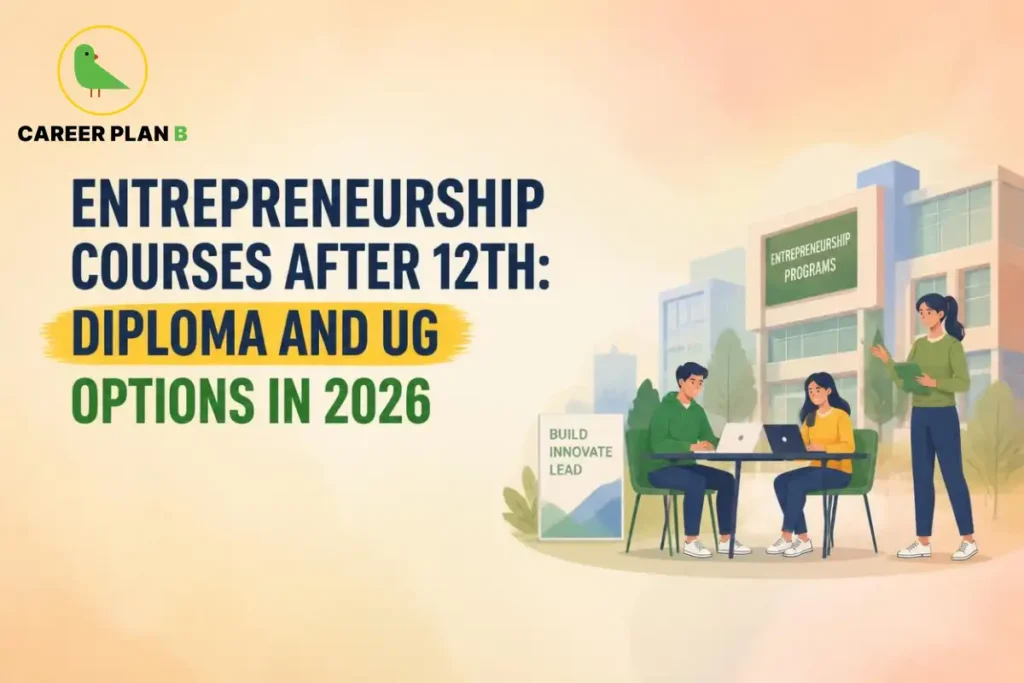
Most career guidance focuses on “what job you will get.” But a growing number of students in India are asking a different question: “What business will I build?” If you are one of them, this blog is for you.
India in 2026 is one of the world’s most dynamic startup ecosystems. The Department for Promotion of Industry and Internal Trade (DPIIT) has recognised over 1,47,000 startups under the Startup India programme as of 2024 — the third-largest startup ecosystem globally. Behind these startups are entrepreneurs who had to learn the craft somewhere. That learning can — and should — start right after 12th.
Source: Startup India ; DPIIT, Ministry of Commerce and Industry
Can You Study Entrepreneurship After 12th?
Yes — and in 2026, there are more structured options than ever before.
1. BBA in Entrepreneurship / Business Administration
The Bachelor of Business Administration (BBA) is the most common UG degree for aspiring entrepreneurs. Many universities now offer BBA with a specialisation in Entrepreneurship. The curriculum covers:
- Business plan development
- Financial management and accounting
- Marketing and consumer behaviour
- Operations management
- Legal aspects of business
- Innovation and design thinking
Eligibility: 12th from any stream (Science, Commerce, or Arts) with minimum 50% aggregate. Some universities require Commerce or Mathematics; many accept all streams.
Have Any Doubts?
2. B.Voc. (Vocational) in Entrepreneurship
Under the National Education Policy 2020 (NEP 2020) and the UGC’s B.Voc. framework, several universities and skill universities offer Bachelor of Vocation (B.Voc.) degrees with an entrepreneurship track. These are 3-year programmes combining domain skill training with academic learning, with multiple entry and exit options.
Source: University Grants Commission
3. Diploma and Certificate Programmes
Several government institutions offer short-term entrepreneurship training:
NIESBUD (National Institute for Entrepreneurship and Small Business Development)
NIESBUD, an apex organisation under the Ministry of Skill Development and Entrepreneurship, offers Entrepreneurship Development Programmes (EDPs), Management Development Programmes (MDPs), and Faculty Development Programmes for aspiring entrepreneurs. These short-term programmes are available to 12th pass students and graduates.
Source: NIESBUD ; Ministry of Skill Development and Entrepreneurship
IIE (Indian Institute of Entrepreneurship), Guwahati
The Indian Institute of Entrepreneurship, established by the Ministry of Skill Development and Entrepreneurship, offers training programmes in entrepreneurship development for students, potential entrepreneurs, and development professionals — with a special focus on North-East India.
Source: IIE
Government Support for Young Entrepreneurs
India’s policy environment for student entrepreneurs is remarkably supportive:
Startup India
The Startup India initiative by DPIIT offers recognised startups access to self-certification, tax benefits, patent fee concessions, government procurement priority, and access to Fund of Funds. Students and graduates building startups can register through startupindia.gov.in.
Source: DPIIT
MUDRA Yojana
The Pradhan Mantri MUDRA Yojana (PMMY) provides micro-loans of up to ₹10 lakh to non-corporate, non-farm small and micro-enterprises. First-time entrepreneurs and students post-12th are eligible for the Shishu category loan (up to ₹50,000) and Kishore category (₹50,001–₹5 lakh).
Source: MUDRA ; Ministry of Finance
Atal Innovation Mission (AIM)
The Atal Innovation Mission, under NITI Aayog, runs Atal Tinkering Labs (ATLs) in schools and Atal Incubation Centres (AICs) in colleges — supporting students from Class 6 through to university level in building prototypes, innovations, and startups.
Source: Atal Innovation Mission; NITI Aayog
MSME Entrepreneurship and Skill Development Programme
The Ministry of MSME runs the MSME Entrepreneurship and Skill Development Programme (ESDP) through its network of Tool Rooms, Technology Development Centres, and EDIs (Entrepreneurship Development Institutes) — offering subsidised entrepreneurship training to youth across India.
Source: Ministry of MSME
Top Institutions for Entrepreneurship Education:
| Institution | Programme | Governing Body |
|---|---|---|
| Indian Institutes of Management (IIMs) | MBA in Entrepreneurship | Ministry of Education |
| Indian Institutes of Technology (IITs) | Technology Business Incubation Programmes | Ministry of Education |
| National Institute for Entrepreneurship and Small Business Development (NIESBUD), Noida | Entrepreneurship Development Programmes (EDPs) and Management Development Programmes (MDPs) | Ministry of Skill Development and Entrepreneurship |
| Indian Institute of Entrepreneurship (IIE), Guwahati | Entrepreneurship Training Programmes | Ministry of Skill Development and Entrepreneurship |
| Entrepreneurship Development Institute of India (EDII), Ahmedabad | Post Graduate Diploma in Entrepreneurship | Autonomous Institution (Supported by SIDBI, IDBI, and the Ministry of Commerce) |
Key Skills Every Entrepreneur Needs
Academic learning is necessary but not sufficient. Successful entrepreneurs also develop:
- Financial literacy — reading balance sheets, managing cash flow, understanding taxation
- Sales and marketing — understanding customers, building brands, digital marketing
- Leadership and team building — managing people with different skills
- Resilience — the ability to learn from failure and adapt
- Legal basics — understanding contracts, intellectual property, and company registration
How Career Plan B Helps
Entrepreneurship requires a specific combination of risk appetite, creativity, and analytical thinking. Career Plan B’s Psycheintel and Career Assessment Tests can identify whether you have the entrepreneurial temperament — or whether a corporate career would better suit your strengths at this stage. Personalised Career Counselling helps you decide between a BBA, B.Voc., and direct startup path. Admission and Academic Profile Guidance supports your applications to top BBA and entrepreneurship programmes. And Career Roadmapping helps you build a plan that balances academic learning with real-world startup experimentation.
Get In Touch With Us
Frequently asked Quesions
Q1. Can I start a startup while studying in college?
Yes. The Startup India initiative by DPIIT actively encourages student entrepreneurs. Atal Incubation Centres (AICs) at many universities provide mentorship, workspace, and seed funding support to students with viable business ideas. (Source: startupindia.gov.in ; aim.gov.in)
Q2. What is NIESBUD and what does it offer?
NIESBUD is the National Institute for Entrepreneurship and Small Business Development under the Ministry of Skill Development and Entrepreneurship. It offers Entrepreneurship Development Programmes (EDPs) and Management Development Programmes for aspiring entrepreneurs, including students after 12th. (Source: niesbud.nic.in)
Q3. What is the MUDRA Yojana and how can students use it?
The PMMY provides micro-loans up to ₹10 lakh to non-corporate micro-enterprises. The Shishu category (up to ₹50,000) and Kishore category (up to ₹5 lakh) are available for first-time entrepreneurs including students. (Source: mudra.org.in)
Q4. What stream is required for entrepreneurship courses?
BBA programmes and most entrepreneurship courses accept students from all streams — Science, Commerce, and Arts. No stream restriction applies, though Commerce students with Mathematics have an advantage in financial subjects.
Q5. What is the Atal Innovation Mission?
The Atal Innovation Mission (AIM) under NITI Aayog runs Atal Tinkering Labs (ATLs) in schools and Atal Incubation Centres (AICs) at colleges and universities to promote innovation and entrepreneurship from an early age. (Source: aim.gov.in)
Have Any Doubts?
Conclusion
The Best Time to Start Is Before You Think You Are Ready
India has invested massively in creating an ecosystem where young entrepreneurs can learn, experiment, and grow — through NIESBUD, IIE, Startup India, MUDRA, and Atal Innovation Mission. The academic infrastructure is there. The government support is there. What is needed is you — with a clear idea, a willingness to learn, and the courage to start.
Find out if you have the entrepreneurial mindset. Take Career Plan B’s Psycheintel Assessment today.