Team6 · July 9, 2026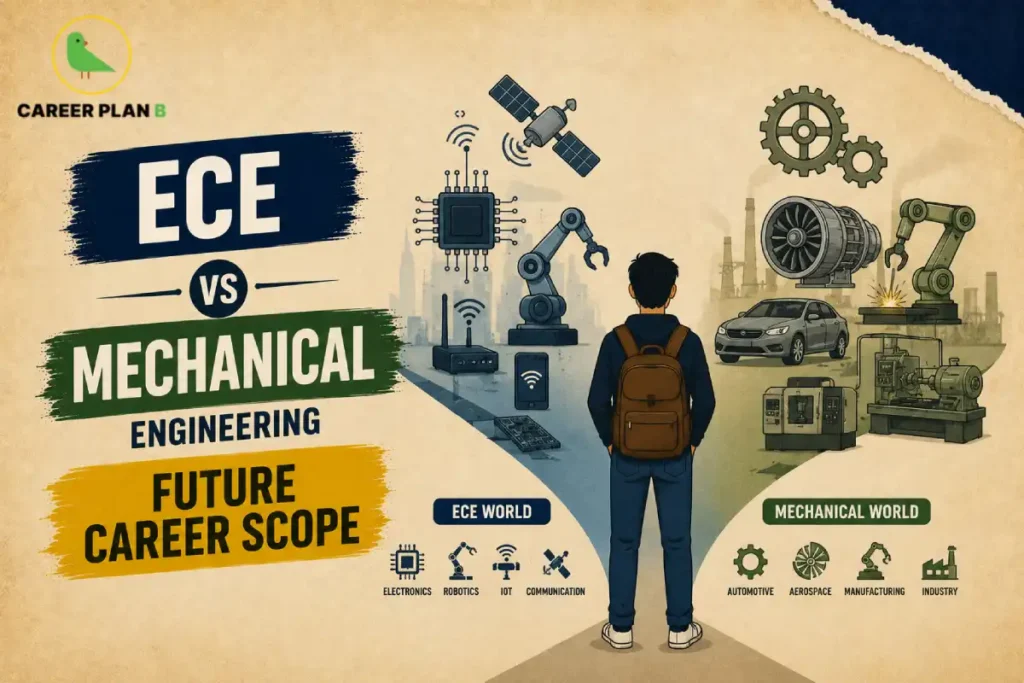
Introduction
Every year, lakhs of students crack entrance exams like JEE Main and state-level CETs only to find themselves stuck at an even harder question: ECE vs Mechanical Engineering, which one should I choose?
It is not a simple answer. Both are among the most sought-after branches in India. Both open doors to government jobs, top private companies, and global opportunities. But they are worlds apart in what they teach, what they demand, and where they take you.
According to AICTE, mechanical and ECE consistently rank among the top enrolled engineering branches across India. Yet most students pick them based on peer pressure or rankings, not actual career alignment.
This blog breaks down the ECE vs Mechanical Engineering debate in full, covering future career scope, salary, job opportunities, and the kind of student each branch is built for so your engineering branch selection after JEE is driven by clarity, not confusion.
What Is ECE: Electronics and Communication Engineering?
Electronics and Communication Engineering (ECE) is a branch focused on electronic circuits, communication systems, and signal processing. It sits right at the crossroads of hardware and software.
Core subjects in ECE include:
- Analog and Digital Electronics
- VLSI Design and Embedded Systems
- Signals and Systems
- Wireless Communication and 5G Networks
- Microprocessors and IoT
- Digital Signal Processing
ECE graduates work with technologies that power your smartphone, satellites, radar, and the internet. It is a branch built for the digital age: fast-moving, innovation-driven, and deeply connected to the global tech ecosystem.
What Is Mechanical Engineering?
Mechanical Engineering is one of the oldest and broadest engineering disciplines. It deals with the design, analysis, and manufacturing of physical systems from tiny machine components to massive industrial turbines.
Core subjects in mechanical engineering include the following:
- Engineering Thermodynamics
- Fluid Mechanics and Hydraulics
- Machine Design and Manufacturing
- Robotics and Automation
- Heat Transfer
- Industrial Engineering and Operations
Mechanical engineers are behind everything from car engines and aircraft structures to air conditioning systems and production lines. It is a branch that values precision, physics, and problem-solving at a very tangible level.
ECE vs Mechanical Engineering: Key Differences at a Glance
| Parameter | ECE (Electronics & Comm.) | Mechanical Engineering |
|---|---|---|
| Core Focus | Electronics, Signals, Communication | Machines, Energy, Manufacturing |
| Work Environment | Labs, software tools, cleanrooms | Factories, design studios, field sites |
| Key Industries | Telecom, IT, Semiconductors, Space | Automotive, Aerospace, Energy |
| PSU Eligibility | ISRO, DRDO, BEL | BHEL, HAL, ONGC, DRDO |
| Top Skills | Circuit design, coding, embedded | CAD/CAM, thermal analysis, design |
| Higher Studies | M.Tech. in VLSI, Communication, AI | M.Tech. in Thermal, Design, Robotics |
Future Career Scope in ECE
The electronics and communication engineering career scope has never been stronger, and it is only going to grow.
We live in an era of 5G rollouts, AI-powered chips, autonomous vehicles, and smart IoT devices. Every single one of these technologies needs ECE professionals at their core. The ECE job opportunities in India span across the following:
- Space and Defence: ISRO and DRDO actively recruit ECE graduates for cutting-edge research in satellite communication, radar systems, and defence electronics
- Telecom Giants: Companies like Airtel, Jio, and Nokia for 5G infrastructure
- Semiconductor and VLSI Firms: Intel, Qualcomm, Texas Instruments globally in high demand
- IT Sector: TCS, Infosys, Wipro for software and embedded roles
- Startups: IoT, edtech hardware, and AI chip startups are booming
Students targeting government roles can also appear for the UPSC Engineering Services Examination (IES) or qualify for GATE for PSU recruitment and M.Tech admissions in premier institutes.
Future Career Scope in Mechanical Engineering
The Mechanical Engineering future scope is evolving rapidly far beyond the traditional factory floor.
The biggest game-changer? The Electric Vehicle (EV) revolution. India’s push toward EVs under the FAME scheme is creating massive demand for mechanical engineers who understand powertrains, battery thermal management, and lightweight vehicle design. Beyond EVs, the career opportunities in Mechanical Engineering are spread across the following:
- Public Sector Giants: BHEL (Bharat Heavy Electricals Limited) and HAL (Hindustan Aeronautics Limited) are top recruiters for core mechanical roles
- Oil and Gas: ONGC and Indian Oil recruit mechanical engineers for exploration and refining operations
- Aerospace and Defence: DRDO and ISRO hire mechanical engineers for structural and propulsion research
- Robotics and Automation: Manufacturing giants like Siemens and ABB for smart factory roles
- Infrastructure and Energy: Renewable energy, nuclear plants, and large-scale construction projects
Mechanical engineers can also crack the UPSC IES exam for prestigious Class 1 government engineering roles across Indian Railways, PWD, and defence establishments.
ECE vs Mechanical Engineering: Salary and Job Opportunities
Here is a realistic snapshot of ECE vs Mechanical salary and jobs for Indian graduates:
| Feature | ECE (Electronics & Comm.) | Mechanical Engineering |
|---|---|---|
| Avg. Starting Salary | ₹5 – ₹12 LPA | ₹3.5 – ₹6 LPA |
| Top Private Pay | ₹15 – ₹45+ LPA (VLSI, FAANG) | ₹10 – ₹30+ LPA (EV, Aerospace, Robotics) |
| PSU Pay (GATE/IES) | ₹12 – ₹25 LPA (CTC) | ₹12 – ₹25 LPA (CTC) |
| Top Recruiters | Intel, NVIDIA, Qualcomm, BEL, ISRO | Tata Motors, HAL, DRDO, ONGC, Siemens |
| Global Scope | Very High (US, Germany, Japan) | Moderate to High (Middle East, Germany, Canada) |
Both branches offer strong PSU pay packages after clearing GATE, which is conducted by IITs under the Ministry of Education, Government of India.
Have Any Doubts?
Who Should Choose ECE? Who Should Choose Mechanical Engineering?
Choosing the best engineering branch for future success is not about market trends alone; it is about matching your natural strengths to the right field.
Choose ECE if you:
- Are fascinated by gadgets, mobile networks, and communication technology
- Enjoy programming and want to blend it with hardware design
- Are interested in AI, semiconductors, IoT, or space communication
- Want strong global job prospects in the tech industry
Choose Mechanical Engineering if you:
- Love understanding how physical systems, machines, and engines work
- Are drawn to manufacturing, automobile design, or aerospace engineering
- Want stability through core government PSU or IES roles
- Are excited about the EV revolution and future mobility technologies
If you are still going back and forth between the two, that uncertainty itself is a signal, and it deserves proper attention before you commit to four years of your life.
How Career Plan B Helps
Choosing between ECE and Mechanical Engineering requires more than just comparing syllabi; it requires knowing yourself. Career Plan B offers personalised career counselling, psychometric and career assessment tests, and career roadmapping to help you identify which branch truly suits your aptitude, interests, and long-term goals. Their expert counsellors ensure your engineering branch selection after JEE is built on self-awareness, not assumptions.
For Latest Information
Frequently Asked Questions (FAQs)
Q1. Which branch has better scope in the future, ECE or Mechanical?
Both have strong futures but in different directions. ECE is surging due to 5G, AI, and semiconductors. Mechanical is growing through EVs, robotics, and aerospace. The better scope depends on your interest area.
Q2. Which branch is easier to get a government job in?
Both are eligible for GATE and UPSC IES. Mechanical has a slight edge in PSU diversity (BHEL, HAL, ONGC, Railways), while ECE is stronger in tech-focused PSUs like ISRO, DRDO, and BEL.
Q3. Can a Mechanical Engineering graduate switch to the IT sector?
Yes, but it requires additional effort in learning programming and software tools. ECE graduates have a more natural transition into IT due to their curriculum overlap with coding and digital systems.
Q4. Is Mechanical Engineering still relevant with the rise of automation?
Absolutely. Automation and robotics are creating new roles for mechanical engineers, not replacing them. Professionals who upskill in CAD, simulation, and automation tools are highly sought after.
Q5. Does AICTE regulate both ECE and Mechanical Engineering programmes?
Yes. Both branches are approved and regulated by AICTE (All India Council for Technical Education), ensuring standardised quality and curriculum recognition across all approved institutions in India.
Conclusion
The ECE vs Mechanical Engineering debate does not have a single right answer because the right branch is the one that fits you, not the one that is trending on a college forum.
If you are drawn to the digital world of chips, signals, communication, and software-hardware integration, ECE is your future. If you are passionate about machines, energy systems, manufacturing, and the physical world of engineering, mechanical engineering is where you will thrive.
Do not rush this decision. Take time to reflect on your strengths, explore both fields, and seek proper guidance before filling that counselling form.
Ready to make a confident choice? Visit Career Plan B for expert career counselling and find the engineering path that is built exactly for you.